

More news on this day
Travelers moving through Phoenix Sky Harbor International Airport encountered one of the sharpest disruption spikes of the spring season as publicly available tracking data showed more than 160 combined delays and cancellations in a single day, snarling operations at one of the Southwest’s busiest hubs and deepening a broader pattern of nationwide air-travel instability.
Get the latest news straight to your inbox!
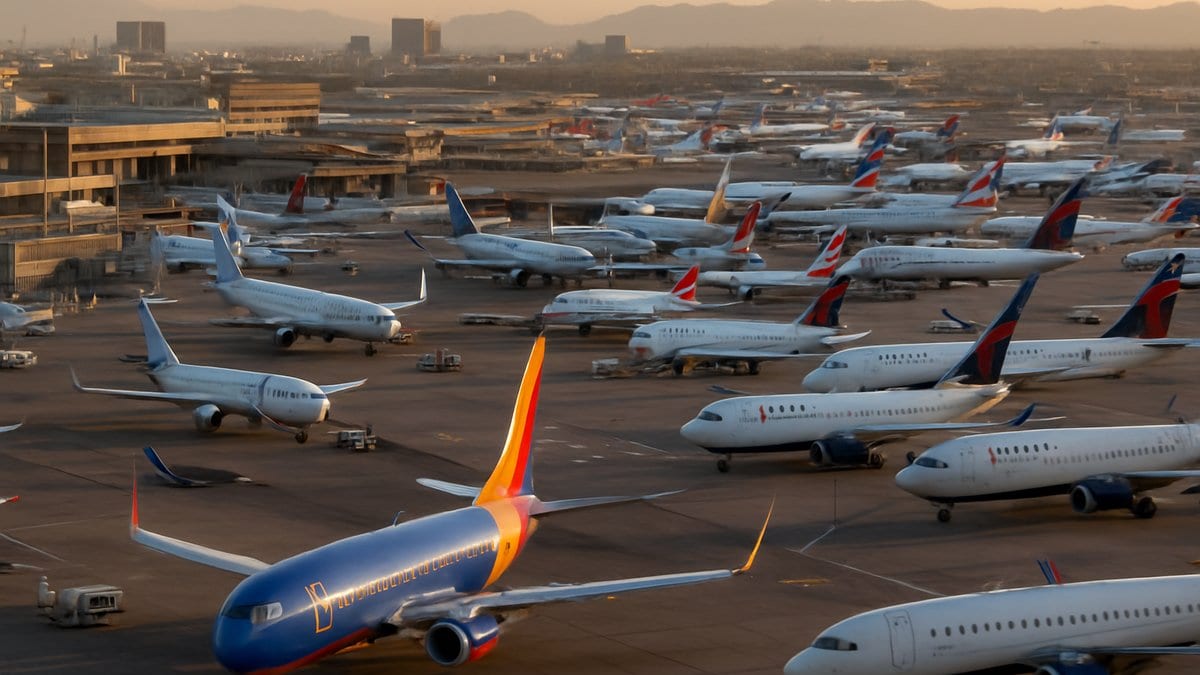
Desert Hub Turns Into Gridlock Zone
The disruption wave at Phoenix Sky Harbor emerged as departure boards filled with backlogged flights on key domestic routes, particularly services operated by American Airlines, Southwest Airlines and JetBlue. According to published coverage focused on Phoenix, these three carriers alone accounted for more than 160 affected departures, including upward of 163 delays and several outright cancellations concentrated on routes to major business and leisure markets. The scale of the disruption quickly transformed the normally efficient desert hub into a chokepoint for travelers heading to coastal and Midwest cities.
Reports from tracking services and aviation-focused outlets indicate that Phoenix’s status as a connective hub for transcontinental traffic amplified the impact. Delays on popular city pairs such as Phoenix to New York, Chicago and Los Angeles left aircraft and crews out of position, while passengers faced long waits inside crowded concourses for revised departure times. With aircraft assigned to tightly timed rotations, even moderate initial delays cascaded into later flights, effectively multiplying the total number of disrupted journeys.
Publicly available airport performance summaries show that Sky Harbor typically handles hundreds of daily departures and arrivals, meaning a surge of more than 160 late or canceled services represents a significant share of its schedule. While the majority of flights eventually departed, the accumulation of hold times at gates, taxiway queues and missed connections turned an operational issue into an all-day gridlock event for many travelers transiting through the desert hub.
Spring Disruption Pattern Across the National Network
The strain at Phoenix is unfolding against a broader backdrop of elevated flight disruptions across the United States in spring 2026. Industry roundups and travel advisories describe a national system facing periodic waves of delays and cancellations, driven by a mix of severe weather systems, ongoing staffing imbalances and tight aircraft utilization. Aggregated data published this week highlighted hundreds of cancellations and several thousand delays nationwide in a single day, underscoring how fragile the air network remains when multiple hubs experience trouble simultaneously.
Analysts note in publicly available commentary that Phoenix has joined longtime pressure points such as Chicago, Dallas and New York in recent disruption cycles. When weather or operational constraints hit one of these hubs, ground delay programs and reroutes reduce the flow of aircraft and passengers through the network, forcing airlines to reshuffle fleets and crews. Phoenix’s role as a connective bridge between the Mountain West, West Coast and central and eastern United States means problems there can quickly reverberate far beyond Arizona.
Travel reporting focused on delay patterns in 2026 also points to increasing climate volatility as a complicating factor. From winter storms in northern regions to high-wind events and rapidly evolving convection in desert markets, weather has produced frequent and sometimes localized ground stops that slow or temporarily halt movements at individual airports. Even when conditions at Phoenix are relatively clear, disruptions elsewhere can push late inbound aircraft into the schedule and set off another round of downstream delays.
Why One Day’s Chaos Hits So Many Travelers
A central reason the Phoenix disruption felt so severe is the compounding nature of airline operations. Air-travel explainers published this spring emphasize that most aircraft do not remain at a single airport, but cycle through multiple cities across a day. A midmorning delay on a Phoenix departure that feeds into a busy coastal hub can then affect an afternoon flight returning to Arizona and, in turn, an evening service bound for another region. By the time operations stabilize, a single late departure can have influenced passengers in several time zones.
Hub airports like Phoenix magnify this dynamic. According to aviation statistics released by the city, Sky Harbor moves tens of millions of passengers each year, many of them connecting between flights. When more than 160 scheduled services are delayed or canceled in such an environment, rebooking options narrow quickly. Passengers arriving late into Phoenix may miss onward connections, forcing airlines to find scarce open seats on later departures or, in some cases, push travelers onto red-eye flights or next-day itineraries.
Public guidance from consumer advocates underscores that these operational realities limit the options available to stranded passengers in real time. Even when airlines activate recovery plans and add staff at customer-service counters, the finite number of available seats and aircraft constrains how many disrupted itineraries can be salvaged on the same day. As a result, an event that begins as a scheduling shock can turn into a prolonged ordeal for travelers stuck overnight or rerouted through secondary hubs far from their original plans.
Tension Between Reliability and Capacity
The Phoenix gridlock also highlights a broader tension in the air-travel system between maximizing capacity and preserving reliability. Industry analyses and government transportation filings describe how carriers have rebuilt and even expanded schedules following the sharp downturn earlier in the decade, but often with lean staffing margins and high aircraft utilization. Under such conditions, there is limited slack to absorb weather disruptions, air-traffic-control constraints or unexpected maintenance events without causing knock-on delays.
Federal data and rulemaking documents reviewed by transportation observers indicate that regulators and airlines continue to debate how best to balance efficiency with resilience. Discussions around ground delay programs, airspace management and airport infrastructure aim to keep traffic flowing during peak periods while minimizing the risk of extended gridlock episodes. In practice, however, travelers continue to experience sharp day-to-day swings between routine operations and sudden surges of cancellations and late departures, such as those recorded at Phoenix.
Local planning documents and airport strategy reports point to ongoing investments in terminal capacity, taxiway improvements and people-mover systems at Sky Harbor intended to accommodate long-term passenger growth. Yet these projects focus primarily on physical throughput rather than on the systemic airline scheduling choices and nationwide staffing levels that shape disruption risk. The latest wave of delays suggests that even well-equipped airports remain vulnerable when upstream constraints collide with packed schedules.
What Travelers Can Do When Phoenix Backs Up
For passengers, the latest gridlock episode at Sky Harbor serves as another reminder to build flexibility into travel plans. Travel-advice features published in recent days recommend checking flight status frequently before leaving for the airport, especially during seasons prone to storms or high heat. Airline mobile apps, notification systems and airport information screens can offer early signs of trouble, allowing travelers to adjust departure times to avoid unnecessarily long waits in terminal gate areas.
Consumer-rights organizations stress in public guidance that U.S. rules distinguish between cancellations and delays, as well as between disruptions caused by weather and those stemming from controllable operational factors. When a flight is canceled and a traveler decides not to continue the trip, the unused portion of the ticket is generally refundable, regardless of whether the original fare was labeled nonrefundable. Policies on meal vouchers, hotel accommodations and rebooking flexibility, by contrast, vary significantly between carriers and situations.
Observers note that the Phoenix event may prompt some travelers to reconsider how they route future trips, especially when close connections through busy hubs are involved. While avoiding major airports altogether is rarely realistic, building in longer layovers, traveling earlier in the day and monitoring developing weather patterns can reduce the risk of being caught in the next wave of disruptions. For now, the latest gridlock at Sky Harbor stands as a vivid example of how quickly a desert hub can shift from smooth operations to a sprawling stoppage affecting tens of thousands of journeys.