

I have spent rushed weekends in both Pilanesberg and Kruger, trying to squeeze a full safari experience into just two or three days. On paper, they both promise Big Five, classic bush scenery and easy access from Johannesburg. In reality, the two weekends felt very different. Pilanesberg was compact, convenient and surprisingly intense.
Kruger was deeper, wilder and, at times, frustratingly stretched for a short stay. If you only have a weekend and you are agonising over which one deserves your limited time, the answer depends less on the animals and more on your appetite for logistics, early mornings and compromise.
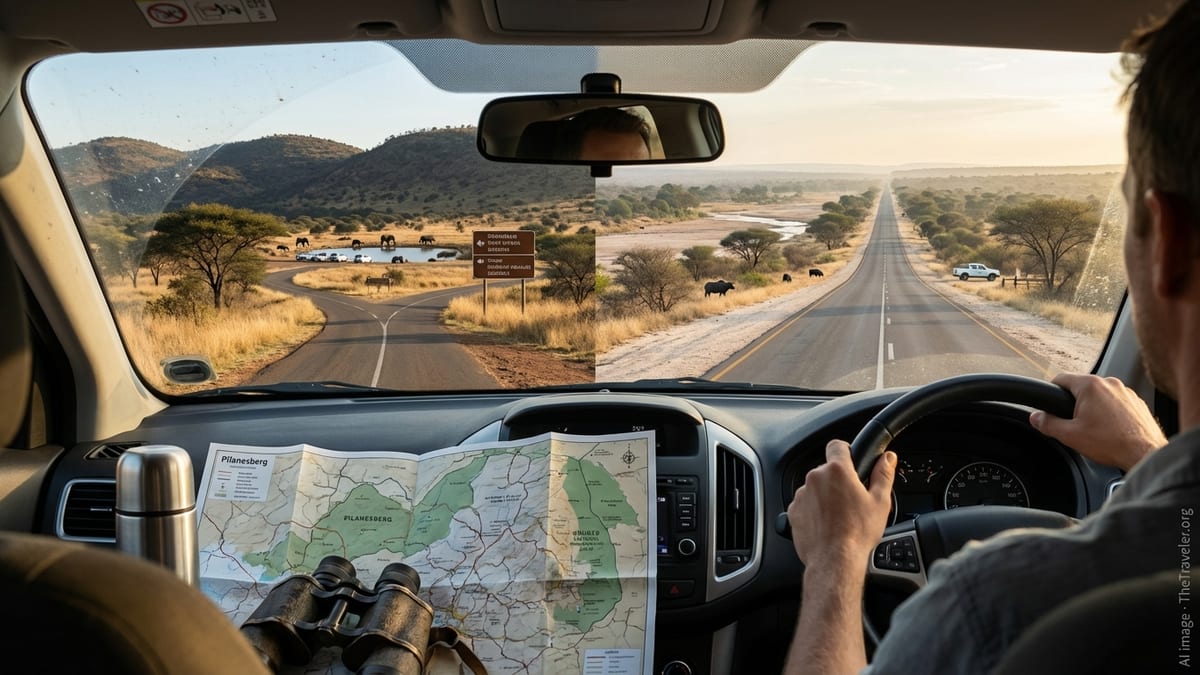
Getting There in a Weekend: Time vs Distance
My first big decision was simply which drive I was willing to tolerate on a Friday after work. Pilanesberg is roughly a 2.5 to 3 hour drive from Johannesburg or Pretoria, depending on traffic and which gate or lodge you are targeting. I have done it in just under three hours leaving Sandton at about 15:00 on a Friday, and I have also crawled there in closer to four hours when I underestimated Friday traffic around Pretoria and Rustenburg. It is still manageable enough that I arrived in time for a relaxed dinner and an early night before a full day of game drives.
Kruger is a different story. On my first weekend attempt, I drove from Johannesburg to Malelane gate, one of the southern entrances, in about 5.5 hours including one fuel and snack stop. That meant leaving before midday to avoid arriving after gate closing time. Entrance gates in Kruger generally open around 05:30 in the summer months and close around 18:00, with slight variations by month, so arriving late simply is not an option. On another trip, I flew to Nelspruit (Mbombela) and picked up a rental car. The flight itself took under an hour, but with check-in, baggage, car rental and the drive to the park, the total door to gate time from Johannesburg still came to around four hours. Kruger is reachable for a weekend, but it is never “just up the road” in the way Pilanesberg is.
This difference matters a lot on a two-night itinerary. With Pilanesberg, I could work a normal Friday, leave mid-afternoon and still feel fresh enough to be at the gate early on Saturday. With Kruger, my Friday became a dedicated travel day, and I had to accept that my effective safari time would be compressed into Saturday plus a few hours on Sunday morning before checking out and driving back. If your weekend is literally two nights and you cannot spare time on Friday, Pilanesberg already has the advantage.
Park Layout, Driving Experience and How “Wild” It Feels
The second major difference I felt over both weekends was the scale and feel of the parks. Pilanesberg covers about 550 square kilometres, set in an extinct volcanic crater. Kruger stretches well over 19 000 square kilometres. On a map, Pilanesberg looks like a compact loop. On the ground, that translates to being able to cover a large portion of the road network in a single long day, even with frequent stops. I never felt that any corner of Pilanesberg was out of reach for a weekend visit.
In Kruger, I had the opposite problem. The first time I stayed in the south near Lower Sabie for just two nights, I grossly overestimated how much ground I could cover. Distances that looked simple on the map, like driving from Malelane gate to Lower Sabie and then up towards Skukuza and back, ate up hours. Speed limits in the park are strictly enforced and relatively low, and it is not realistic to string together long routes on a short trip without feeling like you are just commuting between sightings. By Sunday midday, I realised I had only explored a small southern slice of the park. Kruger felt truly wild and continuous, but that scale worked against me on a weekend itinerary.
The driving experience itself also felt different. Pilanesberg’s tar and gravel roads are generally in good condition, and I did not feel I needed a 4x4. Higher clearance helps with visibility in the rainy season when the grass is long, but a standard sedan is workable. In Kruger, most main roads are tarred and many secondary roads are well maintained gravel, but the distances amplify any discomfort. After five or six hours of driving in a day, even a good vehicle starts to feel tiring, and that is what happened to me both weekends there.
In terms of how “wild” each park feels, Kruger wins. The open vistas, large river systems and sheer sense of space gave me that deep-in-the-bush feeling from the first drive. Pilanesberg, with its ring of hills and well-signposted loops, felt more contained and almost like a very large game ranch. That does not mean it felt artificial, just that I was always aware I was inside a finite crater. On a weekend, though, that containment turned into a positive: I never felt pressured to “cover ground,” and I could simply enjoy the routes I was on.
Wildlife Density, Big Five Chances and Crowds
In both parks I saw the Big Five over different visits, but the character of the sightings was not the same. In Pilanesberg, the smaller size works in your favour. On my last weekend there, I saw elephants multiple times a day, rhinos on both drives, and a pair of lion sightings in one morning near a waterhole. The tradeoff was that several of those sightings were shared with a cluster of vehicles. At one lion sighting I counted more than ten cars, queueing and rotating as guides and self-drivers negotiated viewing angles. It was orderly, but there was no sense of solitude.
Kruger’s wildlife is just as impressive, and in some areas more varied, but the density of animals per kilometre of road felt lower to me, simply because the park is so big. On one hot weekend in February, I had a long mid-morning stretch with very little besides impala, while local guides on the radio mentioned predators seen far from my chosen route. When the sightings did happen, they could be spectacular. I watched wild dogs on the move near Crocodile Bridge and a herd of buffalo crossing the road at dusk, scenes that felt more raw than anything I had experienced in Pilanesberg. But I had to accept that on a short Kruger visit, luck and route choice play a bigger role in whether you see headline animals.
Crowd levels were nuanced. Pilanesberg can feel busy at bottlenecks like hides and popular dams, especially on weekends and public holidays when day visitors from Gauteng pour in. I found that if I started early and focused on the quieter loops first, I had long stretches almost to myself, but by late morning the main routes felt noticeably congested. Kruger, especially in the far south, can see significant day visitor traffic as well, but the road network disperses it more. At famous lion or leopard sightings near camps and rivers, I still experienced vehicle “jams,” particularly when staying near Skukuza, yet I could usually drive fifteen minutes away and feel like I had the road to myself.
One practical point that affected both weekends in Kruger is the gate quota system. During popular periods such as the festive season, there are strict limits on day visitor numbers, and pre-booking a day visit is strongly advised for those not staying overnight. Time slots for entry are typically allocated in the early morning, mid-morning and later morning. That means you cannot simply arrive late and expect to drive in. As an overnight guest inside the park I was not bound by those quotas, but it made me think differently about recommending quick Kruger day trips to people with limited time. With Pilanesberg, I never had to pre-book a day visit slot, and last-minute plans felt much more feasible.
Costs, Conservation Fees and Overall Value for Money
Cost was another point where I had to choose my battles. Kruger is run by South African National Parks, and conservation fees are charged per person per day, on top of accommodation. For the current tariff cycle, international adult visitors pay just over 600 rand per day in conservation fees, with lower rates for South African residents and SADC nationals. Children pay reduced amounts, and infants under two are exempt. Those daily fees add up quickly on even a two-night stay, especially if you are travelling as a family. I felt the pinch when I compared the total bill for two nights in a basic bungalow plus fees with the headline accommodation rate alone.
Pilanesberg’s conservation fees are generally lower than Kruger’s top international bracket, though still significant. They are set per person per day, with different rates for South African residents and foreign visitors, and they apply whether you stay inside the park or just visit for the day. The fees I paid on my last Pilanesberg weekend for two adults felt less severe than what I had paid in Kruger for a comparable number of days, but the savings were largely offset by higher lodge prices inside the park compared to some of Kruger’s older rest camps.
Accommodation cost and style differ noticeably. In Pilanesberg, I stayed in a mid-range lodge inside the park and later in a more basic chalet near one of the gates. Both were comfortable, but the fully catered lodge came at a steep nightly rate per person that would quickly blow the budget for a casual weekend. The cheaper option lacked some charm but still gave me easy access to the gates, and for a two-night stay I ultimately found that more cost-effective. In Kruger, the state-run rest camps offered simple, functional bungalows and rondavels with variable maintenance standards. On one stay, my unit was spotless and recently refurbished. On another, it felt a bit tired, with aging fixtures and a mattress that had seen better days. Prices, however, were noticeably lower than most Pilanesberg lodges, and that freed up budget for extra guided drives.
Working through the numbers, I found that a basic weekend in Kruger, staying in SANParks accommodation and self-catering, was competitive in cost with a weekend in Pilanesberg at a modest lodge or self-catering unit, even after adding conservation fees. Where things tilt toward Pilanesberg is when you factor in transport. A simple self-drive from Johannesburg with current fuel prices and tolls costs far less than either a long drive to Kruger or a flight plus car rental. By the time I added up flights, rental car, conservation fees and accommodation for Kruger, the total cost per person felt closer to a full holiday than a casual weekend. Pilanesberg, by contrast, felt like something I could justify more casually, almost in the same category as a long-activity weekend away.
Accommodation, Comfort and Practical Logistics
Where to sleep became my first “real decision moment” for both parks. In Pilanesberg, I had to choose between staying inside the park at a lodge that included game drives, staying just outside in more affordable self-catering resorts, or mixing the two. The advantage of staying inside was obvious: I could head out on early morning guided drives without worrying about gate queues, and I felt more immersed in the bush. The downside was cost and a slightly regimented schedule around lodge mealtimes and drive times.
On a later visit, I stayed in a self-catering resort outside one of the main gates. That lowered the overall price and gave me flexibility, but it came with some irritations. I had to factor in a commute to the gate each time, manage my own meals in between drives, and accept that I might not be the first vehicle on prime roads at sunrise. For a weekend, I found staying inside Pilanesberg was nicer but not strictly necessary, whereas for Kruger, my view flipped.
In Kruger, staying inside the park in a rest camp made an enormous difference to how much I could experience in a short time. On one weekend, I experimented with staying in a guesthouse outside the southern gate and driving in each day. That meant waking before sunrise, joining the day visitor queue at the gate and watching precious early-morning game viewing time slip by while paperwork and payment were processed. When I stayed inside the park next time, I could be queued at the camp gate before opening and on the best roads right as the sun came up, which resulted in far better sightings.
Comfort is more subjective. Pilanesberg’s private lodges generally felt more polished, with better food, attentive service and softer beds. Kruger’s government camps felt functional rather than luxurious. I found the camp shops useful but limited, and restaurant food was, at best, fine but unremarkable. Self-catering worked well if I planned and brought enough fresh produce and drinks. For a weekend where I did not want to think about groceries or cooking, Pilanesberg clearly won on comfort. For an affordable, flexible bush experience, Kruger retained its charm, but I had to adjust expectations and accept some rough edges.
Seasonality, Weather and When I Would Go Back
Seasonality affected both weekends more than I expected and forced a few more decisions. I visited Pilanesberg once in late winter and once in mid-summer. In winter, the bush was dry, the grass was low and the visibility was excellent. Morning and evening drives were cold but manageable, and midday was comfortably warm. In summer, the park was lush and green, water was widely available and animals were more dispersed. I struggled more with mid-summer heat and glare, and some roads felt less productive. If I had to pick a season for a Pilanesberg weekend, I would choose the dry months when game viewing is more predictable.
In Kruger, I booked my first weekend in February without thinking much about the weather. Afternoon storms were spectacular but disruptive. One fierce thunderstorm forced me off a gravel road earlier than planned, and the humidity left me exhausted by midday. On a later winter weekend, the mornings were icy but the driving was far more pleasant, and game was concentrated near water sources. Kruger’s gate opening and closing times shift seasonally, with earlier closes in the winter months. I had to check these carefully when planning my routes to avoid tight returns to camp.
If I were advising someone now on when to attempt a weekend in either park, I would suggest shoulder seasons leaning toward winter for both, and I would be even stricter for Kruger. In high summer, with long green grass and scattered water, the chances of spending long stretches without major sightings felt higher to me in Kruger than in Pilanesberg, and that is particularly painful on a weekend when every drive counts. In winter, the tradeoff is colder mornings and shorter days but significantly better odds of rewarding sightings in a tight window.
Convenience vs Depth: Which Works Better for a Weekend
After a few rushed weekends, I came to a fairly clear conclusion about which park suits which type of traveller with limited time. Pilanesberg is the better choice if convenience is your main priority. The close proximity to Johannesburg and Pretoria, lack of mandatory flights or epic drives, and compact road network all fit neatly into a Friday to Sunday pattern. I could leave work, drive to the park, enjoy two full game drive days and be back at my desk on Monday without feeling completely drained. The experience still felt like a “real” safari: I saw elephants, rhinos, lions and plenty of plains game, and the landscapes are genuinely beautiful.
The drawbacks of Pilanesberg as a weekend destination are mostly about crowds and a slightly more controlled, commercial feel. At peak times, certain lookouts and waterholes felt almost like viewing platforms at a tourist attraction rather than spontaneous wilderness experiences. I also had to accept that lodge-driven schedules would partially dictate when and how I experienced the park, unless I chose pure self-drive and self-catering. For many weekend travellers, those compromises are acceptable, especially if they are not experienced self-drivers or do not have the time or energy to plan an intricate itinerary.
Kruger, on the other hand, still felt like the iconic, deep safari experience that rewards time. On a weekend, I could only scratch the surface. The drives were longer, the logistics heavier and the timing less forgiving. But when things came together, the quality of the sightings, the variety of habitats and the sheer sense of scale made Pilanesberg feel almost like a “lite” version of the bush. If you are the kind of traveller who would rather do fewer weekends and instead invest more time in a single, longer trip, I would save Kruger for at least three or four nights. Trying to force it into a two-night weekend felt like reading the first chapter of a long novel and then having to put it down.
For those who are determined to do Kruger on a weekend, I would make some firm recommendations based on my experience. First, pick one region, ideally the southern part of the park, and stick to it instead of trying to cover long north–south distances. Second, stay inside the park at a rest camp to maximise early morning and late afternoon drive time. Third, accept that you will not see everything and focus more on enjoying the overall atmosphere than chasing a checklist. If you can approach Kruger that way, a weekend can still be satisfying, but it demands more discipline and realistic expectations than a Pilanesberg break.
The Takeaway
When I look back at my weekends in Pilanesberg and Kruger, I do not see one as categorically better than the other; I see two very different tools for different jobs. Pilanesberg is my choice when I want a low-friction, high-impact weekend, something I can slot into a busy schedule without flying, burning too many leave days or overplanning. It works particularly well for first-time safari-goers, mixed groups with varying fitness and patience levels, and anyone who just wants to see big animals without turning the trip into a logistical project. The tradeoffs are more crowds, higher lodge prices relative to the simplicity of the experience and a slightly curated feeling around some sightings.
Kruger is where I would send travellers who care less about convenience and more about immersion, even if they only have a weekend this time. The park feels like a genuine wilderness system with enough room to breathe and get away from the busiest routes. The conservation fees and travel time are higher, and the older state accommodation will not suit everyone, but the overall sense of place, variety of landscapes and depth of wildlife opportunities make it worth the effort, especially if you can extend beyond a simple Friday to Sunday pattern.
If I had to commit to one park for future quick weekends, I would choose Pilanesberg for short, spontaneous breaks and save Kruger for longer, more deliberate trips when I can justify the time, cost and planning they deserve. For most travellers, my honest recommendation is this: if you have only two nights and need to be back at work early on Monday, Pilanesberg will probably give you a better balance of relaxation, sightings and value. If you can stretch to three or four nights, even with one or two of those falling over a weekend, then Kruger starts to pull ahead and becomes the park that will stay with you long after you drive back through the gate.
FAQ
Q1: Is Pilanesberg or Kruger better if I only have two nights over a weekend?
For a strict two-night weekend, I found Pilanesberg better overall. The shorter drive from Johannesburg, compact size and easier logistics meant I could spend more time actually on game drives and less time in transit. Kruger can work in two nights, but it felt rushed and I constantly had to watch the clock.
Q2: Do I need to book far in advance for a weekend in either park?
For Pilanesberg, I have managed to book accommodation a few weeks out for non-holiday weekends, but popular lodges and school holiday dates still sell out. For Kruger, especially in the more popular southern camps, I found I needed to book months ahead for prime weekends and public holidays. Day visitor quotas in Kruger during peak seasons also mean you should pre-book if you are not staying inside.
Q3: Can I visit either park as a day trip from Johannesburg?
Pilanesberg is realistically doable as a very long day trip from Johannesburg if you are willing to leave very early and return late. I have done it and still had decent sightings. Kruger is not practical as a day trip from Johannesburg; the driving time is simply too long to justify for a single day in the park.
Q4: Which park is more affordable for a weekend once all costs are added?
In my experience, Pilanesberg can be cheaper if you self-drive from Johannesburg and choose modest accommodation, because you avoid flight and higher transport costs. However, the lodges inside Pilanesberg can be quite expensive. Kruger’s government camps are usually cheaper per night, but once you add conservation fees, transport and extras, the total can easily surpass a casual weekend budget.
Q5: Is it safe to self-drive in Pilanesberg and Kruger on my own?
I have self-driven in both parks and felt safe as long as I followed the rules: stay in the vehicle, keep windows mostly up around predators and elephants, respect speed limits and never block animals’ movement. The roads in both parks are well marked. The main risk is not crime but accidents or risky behaviour around wildlife. If you are nervous, a guided drive for your first outing can help.
Q6: When is the best time of year to plan a weekend safari in either park?
I had the most consistent game viewing in the dry winter months and early spring, when vegetation is lower and animals concentrate near water. Summer brings lush scenery and baby animals but also heat, storms and more scattered wildlife. For a short weekend when you want to maximise sightings, I would choose winter or the shoulder seasons for both parks.
Q7: Will I definitely see the Big Five on a weekend in Pilanesberg or Kruger?
No, there are no guarantees in either park, even over a full weekend. I have had weekends where I saw the full Big Five in Pilanesberg and weekends in Kruger where I missed one or two marquee species. Both parks have all of them, but luck, timing and route choice matter. I have learned to focus on the overall experience rather than fixating on ticking every animal off a list.
Q8: How early do I need to wake up for morning drives on a weekend safari?
In both parks, the most productive drives were usually around sunrise. That meant being at the camp or park gate before opening, often around 05:00 in summer. In Pilanesberg, staying inside the park made it easier to be on the road at opening time. In Kruger, staying outside and queuing as a day visitor cut into my early morning window, so I now prefer staying inside whenever possible.
Q9: Is a guided game drive worth paying extra for on a short weekend?
On balance, I think it is. In both Pilanesberg and Kruger, the guided drives I joined produced better sightings on average than my self-drives, especially at dawn and dusk. Guides communicate with each other and understand animal behaviour and road conditions. On a weekend, where you have only a few drives to work with, that local knowledge can make the difference between an average and an excellent experience.
Q10: If I have never been on safari before, which park should I try first?
If you are completely new to safari and short on time, I would start with Pilanesberg. The logistics are simpler, the distances are shorter and the experience is still exciting and varied. Once you know you enjoy safari travel and can commit more days, I would then plan a longer trip to Kruger to appreciate its scale and diversity without the pressure of cramming everything into a single weekend.