

More news on this day
Poland’s long-distance rail operator PKP Intercity is preparing to roll out Nieśpieszny, a new retro train project using restored 1980s carriages and locomotives, blending slow travel, national nostalgia and regional tourism development into one highly anticipated service.
Get the latest news straight to your inbox!
A Retro Train Timed for a Rail Travel Boom
According to published coverage in Polish media, the Nieśpieszny service is scheduled to start running in April 2026, initially on weekend and seasonal routes that emphasize scenery over speed. The project coincides with the 25th anniversary of PKP Intercity and comes after several years of record passenger growth on Poland’s long-distance network, making it a high-profile addition to the timetable.
Reports indicate that the train will operate at lower speeds than modern express services, reflecting both the technical limits of the historic rolling stock and a deliberate focus on unhurried journeys. The branding of Nieśpieszny, which translates roughly as “unhurried,” signals that the experience is designed as an attraction in itself rather than a race between major cities.
Industry-focused outlets describe Nieśpieszny as part of a wider push by PKP Intercity to diversify its offer beyond fast intercity links and premium categories. By adding a heritage-style product at a time when interest in rail-based city breaks and domestic tourism is growing, the operator is positioning itself to capture travelers who value atmosphere and storytelling as much as punctuality.
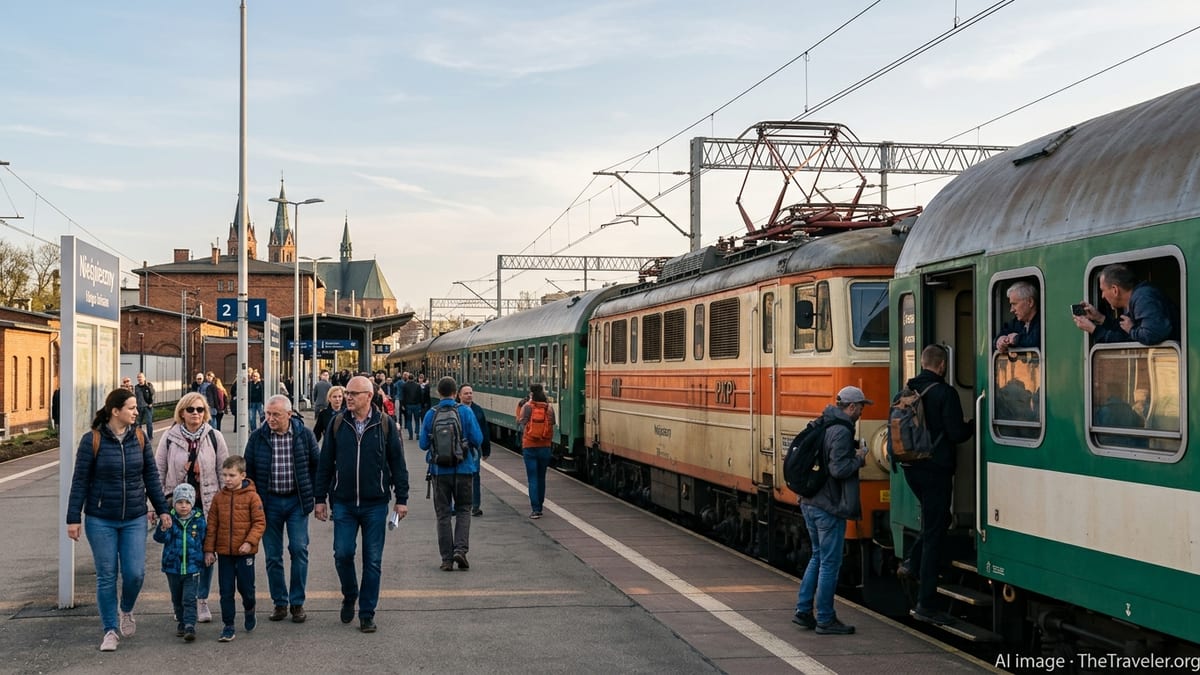
Coverage in both Polish and foreign travel media suggests that advance interest in the train has been strong, with images of orange-and-cream locomotives and classic green carriages circulating widely on social channels. Commentators point to the project as an example of how national rail operators can turn their own history into a marketable tourism asset.
Inside the 1980s-Inspired Nieśpieszny Experience
Publicly available information shows that the Nieśpieszny sets will be assembled from refurbished carriages and locomotives dating largely from the 1970s and 1980s, including compartment cars familiar to generations of Polish travelers. Interiors are being restored to reflect the aesthetics of the era, with period-style upholstery, fittings and signage intended to evoke the final decades of the People’s Republic of Poland.
Railway specialist reports note that selected coaches will retain traditional six-person compartments, wood-effect panelling and classic overhead luggage racks rather than the open-plan interiors now common in Europe. The aim is to recreate the sensory memory of older Polish trains while complying with today’s safety and technical standards.
Media coverage also highlights plans for historically themed dining options on board, with buffet or restaurant cars styled around vintage Polish Railways catering. Menus are expected to showcase familiar comfort dishes and drinks that resonate with domestic passengers while providing an accessible point of entry for international visitors curious about everyday life in 1980s Poland.
The rolling stock is expected to be hauled by preserved electric locomotives in their original livery, creating a coherent visual identity from platform to carriage. Photography released to the press emphasizes details such as classic seat fabrics, retro light fixtures and enamel signage, underlining the project’s ambition to feel like a living museum on rails rather than a simple repaint.
Scenic Routes Designed to Boost Regional Tourism
Travel and tourism outlets in Poland report that Nieśpieszny will focus on picturesque, often secondary routes rather than the country’s fastest rail corridors. Early indications point to connections linking major cities with coastal resorts, lakes districts and mountain regions, encouraging passengers to explore beyond the well-trodden Warsaw–Kraków axis.
By stopping at mid-sized towns and smaller stations that are usually bypassed by express services, the train is expected to channel visitor traffic into places that rarely feature in international itineraries. Local tourism boards have welcomed the prospect of regular arrivals of rail enthusiasts, families and foreign visitors drawn by the retro novelty.
Reports indicate that the timetable will be built around weekend and holiday travel, maximizing appeal for leisure passengers while minimizing conflicts with high-frequency commuter and fast intercity paths. This structure allows Nieśpieszny to function as a moving attraction, often scheduled to pass through scenic sections of line in daylight so that passengers can enjoy rivers, forests and historic townscapes along the way.
Analysts of the Polish tourism sector note that the project fits a broader trend toward themed and experiential travel products, from wine routes to industrial heritage trails. In this case, the railway itself becomes both transport and destination, using nostalgia to disperse visitor spending more evenly across the country.
Cultural Memory on Rails: From PRL Aesthetics to Pop Culture
Cultural commentators in Poland describe Nieśpieszny as part of an ongoing reappraisal of the late communist era, often referred to locally as PRL. Rather than focusing solely on politics, the project foregrounds everyday experiences: crowded compartments, enamel mugs of tea, linoleum corridors and the characteristic sounds of steel wheels on jointed track.
Media coverage notes that the train’s aesthetic closely aligns with a wave of PRL-inspired cafes, design exhibitions and television productions that have gained popularity in recent years. For many Poles who grew up in the 1980s, the decor and atmosphere promise a personal journey into childhood memories; for younger generations and foreign visitors, they offer an immersive introduction to a period usually known only from textbooks or film.
By anchoring this cultural revival in a functioning long-distance train, the Nieśpieszny project extends historical interpretation beyond museums into the landscape itself. Passengers will be able to watch contemporary Poland roll past the window while seated in surroundings that recall a very different economic and social reality, creating a layered experience of continuity and change.
Observers point out that the concept also taps into a wider European fascination with rail nostalgia, from heritage steam lines in the United Kingdom to panoramic retro services in the Alps. In that context, Nieśpieszny positions Poland alongside other countries that have successfully turned their railway history into a draw for both domestic and international tourists.
Economic Hopes and International Attention
According to coverage in Polish business and tourism media, PKP Intercity views Nieśpieszny as more than a one-off anniversary gesture. The project is framed as a test of whether themed, slower services can generate consistent demand, higher ancillary spending and positive publicity that benefits the wider brand.
Local authorities in regions expected to appear on Nieśpieszny routes are reported to be exploring tie-in events, such as station festivals, markets and cultural programs timed to train arrivals. Such initiatives could create a virtuous circle in which the train draws visitors, local programming enriches the experience and word-of-mouth encourages repeat travel.
International media have already begun to feature the retro train as an emerging European travel story, presenting it as an alternative to crowded budget flights and motorway traffic. For Poland’s tourism promotion efforts, Nieśpieszny offers a highly visual, easily explained hook that combines sustainable transport, heritage and regional discovery in a single product.
As the launch date approaches, advance coverage suggests that Nieśpieszny is poised to become a flagship example of how rail operators can leverage history to shape the future of travel. Whether it ultimately expands from a niche attraction into a stable fixture of the Polish timetable, the project is already reframing the conversation around what long-distance trains in Central Europe can be.