

Churchill in northern Manitoba has become synonymous with polar bears on sea ice and curtains of green aurora overhead. Yet this tiny rail-and-flight access town is far from the only place on Earth where wildlife encounters and northern lights collide. From Norwegian fjords and Swedish mountains to Alaskan interior forests and remote Canadian tundra, a handful of regions offer a similar blend of untamed landscapes, charismatic animals and reliable aurora displays, each with its own character and trade offs. For travelers looking for alternatives to Churchill, these destinations provide fresh ways to experience the high latitudes without losing the magic of the Arctic night.
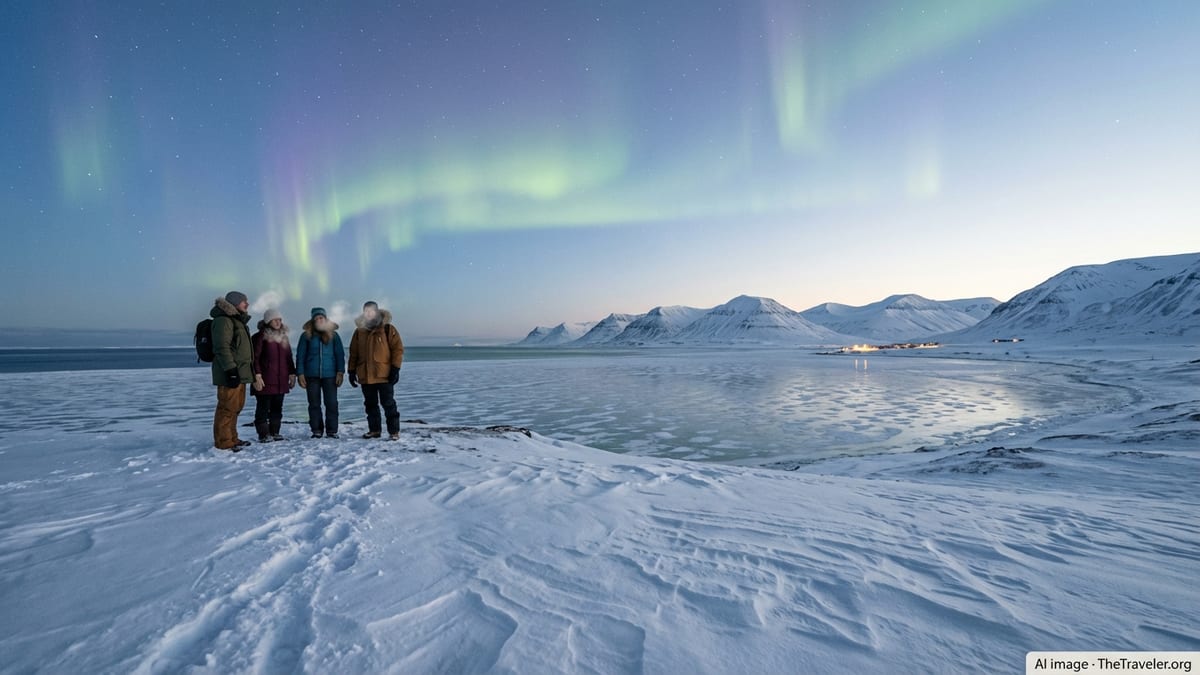
Svalbard, Norway: High Arctic Wilderness and Polar Bears
Svalbard sits between mainland Norway and the North Pole, placing visitors deeper into the High Arctic than Churchill. The main settlement of Longyearbyen is a functioning community with schools, shops and research stations, but step beyond town and you are in a stark world of glaciers, sea ice and mountains where polar bears, walrus and seals roam. Ship based expeditions cruise along the archipelago’s fjords in late spring and summer, searching the ice edges for bears and other wildlife while offering guided landings in approved areas.
Unlike Churchill’s town based tours, most wildlife trips in Svalbard are ship centered, and recent years have brought stricter rules around how close visitors can get to polar bears and sensitive habitats. New visitation guidelines coming into force by mid 2025 tighten minimum distances to bears and limit passenger numbers for landings, part of a broader push to reduce tourism’s footprint while still allowing responsible viewing. For travelers, this means more emphasis on observation from decks and zodiacs and fewer impromptu shore approaches, but also a calmer, more deliberate experience with expert guides interpreting what you see.
Aurora viewing in Svalbard differs from Churchill in timing and atmosphere. Because the archipelago experiences a long polar night from roughly November to January, the sun does not rise for weeks, creating nearly continuous darkness that can be ideal for northern lights when skies are clear. Autumn and late winter tend to combine better weather with accessible tours, and visitors can choose from dog sled excursions, northern lights camps and photography outings that escape Longyearbyen’s modest light pollution. Clear weather can be fickle this far north, however, so it is wise to plan several nights to increase your chances.
Conditions in Svalbard are extreme even by Arctic standards, with low winter temperatures, strong winds and fast changing sea ice. This is part of the appeal for many travelers seeking a raw, frontier feeling outside more familiar Canadian settings. It also brings higher costs, stricter safety requirements and a heavier reliance on organized expeditions. For visitors used to Churchill’s mix of tundra vehicles and in town lodges, Svalbard offers an escalation in both remoteness and regulation, but rewards those who make the journey with some of the planet’s most dramatic polar bear habitat and a powerful sense of being at the very edge of the inhabited world.
Tromso, Norway: Whales, Fjords and Accessible Auroras
Where Churchill offers a small frontier town beside Hudson Bay, Tromso presents a vibrant Arctic city framed by mountains and fjords above the Arctic Circle. Often described as the gateway to the Arctic, Tromso combines a lively cultural scene with quick access to wild landscapes. In winter, boats head out to search for humpback and orca that follow herring into the surrounding waters, while small group tours chase clear skies inland for northern lights viewing away from the city’s glow.
Tromso sits directly beneath the auroral oval, which makes it one of the world’s most reliable urban bases for seeing the northern lights from roughly September through March. Many operators run evening excursions that drive or sail you into darker surroundings, balancing cloud forecasts and solar activity to find the best sky each night. Unlike Churchill, where aurora tours are often a secondary activity to wildlife viewing, many visitors come to Tromso primarily for the lights and add winter sports, Sami cultural experiences or whale watching as complementary experiences.
Wildlife around Tromso has a distinctly marine character. Seasonal whale watching tours focus on orca and humpback whales that gather to feed on winter herring, with peak viewing often falling between late autumn and mid winter. Sea eagles, seals and coastal birds add to the mix. There are no polar bears here, but dog sledding, reindeer sled rides and snowmobiling on surrounding plateaus offer ways to experience Arctic landscapes in motion. For travelers drawn to Churchill’s tundra but equally interested in culture, restaurants and museums, Tromso strikes a comfortable middle ground between wilderness and urban amenities.
Accessibility is one of Tromso’s biggest advantages as a Churchill alternative. The city is connected by regular flights to Oslo and other European hubs, and new seasonal routes, including services from Dublin operating into 2026, make it more reachable for travelers from North America via connections. This ease of access brings more visitors and a busier feel than Churchill in polar bear season, yet thoughtful planning can still deliver quiet moments on a dark fjord or snowy valley while the aurora ripples across the sky.
Abisko, Sweden: Clear Skies and the Aurora Sky Station
For many aurora enthusiasts, Abisko in Swedish Lapland has a near legendary reputation thanks to its unusually clear skies. Nestled inside a rain shadow created by surrounding mountains, the village often enjoys breaks in the clouds even when nearby areas remain overcast. This local microclimate, combined with its location north of the Arctic Circle, makes Abisko one of Europe’s most dependable places to see the northern lights across a season that generally runs from late August to late March.
Unlike Churchill’s tundra vehicles and polar bear lookouts, Abisko’s star attraction is the Aurora Sky Station, a mountaintop facility reached by a chairlift that carries guests above the treeline on clear winter nights. Visitors ride up to a simple complex with indoor seating, an aurora exhibition, a small cafe and expansive outdoor viewing platforms. Warm overalls and boots are typically provided to help guests stay comfortable during the slow, cold ascent and while standing outside to watch the sky. The experience is less about wildlife and more about immersion in Arctic night, with guides on hand to explain the science and folklore of the lights.
Abisko’s landscapes still provide a sense of wildness that can appeal to travelers familiar with Churchill’s wide horizons. The view from the Sky Station looks over the U shaped Lapporten valley and the frozen expanse of Lake Tornetrask, often under a canopy of stars. During the day, cross country ski tracks and winter hiking routes thread through birch forests and low alpine terrain. While large mammals are more elusive than in polar bear hotspots, the broader region is home to moose and reindeer, and birdlife appears with the seasons.
Access to Abisko involves a combination of flights and rail or road, usually via Stockholm and Kiruna, followed by a scenic train ride or transfer along the main Lapland line. Once there, light pollution is limited and you can often walk a short distance from your lodge to reach dark skies, making do it yourself aurora watching easier than in more urban bases. For travelers whose primary goal is maximizing northern lights sightings, Abisko offers a focused, relatively low key alternative to Churchill, swapping charismatic megafauna for one of the most reliable night skies in the auroral zone.
Fairbanks, Alaska: Interior Forests and Northern Lights Lodges
Fairbanks occupies an interior position in Alaska that places it directly under the auroral oval while remaining connected by road and air to the rest of North America. The city itself is larger and more spread out than Churchill, but within a short drive, roads lead into dark, forested hills where purpose built lodges and simple viewing cabins cater to aurora travelers. Between roughly late August and April, clear, cold nights can deliver frequent displays, particularly during mid winter when temperatures can drop sharply.
Many aurora travelers to Fairbanks choose to stay outside the city core at small inns and lodges that offer on site viewing decks and optional late night wake up calls when the lights appear. This style of travel feels different from Churchill’s structured tundra vehicle excursions. Days can be filled with dog sledding, visits to hot springs, snowmobiling or museum tours, while evenings are left intentionally flexible so guests can watch the sky from just outside their room or take a guided excursion to a nearby ridge.
Wildlife experiences near Fairbanks tend to be more opportunistic than guaranteed, but the broader region is home to moose, foxes and occasionally wolves. In summer, river trips and backcountry lodges focus on hiking, fishing and exploring boreal landscapes. While you will not see polar bears roaming just outside town as you might near Churchill in peak bear season, the sheer scale of Alaska’s wildlands offers a sense of space that many visitors find equally compelling.
From a practical perspective, Fairbanks can be easier for some travelers from the United States to reach than remote Canadian outposts. There are regular flights from Anchorage and seasonal connections from several lower 48 cities, plus a highway network that allows for road trips through interior Alaska and the Yukon. Costs can still be significant once tours, winter clothing and lodging are factored in, but the range of options, from basic cabins to upscale lodges, gives travelers more flexibility to match their budget and comfort level than in smaller, highly specialized destinations.
Yellowknife, Canada: Aurora Capital with Subarctic Flair
For travelers who like the idea of staying in Canada but want an alternative to Churchill’s Hudson Bay coast, Yellowknife in the Northwest Territories is a compelling option. Often referred to as the aurora capital of North America, Yellowknife sits beneath the auroral oval on the shore of Great Slave Lake, with dark winters and a relatively dry climate that support frequent northern lights displays. Operators in the region commonly promote the possibility of seeing auroras on many nights throughout the main viewing season.
Yellowknife’s aurora tourism has grown steadily over the past decade, leading to a network of dedicated viewing camps, heated teepees and small lodges outside the main town site. Visitors are typically transported out each night to locations chosen for their open horizons and minimal light pollution. Once there, guests can move between warm shelters and outdoor viewing areas, much as Churchill visitors alternate between tundra vehicles and viewing platforms. The big difference is the focus: in Yellowknife, aurora is the star attraction, with wildlife an occasional bonus rather than the primary draw.
That said, the subarctic environment around Yellowknife supports its own wildlife highlights. In winter, you may spot fox tracks or hear sled dogs as you travel to and from viewing areas. In summer and early autumn, migratory birds, woodland caribou and black bears inhabit the surrounding forests and lakes. The city also serves as a gateway to more remote parks and lodges deeper in the Northwest Territories, where boat based and hiking focused trips explore a landscape carved by glaciers and rich in Indigenous culture.
Modern Yellowknife offers more urban comforts than Churchill, including a compact downtown with restaurants, galleries and festivals, as well as a distinctive Old Town where colorful wooden houses and houseboats line the waterfront. Access involves scheduled flights from hubs such as Edmonton and Calgary, making it feasible to combine with other Canadian highlights. For travelers seeking a northern destination that balances strong aurora potential with a feeling of community and culture, Yellowknife provides a Canadian alternative that complements rather than replicates Churchill’s coastal tundra experience.
Nunavut and Arctic Quebec: Remote Canadian Tundra
Travelers drawn to Churchill’s wide open tundra and Inuit culture sometimes look farther north within Canada for an even more remote experience. Communities in Nunavut and northern Quebec, such as Rankin Inlet, Pond Inlet or Kuujjuaq, sit on the edge of Arctic seas and inland tundra where polar bears, seals and migratory birds live alongside Inuit communities. These destinations typically see far fewer visitors than Churchill, and tourism infrastructure is correspondingly lighter, with smaller hotels, local guides and a strong emphasis on cultural exchange.
Wildlife viewing in these regions can be spectacular but also more unpredictable than in heavily tour focused hubs. In some coastal communities, summer and early autumn bring opportunities to see beluga or narwhal from small boats, along with seabird colonies on nearby cliffs. Polar bears may be observed on guided trips when conditions and safety considerations allow, but strict regulations and respect for both people and bears shape every outing. Travelers need to be comfortable with flexible itineraries that adapt to weather, ice conditions and local priorities.
Aurora viewing in Nunavut and Arctic Quebec benefits from low light pollution and long winter nights, yet cloud cover and extreme cold can pose challenges. Unlike Churchill, where a cluster of operators has developed specialized viewing platforms and evening programs, northern communities often approach aurora watching as a more informal activity. Visitors may simply step outside a lodge or accompany local guides on short excursions when forecasts look promising. What these regions lack in polished tourism infrastructure, they often make up for with authenticity and the chance to spend time in communities where Arctic life is lived daily rather than staged for visitors.
Reaching these destinations requires more logistics and higher budgets than many alternatives. Flights typically route through regional hubs and can involve multiple legs on small aircraft. Once on the ground, travelers should be prepared for limited dining options, a slower pace and the need to follow local guidance closely. For those willing to embrace these conditions, Nunavut and Arctic Quebec provide perhaps the closest Canadian analogs to Churchill’s combination of tundra, wildlife and northern lights, with the added depth of being guest in communities that are still shaping their own tourism stories.
Planning Your Trip: Seasons, Ethics and Expectations
Choosing a destination like Churchill starts with deciding what matters most: polar bears, other wildlife, northern lights or a particular cultural setting. Churchill’s polar bear viewing is concentrated in a relatively narrow window in late autumn as bears congregate near the freezing Hudson Bay. Aurora there peaks in late winter. In contrast, places such as Tromso, Abisko, Fairbanks and Yellowknife are primarily aurora destinations that add wildlife and winter activities as complementary experiences, often with a season stretching from early autumn through spring.
Wherever you go, it is important to factor in both climate and daylight. High Arctic locations like Svalbard and northern Nunavut can offer nearly continuous darkness during the polar night, which maximizes aurora opportunities but also demands resilience to extreme cold and limited daylight for other activities. More southerly northern lights hubs have longer twilight and daytime hours but may see more variable cloud cover. Planning for at least three to five nights improves your odds of witnessing a strong display, especially as solar activity and weather fluctuate from night to night.
Ethical travel is increasingly central in sensitive Arctic and subarctic environments. Regulations are tightening in places like Svalbard to reduce disturbance to polar bears and other wildlife, and local communities in Canada, Alaska and Scandinavia are voicing clear expectations around respectful visitation. Choosing operators that prioritize small groups, adhere to local guidelines and support Indigenous participation in tourism helps ensure that your trip contributes positively. It also tends to lead to richer experiences on the ground, as guides share not just natural history but also the social and environmental context of the regions you visit.
Finally, manage your expectations with a healthy respect for the unpredictability of wild places. Even at renowned hotspots, northern lights can be subdued for nights at a time, and wildlife may not appear on cue. Approaching your journey as an opportunity to experience Arctic and subarctic landscapes in all their moods, rather than a checklist of specific sightings, makes it easier to appreciate what does unfold. Whether you end up on a ship off Svalbard, a mountaintop in Abisko, a lakeshore near Yellowknife or a forest lodge outside Fairbanks, the combination of crisp air, snow underfoot and the possibility of color in the night sky is a reward in its own right.
The Takeaway
Churchill has earned its reputation as a premier destination for polar bears and northern lights, but it is far from alone. Svalbard’s remote archipelago, Tromso’s fjords, Abisko’s clear skies, Fairbanks’s forested hills, Yellowknife’s subarctic shoreline and the remote communities of Nunavut and Arctic Quebec all offer different ways to experience high latitude magic. Each destination balances accessibility, cost, wildlife encounters and aurora reliability in its own way.
For travelers willing to look beyond a single famous name, this diversity is good news. It means you can match your priorities and travel style to a place that fits, whether you crave ship based expeditions among ice floes, nights at a dedicated aurora lodge or time in small northern communities. With thoughtful planning, an ethical mindset and realistic expectations, alternatives to Churchill can deliver equally powerful memories of wildlife, wide skies and the quiet wonder of the aurora borealis.
FAQ
Q1: Is there anywhere else I can reliably see polar bears besides Churchill?
Outside Churchill, guided expeditions around Svalbard and certain coastal communities in Nunavut and Arctic Quebec offer chances to see polar bears, although access is more remote and regulations are strict.
Q2: Which destination is best if my main goal is the northern lights, not wildlife?
Abisko in Sweden, Yellowknife in Canada, Tromso in Norway and Fairbanks in Alaska are all strong choices, with infrastructure focused on aurora viewing and relatively frequent clear skies.
Q3: When is the best time of year to see the northern lights in these places?
Most high latitude aurora destinations have viewing seasons from roughly late August or September through March or early April, with the darkest winter months offering the longest nights.
Q4: Are these alternatives more expensive than visiting Churchill?
Costs vary widely. Remote places like Svalbard and Nunavut tend to be more expensive than larger hubs such as Tromso or Fairbanks, while Abisko and Yellowknife often fall somewhere in between depending on lodging and tours.
Q5: Can I combine wildlife viewing and northern lights in a single trip?
Yes, but you may need to prioritize. Churchill and Svalbard are strongest for polar bears, while Tromso, Fairbanks and Yellowknife combine auroras with activities like whale watching, dog sledding or reindeer experiences.
Q6: How far in advance should I book a trip to these Arctic destinations?
Popular aurora and wildlife seasons often sell out months in advance, especially in smaller communities, so booking at least six to nine months ahead is sensible, and longer for specialized expeditions.
Q7: Do I need special clothing or gear for travel in these regions?
Expect very cold conditions in winter. You will need insulated boots, windproof outer layers, warm base layers, hat and gloves, although some tour operators provide outerwear for key activities.
Q8: Are these trips suitable for families with children?
Many aurora hubs like Tromso, Fairbanks and Yellowknife offer family friendly activities, while more extreme or ship based destinations such as Svalbard and remote Nunavut communities may be better suited to older children or experienced travelers.
Q9: How likely am I to see the northern lights if I visit for a few nights?
It depends on clouds and solar activity, but staying at least three to five nights in a good location significantly improves your chances compared with a single night visit.
Q10: What environmental considerations should I keep in mind when choosing a destination?
Look for operators that limit group sizes, follow strict wildlife viewing distances, respect local communities and support conservation or cultural initiatives, so your trip has a lower impact on fragile Arctic environments.