

The Apostle Islands on Lake Superior are a rare blend of red sandstone sea caves, quiet boreal forest, and wide open water that can feel almost oceanic. Travelers who fall for this remote corner of Wisconsin often go home wondering where else in the world offers the same mix of sculpted cliffs, island mazes, and low key harbors that still feel wild. While no two coasts are identical, several destinations echo the Apostle Islands’ spirit of wave carved rock, cold clear water, and room to breathe.
What Makes the Apostle Islands So Special
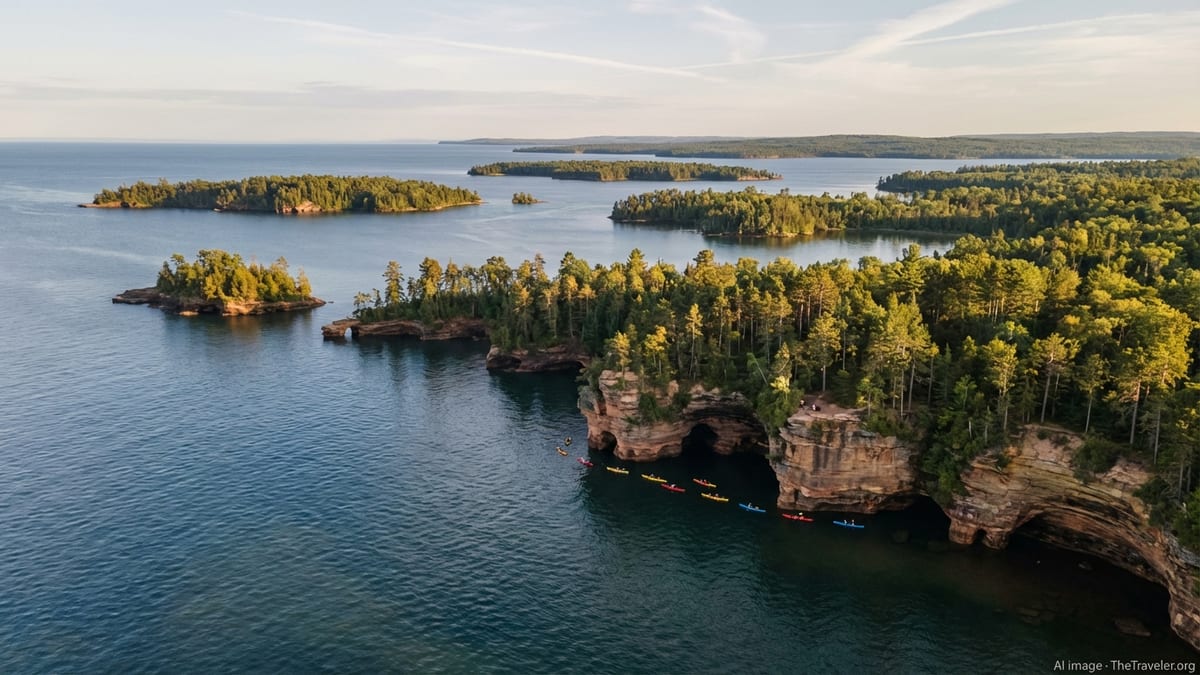
Any search for places like the Apostle Islands has to begin with what sets this Great Lakes archipelago apart. Protected as Apostle Islands National Lakeshore, the park gathers more than 20 islands and a stretch of mainland shoreline on Lake Superior. Centuries of storm driven waves, freeze and thaw cycles, and the lake’s shifting ice have sculpted the Devils Island Formation sandstone into a honeycomb of arches, vaulted chambers, and long wave tunnels tucked into the cliffs. In summer, red rock contrasts with dark blue water and deep green forest running right to the edge of the precipice. In cold winters, the same caves rimed with icicles turn into one of North America’s most dramatic ice walking experiences when conditions allow.
Unlike many busy coastal parks, the Apostle Islands remain relatively low key. There are no roads between islands, no car ferries, and limited marina services. Sea kayakers weave through narrow slots and re entrants beneath overhangs, while sailboats and small cruisers hop between forested islands that feel far more remote than their distance from the mainland suggests. Wildlife is subtle but rich. Bald eagles, cormorants, and gulls patrol the cliffs, while quiet inland trails wind past hemlock groves, bogs, and historic light stations. It is this combination of intricate shoreline, human scale adventure, and a sense of stillness that defines the Apostles and provides the template for similar coastal nature escapes elsewhere.
With that character in mind, the destinations that feel most like the Apostle Islands are not simply places with islands and water. They tend to share certain patterns: layered or sculpted rock that records the work of waves, a patchwork of coves and points best explored by small boat, protected status that limits development, and a climate that keeps the crowds modest for much of the year. From other corners of the Great Lakes to distant Pacific fjords, you can find this familiar blend of water, stone, and quiet if you know where to look.
Pictured Rocks National Lakeshore, Michigan
On the opposite side of Lake Superior, Pictured Rocks National Lakeshore might be the single closest match to the Apostle Islands’ look and feel. Here the shoreline runs in one long sweep instead of scattered islands, but the same basic ingredients are in play: Cambrian age sandstone cliffs, cold inland sea, and forest that presses right up to the brink. The lakeshore’s namesake cliffs rise 50 to 200 feet above the water and stretch for roughly 15 miles between Sand Point and Spray Falls. Mineral rich groundwater stains the sculpted rock face with streaks of red, orange, yellow, and green that seem almost painted, giving the place its name.
Like the Apostle Islands, the best way to understand Pictured Rocks is from the water. Boat tours and private paddlers glide beneath arches, shallow caves, and free standing towers that have been hollowed out by Lake Superior’s relentless chop. The wave action here is serious enough that the park service and outfitters treat weather windows with respect, much as they do around the Apostles’ outer islands. On calmer days, kayakers can nose into dim recesses and narrow slots where sound echoes and the water changes color from cobalt to a strange luminous jade.
On land, Pictured Rocks echoes the Apostle Islands’ blend of backcountry quiet and accessible viewpoints. Short trails lead to cliff edge overlooks, waterfalls, and sandy beaches, while the long distance North Country National Scenic Trail parallels the shoreline for those who want a multi day walk with big lake views. There are no front country lodges along the cliffs themselves, which helps preserve the sense of wildness even at busy times of year. If you love photographing the Apostle Islands’ sandstone meeting Superior’s moods, Pictured Rocks will feel like visiting a cousin with a slightly more dramatic profile.
Sleeping Bear Dunes and the Islands of Northern Lake Michigan
For travelers drawn more to the Apostle Islands’ sense of open water and quiet beaches than its sea caves, northern Lake Michigan offers a different but related experience. Sleeping Bear Dunes National Lakeshore protects a sweep of high bluffs, dune fields, and wooded headlands on the mainland, plus North and South Manitou Islands offshore. The shoreline here is gentler than Lake Superior’s rugged north coast, yet the feeling of standing above a vast inland sea, with wind humming in the grasses and almost nothing on the horizon, will be familiar to Apostle Islands regulars.
From the main overlooks, the dunes rise steeply from the water, creating long, curving bays where turquoise shallows blur into deeper blues. The Manitou islands, reachable only by passenger boat, keep development minimal and reward visitors who prefer simple campgrounds, long walks on pebbly beaches, and dark night skies. Historic farms, lighthouses, and shipwreck stories add a cultural layer that parallels the maritime history scattered through the Apostles.
Although there are no extensive sea caves here, the play of wind and waves has carved other kinds of transient sculpture into the coast. Blowouts form where vegetation gives way and sand pours down the slopes, old forested dune ridges march inland, and cobble banks shift with storms. Kayakers find plenty of quiet shore to explore along the base of the bluffs and around the islands. On calm days the water can feel almost Caribbean in color, a reminder that the Great Lakes hold many moods and that a place does not need dramatic cliffs to deliver the same sense of sky, water, and space that defines an Apostle Islands crossing.
Channel Islands National Park, California
If you are willing to trade freshwater for salt, the Channel Islands off southern California are in many ways a Pacific Ocean counterpart to the Apostle Islands. Roughly a dozen miles off the mainland, the park’s cluster of rocky islands rises abruptly from deep water, creating a complex coast of cliffs, coves, and sea caves. Santa Cruz Island alone hosts more than a hundred sea caves, including long tunnels and vaulted chambers that rank among the largest in North America. Around Anacapa and Santa Rosa, paddlers weave beneath natural arches, along cliff faces punctuated by shadowy openings, and into hidden pocket beaches where swell refracts in every direction.
The atmosphere here is very different from the North Woods, with golden slopes, chaparral, and bare volcanic rock in place of spruce and birch. Yet travelers who love the Apostle Islands’ emphasis on small boat exploration will recognize the same rhythms. There are no cars on the islands, access is by boat only, and once the day boats depart, campgrounds grow very quiet. At sea level, thick kelp forests sway just below the surface, providing habitat for fish, sea lions, and harbor seals. Divers and snorkelers treat the submerged reefs and cave entrances much the way kayakers treat the shoreline, creeping into corners and watching how light and water interact with stone.
The Channel Islands also mirror the Apostles in their role as wildlife refuges. Steep lava cliffs and offshore rocks support nesting seabirds, including threatened species that depend on predator free reaches of coast. Northern elephant seals, California sea lions, and other marine mammals haul out on remote beaches in large numbers. Migrating gray whales pass close enough to watch from the bluffs in winter, and the surrounding marine sanctuary limits some kinds of fishing and protects kelp forests and reef ecosystems. For travelers who want the intimate scale of the Apostle Islands but in a warmer, more biologically diverse marine setting, this national park is one of the closest analogues in the United States.
Alaska’s Kenai Fjords and Aialik Bay
On the outer coast of Alaska’s Kenai Peninsula, a shattered shoreline of bays and inlets offers a far colder but equally compelling echo of the Apostle Islands’ relationship between ice, rock, and water. Aialik Bay, a deep fjord branching into Kenai Fjords National Park, funnels glacier carved valleys straight into the North Pacific. The bay stretches more than 20 miles from mouth to head and includes side arms, coves, and small islands that break up the long channels. Instead of sandstone, dark metamorphic and igneous cliffs plunge directly into the sea, often streaked with waterfalls or capped by remnant icefields.
Here, too, the main story is one of access primarily by boat. There are no permanent settlements on Aialik Bay and only a couple of public use cabins tucked along the shore. Day cruises, water taxis, and guided paddling trips provide most visitors with their window into the fjord system. When conditions are favorable, small skiffs and kayaks can slip close to tidewater glaciers, weave around brash ice, and pause beneath hanging valleys where creeks fall almost directly into salt water. The sense of being surrounded by steep walls and cold, opaque water will feel familiar to anyone who has picked their way around the Apostle Islands on a rough weather day, even though the scale in Alaska is far grander.
Wildlife here is more conspicuous but plays a similar role in shaping the experience. Harbor seals rest on floes in front of calving ice fronts, Steller sea lions gather on isolated rocks at the entrance to the bay, and porpoises or whales may surface in the main channel. Sea birds wheel along the cliffs or cluster around upwellings where currents meet. The interplay between glacial processes, marine ecosystems, and an intricate, boat dependent shoreline creates a northern cousin to the Apostles: quieter, more remote, and more severe, but with the same sense that water and stone are locked in a slow conversation.
Remote Shores of Lake Superior: Pukaskwa and Beyond
Travelers who want an experience even wilder than the Apostle Islands without leaving the Great Lakes can look north to Canada’s Lake Superior coast. Pukaskwa National Park in Ontario protects a long stretch of roadless shoreline where granite headlands, cobble beaches, and river mouths alternate for many kilometers with almost no development. There are fewer discrete islands here than in the Apostles, but the effect from the water is similar: a repeating chain of points, coves, and peninsulas that can feel endless in fog or rough weather.
Backcountry hikers follow a rugged coastal trail that rises from pocket beaches to high rock ledges and then drops back down again, often with no sign of other people for days. From small boats, paddlers and sailors explore narrow inlets and broad, river fed bays, camping on remote beaches and watching the weather roll off the main body of Superior. The water is at least as cold here as it is off Wisconsin, and storms can be dramatic. Yet in calm conditions, the clarity and color of the lake can rival any oceanic coast, with transparent shallows revealing boulders and long underwater shelves.
Although the geology differs, the emotional landscape of Pukaskwa has much in common with the Apostle Islands on a quieter, more solitary day: long views, the sensation of being very small in front of a very large body of water, and the relief of slipping into a protected cove after hours of exposure. For travelers who fell in love with the Apostles precisely because they are not crowded or heavily built up, this stretch of Superior offers a chance to go further in the same direction, trading convenient access for even more space and silence.
Atlantic Echoes: Island Coasts of Maine and Atlantic Canada
On the opposite side of the continent, parts of the North Atlantic coast also echo the Apostle Islands’ mixture of islands, lighthouses, and intimate harbors. While Maine’s shore is mostly granite rather than sandstone, its bold headlands and island choked bays foster a similar exploration style: short hops by small boat, frequent changes in perspective as you round each point, and the constant interplay of fog, sun, and wind. The islands range from small, wooded knolls with a single light station to larger communities connected by ferries, all separated by tide swept channels that demand attention from mariners.
Offshore, the eastern provinces of Canada add even wilder options. Portions of Nova Scotia, New Brunswick, and Newfoundland feature protected coastal parks where spruce forest meets abrupt cliffs or long cobble beaches. Sea stacks, narrow guts, and caves carved into softer seams of rock provide vertical interest, while lighthouses and fishing stages lend a quiet human presence similar to the historic structures scattered through the Apostle Islands. Puffins, seals, and whales replace cormorants and loons as the most prominent wildlife, but the feeling of watching animals that are at home in rough water carries over completely.
In both New England and Atlantic Canada, much of the experience still hinges on weather windows, small craft, and a willingness to embrace conditions that can change quickly. Summer fog can reduce visibility to a few boat lengths, just as Superior’s squalls can suddenly transform an otherwise manageable crossing. For travelers who appreciate that edge in the Apostle Islands, these Atlantic archipelagos offer another way to balance comfort and adventure, with a different maritime culture layered on top.
Planning a Trip to Places Like the Apostle Islands
Although these destinations are scattered across the continent, planning for them shares certain themes. The first is timing. Just as the Apostle Islands’ famous ice caves only occasionally become safely accessible during very cold winters, many of these coastal parks have narrow windows when conditions are at their gentlest. Summer and early fall often bring calmer seas and more predictable weather, whether you are paddling among Channel Islands kelp forests or hiking above Lake Superior cliffs. Shoulder seasons can be rewarding but demand more flexibility and tolerance for storms, fog, or chill.
Logistics are another common thread. In several of these places there are no car ferries or bridges, and overnight stays may require coordinating with passenger boats, water taxis, or small air services. Campsites and cabins can be limited, and some may need to be reserved well ahead of time, particularly in national parks with short operating seasons. Travelers who enjoyed the Apostle Islands’ simple campgrounds and rustic light station stays will likely be comfortable with similar infrastructure elsewhere, but it is worth researching how remote your chosen destination truly is before you go.
Finally, all of these areas benefit from light touch, low impact travel. Pack out everything you bring in, stay on established routes where requested, and give wildlife generous space. On water, that can mean diverting well around haul outs or nesting cliffs instead of slipping close for a photo. On land, it may mean observing closures that protect sensitive plants, bird colonies, or cultural sites. The reward for that restraint is the chance to experience coasts that still feel largely governed by natural rhythms, much like the Apostle Islands do when you push beyond the crowded points of entry.
The Takeaway
The Apostle Islands are unforgettable because they combine a specific style of shoreline with a particular feeling of space and remoteness. Red sandstone caves, quiet islands, and the cold, deep expanse of Lake Superior come together in a way that is hard to copy exactly. Yet if you broaden the search to look for places where water has carved and complicated a coast, where small boats and good boots are the best tools for exploration, and where development steps back far enough to let weather take center stage, suddenly the map fills with possibilities.
From the colorful cliffs of Pictured Rocks to the kelp fringed caves of the Channel Islands, from Alaska’s ice rimmed fjords to the storm tested headlands of Atlantic Canada, each of these destinations carries a little of the Apostle Islands’ DNA. They invite the same kind of slow travel, the same willingness to sit in a quiet cove and listen to waves echo through rock. For travelers who treasured their first trip to the Apostles and are ready for a new horizon, these coasts offer fresh water, salt water, and everything in between, all stitched together by the enduring partnership of stone and sea.
FAQ
Q1. What qualities should I look for if I want a destination similar to the Apostle Islands?
Look for places with carved or cliffed shorelines, limited road access, options for small boat travel, protected natural status, and a quieter, less developed atmosphere.
Q2. Are there other Great Lakes destinations that feel like the Apostle Islands?
Yes. Pictured Rocks National Lakeshore on Lake Superior and Sleeping Bear Dunes with the Manitou islands on Lake Michigan both offer comparable scenery and a similar sense of space.
Q3. Which saltwater destination is most like the Apostle Islands for sea cave paddling?
Channel Islands National Park off southern California is a strong match, with numerous sea caves, natural arches, and cliff lined coasts best explored by kayak.
Q4. How does Alaska’s Kenai Fjords compare to the Apostle Islands?
Kenai Fjords, particularly Aialik Bay, feels much more dramatic in scale, with glaciers and steep fjords, but it shares the same boat based access and emphasis on wild coastal scenery.
Q5. Is summer always the best time to visit these coastal nature destinations?
Summer and early fall usually offer calmer water and more stable weather, but some travelers prefer quieter spring or late season trips if they are prepared for rougher conditions.
Q6. Do I need sea kayaking experience to enjoy sea caves and cliff coasts?
Basic paddling skills are essential around cliffs and caves. Guided trips are recommended for beginners because conditions can change quickly along exposed shorelines.
Q7. How can I travel responsibly in fragile coastal environments?
Stay on established routes, pack out all waste, keep a wide buffer from wildlife, follow local regulations, and avoid entering sensitive caves or haul out sites when animals are present.
Q8. Are there family friendly options among places like the Apostle Islands?
Yes. Scenic boat cruises, short coastal hikes, and calm bay paddles at destinations such as Pictured Rocks or Sleeping Bear Dunes can suit families with varying ability levels.
Q9. What special gear should I consider for these trips?
Layers for variable weather, sturdy footwear, a properly fitted life jacket for any boating, and dry bags for valuables are important, along with navigation tools if you go beyond marked routes.
Q10. How far in advance should I plan a visit to these coastal parks?
Popular summer dates and limited campgrounds can fill months ahead, so it is wise to research ferry schedules, permits, and reservations well before finalizing travel plans.