

Somewhere between the grain elevators and the endless sky, the Canadian Prairies hide a string of towns that most drivers barely notice. Places like Wolseley in southeastern Saskatchewan look like simple fuel-and-coffee stops from the Trans Canada Highway, yet a closer look reveals lakeside swings, ornate opera houses, aging brick storefronts and a kind of unhurried hospitality that has vanished from bigger centres. For travellers willing to turn off the highway and slow their pace, these quiet prairie stops are some of the most rewarding detours in Western Canada.
Why Wolseley Captures the Spirit of the Prairies
Wolseley sits just off Highway 1 between Regina and the Manitoba border, a compact community wrapped around Fairly Lake. The town grew up alongside the Canadian Pacific Railway in the 1880s, and its streets still follow that rail-first logic: grain country at the edges, a tight little commercial core, and public buildings that signal how optimistic early settlers were about their future. Today, Wolseley is often described as one of the prettiest small towns in Saskatchewan, a place where history feels woven into everyday life rather than preserved behind glass.
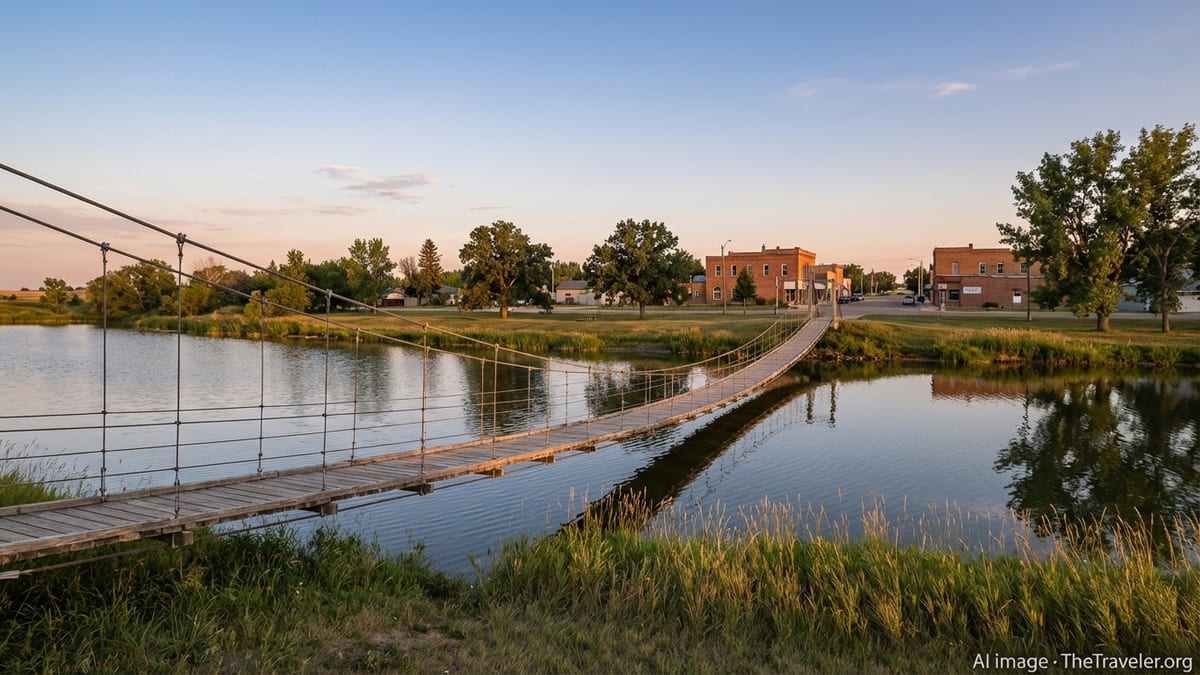
The town’s signature sight is its swinging bridge stretched low across Fairly Lake, a suspended pedestrian crossing originally built in the early 1900s to link homes on one side of the water with shops on the other. The current bridge, rebuilt in the early 2000s after earlier versions were lost to storms, remains slightly wobbly underfoot and immensely photogenic, especially at sunrise when the lake is still and the planks reflect in the water. Walking across takes only a minute or two, but it captures the town’s unusual layout: this is a prairie community where the centrepiece is not an elevator or a highway junction, but a lake.
Just beyond the bridge, Wolseley’s public architecture hints at the town’s former status as a regional hub. The brick-and-stone Town Hall and Opera House, completed in 1907 in an Italian Baroque style, once housed everything from the fire brigade to travelling theatre troupes and still hosts community events after extensive restoration. Nearby stands the 1890s courthouse, widely noted as the oldest surviving courthouse building in Saskatchewan, now the focus of an ongoing heritage rehabilitation project. Even if you never step inside, the cluster of imposing civic buildings clustered around such a small lake makes Wolseley feel like a pocket-sized county seat transported from another era.
For road-trippers, the appeal is the contrast: minutes after pulling off a high-speed, four-lane highway, you can be parked beside a calm lake, strolling over a gently swaying bridge and taking in a streetscape of century-old façades. Wolseley offers enough services to be practical, yet remains small enough that you can walk almost everywhere. It is this balance of usefulness and tranquility that makes it a useful template when seeking out other prairie towns with a similar feel.
What Makes a “Quiet Prairie Stop” Worth the Detour
Not every small settlement beside a grain field rewards a visit. The prairies are dotted with places that have lost their last café or motel, leaving only a fuel pump and a closed-up hall. The towns most worth a detour tend to share a handful of qualities: a walkable centre with older architecture still standing, at least one distinctive landmark, basic traveller services, and some direct relationship with the landscape that surrounds them, whether that is a river valley, a shelterbelt nursery or a man-made lake like Fairly Lake.
Scale matters. A town the size of Wolseley is large enough to sustain a grocery store, a diner or bakery, basic medical services and a school, but small enough that traffic is light and evenings fall quiet. This creates a particular rhythm: weekday mornings have farmers meeting for coffee, midafternoons can feel nearly empty, and by dusk you might share a lakeside path with only a few dog walkers and migrating geese. Travellers interested in photography, writing or simply some time to decompress often find this pace more appealing than the bustle of larger regional centres.
Heritage is another key ingredient. In many prairie communities, brick or fieldstone public buildings, ornate main-street blocks and wooden grain elevators are among the most visible reminders of the ambitious settlement era that began in the late nineteenth century. Where local volunteers have restored an opera house, preserved a courthouse or converted an old family home into a bed-and-breakfast, the result is a town that offers far more to explore on foot than a standard highway service strip. Wolseley’s protected historic properties and self-guided heritage tour are a strong example of how a small place can tell a big story.
Finally, a good quiet stop should feel welcoming rather than curated. These are working towns, not open-air museums. The bakery that supplies cinnamon buns to local farmers, the rink that hosts minor hockey, the community hall that holds fall suppers and wedding socials: they exist first for residents, but visitors are usually invited in. In places like Wolseley, Indian Head and Whitewood, that blend of everyday life and historic setting is the real draw.
Indian Head: Trees, Fields and a Classic Prairie Main Street
Roughly an hour east of Regina on the Trans Canada Highway, Indian Head makes an excellent companion stop to Wolseley. Established in the early 1880s and incorporated as a town in 1902, it grew as a service centre for surrounding grain farms and later became known nationally for its federally operated experimental farm and tree nursery. For decades, the facility produced shelterbelt tree seedlings that helped protect prairie fields from wind erosion, and the town still leans into its identity as a centre for agroforestry and research.
Modern-day visitors will first notice the towering Indigenous-themed roadside statue that greets drivers arriving from the highway, one of the more distinctive pieces of prairie roadside art. Beyond that, Indian Head reveals a compact historic core, with a traditional main street, older brick buildings and leafy residential avenues that feel unexpectedly green in the middle of grain country. Compared with bigger centres farther west, traffic is lighter and it is easy to park and wander without a clear agenda.
Indian Head’s calm atmosphere is a large part of its charm. There are small-town conveniences like cafés, shops and services, but evenings tend to be quiet, with the loudest sounds more likely to be from passing freight trains or Canada geese overhead than from nightlife. The town’s location along the transcontinental rail line and national highway makes it an easy coffee or lunch break for road-trippers who prefer a slower feel than the service plazas closer to Regina.
For travellers who enjoy connecting a town’s present to its past, Indian Head and Wolseley form a satisfying pair. Both were born in the railway boom, both retain historic architecture, and both sit amid expansive farmland, yet each has carved out a slightly different character: Wolseley wrapped around its lake and swinging bridge, Indian Head framed by test plots and shelterbelts.
Whitewood and Grenfell: Crossroads Communities With History
Continue east from Wolseley and you soon reach Whitewood, a town that owes its existence to both the railway and its strategic position where the Trans Canada meets Highway 9. Established in the 1880s and incorporated as a town in the early 1890s, Whitewood quickly became a regional service point, drawing settlers from various backgrounds and nearby First Nations communities. Today it remains small, with a population comfortably under one thousand, yet still offers a traditional main street and essential services that make it a practical pause between Regina and Brandon.
Whitewood’s historic core retains the bones of a classic prairie town: older commercial façades along its central street, a modest mix of brick and wood-frame buildings, and residential avenues that fan out into fields almost immediately. It is easy to park and stretch your legs, photograph fading signage or early twentieth-century architecture, and imagine what the town might have felt like when steam trains were the main arrival route. The scale keeps things quiet; even on weekdays, you are more likely to meet neighbours chatting on a sidewalk than a rush of traffic.
Nearby Grenfell, a few minutes to the west, offers a similar main-street rhythm on a slightly smaller scale. Once an important stop on the Canadian Pacific line, it served as a supply centre for the surrounding mixed farms and is still anchored by grain handling facilities and a compact downtown. Many travellers barely notice as they pass the exit signs; those who do turn in often find a town that rewards simple pleasures: a meal in a local café, a walk past older homes, a detour to a small museum or town park.
Together, Whitewood and Grenfell show how crossroads communities can maintain a sense of identity even as long-haul travel largely bypasses them. They are not destinations for packed itineraries, but they excel at offering an hour or two of calm between long highway stretches, especially for drivers who appreciate history and unfussy hospitality.
Other Towns That Echo Wolseley’s Charm
Wolseley may be unusual in having a full-sized lake and swinging bridge at its heart, but several other prairie towns share enough similarities that travellers drawn to one will likely appreciate the others. Indian Head, Whitewood and Grenfell form a natural cluster along Highway 1, yet the wider region includes smaller centres like Balgonie, Pilot Butte and Moosomin that each mix historic streetscapes with a quieter atmosphere than bigger cities. Some have restored grain elevators or brick schools; others have drive-in theatres, heritage churches or valley viewpoints only a few minutes from town.
Across the prairie provinces, the formula repeats with local variations. In Manitoba, towns like Virden and Souris combine early-twentieth-century architecture with parks, river crossings and walking bridges reminiscent of Wolseley’s swinging span. In Alberta, smaller centres off the main routes offer similar experiences: modest business districts, heritage halls used for weekly community events, and public art that reflects immigrant histories from Eastern Europe, Asia or the British Isles. The details change, but the central experience remains the same: a gentle pace, residents who still greet strangers, and a feeling that life is tied more to the harvest schedule than to big-city workweeks.
As rural populations shift and consolidate, many of these places have refocused on quality of life rather than growth. Municipal councils and volunteer groups put energy into beautifying main streets, preserving landmark buildings, and maintaining recreation facilities that keep locals engaged through long winters. Visitors benefit indirectly, finding tidy parks, interpretive signs, walking trails and seasonal events that would not exist without that community effort.
When planning a drive across the Prairies, it can be useful to mark a handful of such towns on the map rather than relying solely on large service centres. Stopping in places that echo Wolseley’s character turns a straightforward transit into a more layered journey, one that alternates open road with lived-in streets and historic corners.
Planning a Slow-Paced Prairie Road Trip
Exploring towns like Wolseley is less about ticking off individual attractions and more about how you travel. Distances on the Prairies can be deceptive; the landscape’s vastness makes an hour or two on the highway feel shorter than it is. Building in time for unhurried stops is essential. A realistic approach for a day’s drive might include only two or three towns, with at least an hour set aside in each to walk, linger over coffee and simply sit on a bench or lakeside rock watching the weather roll through.
Season makes a significant difference. Late spring and early summer bring the softest colors, with bright green fields, blooming shelterbelts and longer daylight. High summer can be hot and dry, but also ideal for picnics under mature town trees or evening walks when the light stretches well past nine. Autumn highlights the reds and golds of shrubs and shelterbelts, while winter offers crystalline air, snow-dusted streets and a very different kind of quiet, particularly appealing to photographers and those comfortable driving in colder conditions.
Because services in smaller centres can change from one year to the next, it is wise to check ahead for current information on fuel, dining and accommodations, especially if you are arriving late in the day or during shoulder seasons. Tourism offices, municipal websites and provincial tourism agencies often publish up-to-date listings of open businesses, seasonal festivals and heritage tours. In Wolseley, for example, a tourist information centre near the highway operates seasonally, pointing visitors to the swinging bridge, courthouse, Town Hall and local events.
Pacing also matters within each town. Rather than rushing through a checklist, try adopting local habits: start at the main café, ask staff what they would show a visiting friend, then let their suggestions guide you. That might mean a detour to the skating rink, a walk past the school playground, or a visit to a small-gallery space used by local artists and writers. In Wolseley, community groups use shared spaces downtown for photography clubs, writing circles and artisan collectives; catching a glimpse of that creative life can be as memorable as any landmark.
Respectful Travel in Small Prairie Communities
Quiet does not mean empty, and it is important for visitors to remember that towns like Wolseley are living communities, not stage sets. A respectful approach starts with simple courtesies: obey posted speed limits on residential streets, park thoughtfully, and remember that shops may have limited hours tailored to local routines rather than tourist traffic. If a café closes earlier than you expect or a museum is open only on certain days, consider it part of the rhythm that allows these places to stay authentic rather than reshaping themselves entirely for visitors.
Photography is one of the great pleasures of prairie travel, but it also requires sensitivity. Historic homes, barns and elevators can be compelling subjects, yet many are on private land. When in doubt, ask permission before wandering down side lanes or farm approaches. In town, be mindful when photographing people, particularly children around schools, rinks or playgrounds. Most residents are proud of their towns and happy to share stories if approached politely, and that conversation often leads to better images and insights than a quick snapshot taken from a car window.
Economic support, even on a small scale, matters in places where local businesses operate on thin margins. Choosing to buy coffee in town instead of at a highway chain, picking up a book from a joint library-fundraiser sale, purchasing a print from a local photographer or paying for a guided tour of a historic building helps keep those services viable. In Wolseley, for instance, continued use of the Town Hall and Opera House for community events, weddings and performances plays a role in justifying the ongoing investment in its upkeep.
Finally, remember that weather on the open plains can change rapidly. Respect local advice about road conditions, storms and extreme cold or heat. Town residents often have a finely tuned sense of incoming systems; if someone at a gas station or coffee shop suggests delaying your departure because of an approaching storm front, it is usually worth listening.
The Takeaway
Driving across the Canadian Prairies is often described as an exercise in endurance: long straight roads, distant horizons, few obvious landmarks. Yet towns like Wolseley show that this reputation misses something essential. Step off the highway, and you find lakeside bridges that sway underfoot, opera houses carved from brick and stone, tree nurseries that helped shape half a continent’s landscape, and main streets where hand-painted signs still outnumber digital billboards.
The rewards in these quiet stops are subtle. There may be no blockbuster attractions or elaborate visitor centres, but there is time: time to pause by a courthouse older than the province itself, to watch swallows skim over a man-made lake lit by evening sun, to chat with a volunteer opening up a gallery for a weekend show. In an era when many trips are planned around must-see lists and time-lapse schedules, the prairies invite a different pace.
For travellers willing to trade rush for reflection, towns like Wolseley, Indian Head, Whitewood and their neighbours offer exactly that. They are places where the distance between visitor and local can shrink with a single conversation over coffee, where history and everyday life occupy the same small streets, and where an hour’s detour can linger in memory long after the kilometres have rolled by. In the end, it is not only the great plains that define this landscape, but the small communities that quietly anchor them.
FAQ
Q1. Where is Wolseley located and how far is it from Regina?
Wolseley is in southeastern Saskatchewan, just off the Trans Canada Highway, roughly a 60 to 75 minute drive east of Regina depending on road conditions.
Q2. What is Wolseley best known for?
Wolseley is known for Fairly Lake at the centre of town, its swinging pedestrian bridge, a historic Town Hall and Opera House, and one of the oldest courthouses in Saskatchewan.
Q3. Are there services for travellers in Wolseley?
Yes, Wolseley typically offers fuel, basic groceries, dining options, a small beach, a golf course and seasonal tourist information, though specific businesses may change over time.
Q4. What other towns are similar to Wolseley for quiet prairie stops?
Towns such as Indian Head, Whitewood and Grenfell in southeastern Saskatchewan offer comparable experiences, with historic main streets, modest services and a relaxed pace.
Q5. When is the best time of year to visit prairie towns like Wolseley?
Late spring through early autumn is ideal for comfortable temperatures, open attractions and longer daylight, though winter visits can be rewarding for those prepared for cold.
Q6. Do I need to book accommodation in advance in these small towns?
It is wise to plan ahead, especially in peak summer or on long weekends, as accommodation options are limited and may fill quickly or close in the off-season.
Q7. Is it possible to explore towns like Wolseley on foot?
Yes, these towns are generally very walkable, with compact centres that allow you to park once and visit the main sights, parks and cafés on foot.
Q8. How much time should I allow for a stop in a town like Wolseley?
Allow at least one to two hours to walk the swinging bridge, explore the heritage buildings, enjoy a snack and sit by the lake or in a local park.
Q9. Are these prairie towns family-friendly?
Yes, they are typically very family-friendly, with playgrounds, open green spaces, calm streets and seasonal events that appeal to children and adults alike.
Q10. What should I keep in mind to be a respectful visitor in small prairie communities?
Drive slowly on local streets, support local businesses when possible, respect private property while taking photos, and follow local advice on weather and road conditions.