

More news on this day
As London prepares a landmark David Hockney exhibition in 2026, a cross‑Channel trail of recent and upcoming shows in the United Kingdom and France is giving international travelers a rare chance to trace seven decades of the artist’s work in real time.
Get the latest news straight to your inbox!
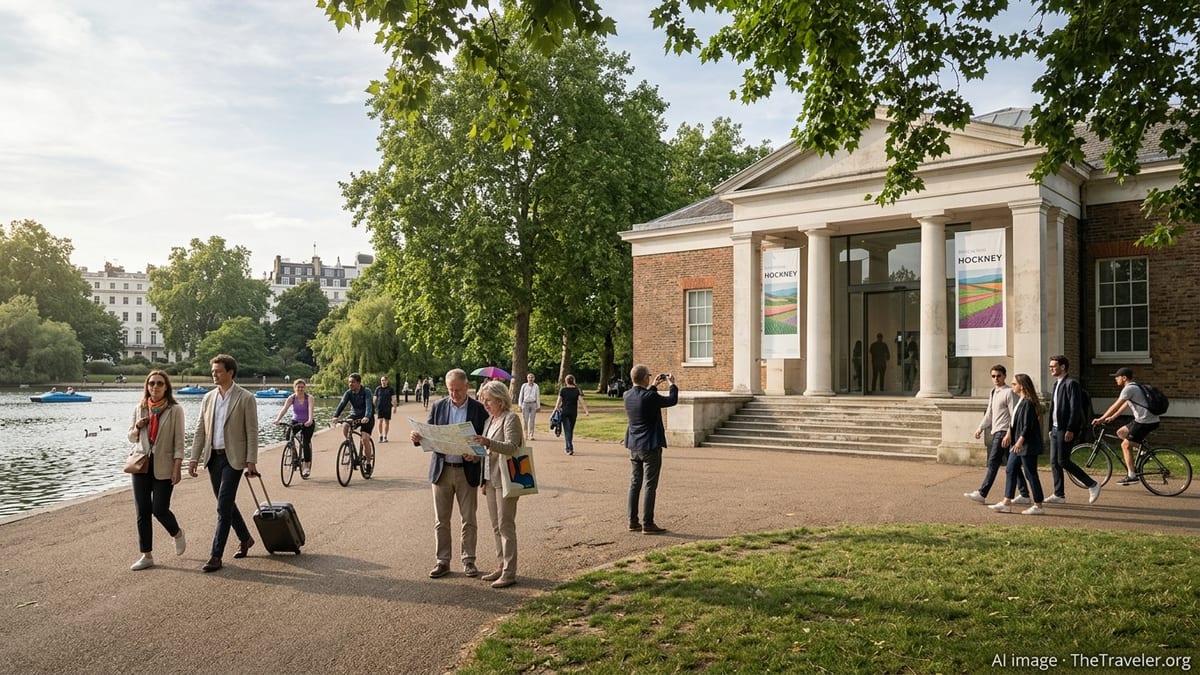
London’s 2026 Centerpiece: Serpentine North in Hyde Park
Publicly available information from Serpentine Galleries shows that London will anchor Hockney travel in 2026 with a major exhibition at Serpentine North in Kensington Gardens, scheduled from 12 March to 23 August 2026. Conceived in close collaboration with the artist, the show is described in advance material as his first exhibition at the gallery and a chance to “slow down” and notice the extraordinary within the everyday. For long‑haul visitors, the lengthy run across spring and summer widens the booking window for flights and hotel stays in the British capital.
A highlight of the London presentation is the arrival of Hockney’s ninety‑metre‑long frieze “A Year in Normandie,” created from iPad drawings made in his garden in northern France. Reports in the British press indicate that the work will be shown in London for the first time, effectively importing a vast slice of the Normandy landscape to Hyde Park. The piece offers travelers an immersive way to connect the London leg of their journey with later stops in France, where many of these scenes were first conceived.
Advance coverage in art and design outlets lists the Serpentine show among the city’s most anticipated exhibitions of 2026, alongside major presentations at the National Portrait Gallery and other institutions. For visitors planning multi‑day itineraries, the concentration of high‑profile shows within walking or short taxi distance of each other around central London strengthens the case for using the city as a base before or after crossing the Channel.
From a practical standpoint, Serpentine North sits in the heart of Hyde Park, placing guests within easy reach of luxury hotels in Knightsbridge and Mayfair, as well as boutique properties in Notting Hill and Marylebone. The area is serviced by several Underground lines, making it straightforward for international arrivals to transfer from Heathrow or Gatwick and step almost directly into Hockney’s reimagined vision of the French countryside.
Extending the Capital Experience: London’s Hockney Hotspots
Beyond the Serpentine program, recent seasons have reinforced London’s long‑term relationship with Hockney’s work. Gallery listings from late 2025 note an “eye‑popping” presentation of new paintings at Annely Juda Fine Art in Mayfair, under the title “Some Very, Very, Very New Paintings Not Yet Shown in Paris.” Although that specific show was time‑limited, its location underlines how the West End continues to serve as a testing ground for the artist’s latest experiments.
Elsewhere, Turner Contemporary in Margate recently unveiled a new installation known as the Sunley Window by Hockney, coinciding with the build‑up to the 2026 Serpentine exhibition. Public information from the Kent gallery indicates that this vivid architectural work celebrates its fifteenth anniversary season and offers an additional Hockney‑related stop for travelers willing to pair a London city break with a coastal diversion by high‑speed train.
London’s auction houses, particularly Christie’s and Sotheby’s, continue to feature Hockney works prominently in contemporary art sales, with records showing recent offerings of landmark canvases and digital drawings. For jetsetters, monitoring evening sale calendars can add another dimension to an art‑focused visit, with the possibility of viewing works on preview even without raising a paddle.
The broader London art landscape has also embraced immersive approaches to Hockney’s practice. Prior seasons saw large‑scale digital experiences, such as “Bigger & Closer (not smaller & further away)” at the Lightroom venue near King’s Cross, where projection, sound design, and the artist’s own narration introduced new audiences to his landscapes and swimming pools. Travelers arriving in 2026 may find similar experiential programming running in parallel with the more traditional gallery settings, creating multiple ways to engage with the same creative universe during a single stay.
Paris as Gateway: The Fondation Louis Vuitton Retrospective
Across the Channel, Paris has recently staged what several outlets describe as the most extensive exhibition of Hockney’s career. The show “David Hockney 25” at Fondation Louis Vuitton, which ran through 2025, brought together more than 400 works from 1955 to 2025, many drawn from international museums, private lenders, and the artist’s own foundation. French and British media characterized it as both a celebration of seven decades of experimentation and a statement of Paris’s ambition to reclaim its role as a leading European art capital.
Although that retrospective has now closed, its impact is likely to shape future programming in the city, and it has established Paris as a natural gateway for travelers following Hockney’s path between the United Kingdom and France. The foundation’s Frank Gehry‑designed building in the Bois de Boulogne, coupled with its track record of large‑scale monographic shows, suggests that further Hockney‑related initiatives or complementary exhibitions are plausible in the coming years.
During the run of “David Hockney 25,” travel forums and cultural coverage highlighted the need for timed entry reservations and advance ticket purchases, particularly in peak summer months. For international visitors planning future Paris stays, these recent patterns offer guidance on how to structure days around major exhibitions and nearby attractions, from the luxury shopping streets of the 16th arrondissement to garden walks in the surrounding parkland.
Jetsetters interested in contemporary collecting may also note that the Paris market has seen dedicated Hockney sales and curated exhibitions at commercial galleries and auction houses. Press releases from international auctioneers refer to focused Hockney presentations in the city, typically scheduled to coincide with the broader exhibition calendar. Aligning trips with these events can provide additional opportunities to see works that may not appear in public institutions.
Normandy and Northern France: Following the Landscape
For travelers intent on connecting the London Serpentine frieze with its source material, Normandy has become central to any Hockney itinerary. Tourism agencies and museum documentation report that the artist has lived and worked in the region since 2019, producing a series of iPad landscapes that chronicle the changing seasons in his garden and the surrounding countryside. These digital works formed the basis of “A Year in Normandie,” now headed to London in monumental scroll form.
In 2024, the Musée des Beaux‑Arts in Rouen presented “David Hockney: Normandism” as part of the Normandie Impressionniste festival, juxtaposing the artist’s recent Normandy landscapes with historical works by Claude Monet and others. Official festival materials described the show as an exploration of continuity between contemporary digital methods and the plein air traditions of nineteenth‑century painting. Although that exhibition has concluded, it established Rouen as a point of interest for travelers seeking to trace the visual dialogue between Hockney and earlier interpreters of the Seine valley light.
Normandy’s tourism bodies continue to promote itineraries that connect sites associated with Hockney’s recent output, from rural villages and orchards to coastal viewpoints. While the exact location of his residence remains private, the broader region around the Pays d’Auge, the Côte de Nacre, and the inland bocage provides ample opportunities for visitors to experience similar vistas of hedgerows, blossom, and wide skies. Many luxury properties now market countryside retreats and chateau stays framed around landscape painting, cycling, and seasonal gastronomy.
Travelers planning to cross from London to Normandy can opt for a short flight to Paris followed by high‑speed rail to Rouen or Caen, or choose direct ferries from southern England into ports such as Le Havre and Ouistreham. For those building a Hockney‑themed journey, pairing a few days in Paris with drives through the Normandy countryside before returning to London by train via the Channel Tunnel offers a circular route that mirrors the artist’s own movements between these locations.
Designing a Cross‑Channel Hockney Itinerary
With London’s Serpentine North exhibition confirmed for March to August 2026 and the memory of Paris’s vast Fondation Louis Vuitton retrospective still fresh, international visitors have the framework for a multi‑stop Hockney journey that can be tailored to different travel windows. One approach is to begin in London, taking in the Serpentine show, commercial gallery programming, and any coinciding auctions, then continue by Eurostar or air to Paris for museum visits and time in the city’s contemporary art districts.
From Paris, onward travel into Normandy allows guests to experience the landscapes that underpin recent series such as “A Year in Normandie” and “The Arrival of Spring.” Even without a dedicated Hockney exhibition on view, the region’s abbeys, orchards, and coastal towns provide visual echoes of the motifs displayed in London and Paris. Boutique hotels, Michelin‑listed restaurants, and spa resorts enable an itinerary that combines close looking at art with the slow pleasures of country roads and long lunches.
Travel planners note that 2026 will be a busy year for European culture tourism, with major exhibitions, festivals, and sporting events layered across the calendar. Jetsetters aiming for Hockney‑focused trips are therefore advised by public travel guidance to secure key dates well ahead, especially around spring holidays and peak summer. Building in additional nights in each city can help accommodate timed entry slots, last‑minute restaurant reservations, and the simple desire to revisit favorite works.
For many visitors, the appeal of this seven‑decade creative journey lies not only in its art‑historical significance, but in the way it ties together some of Western Europe’s most compelling destinations. From Hyde Park to the Bois de Boulogne and the orchards of Normandy, following Hockney’s path offers a coherent, visually rich way to structure cross‑border travel over the coming seasons.