

More news on this day
Prime Minister Narendra Modi has inaugurated the Noida International Airport in Jewar, marking a major expansion of air connectivity for the National Capital Region and setting the stage for commercial flights from late 2025.
Get the latest news straight to your inbox!
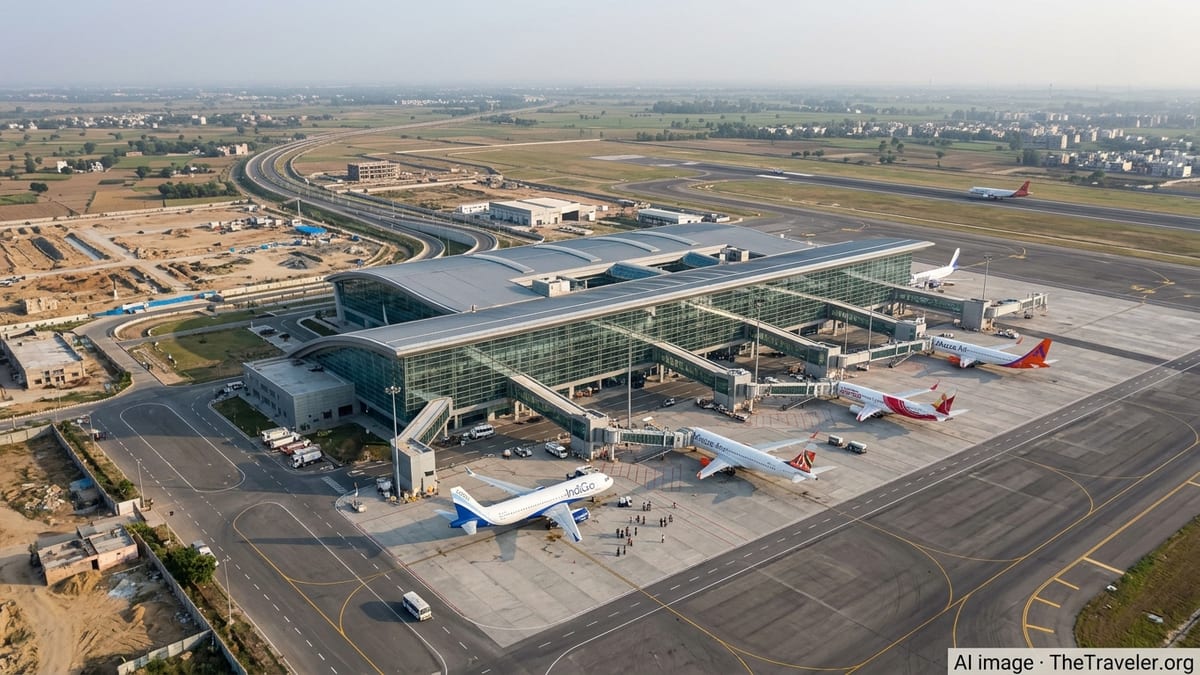
A New Gateway for Delhi NCR and Western Uttar Pradesh
The Noida International Airport at Jewar has been developed as a greenfield hub to ease congestion at Delhi’s primary Indira Gandhi International Airport and to serve the fast-growing urban belt of Noida, Greater Noida and Ghaziabad. Publicly available information shows that the airport, located along the Yamuna Expressway in Gautam Buddha Nagar district, is planned as a multi-phase project designed to handle tens of millions of passengers per year once fully complete.
Reports indicate that the first phase features a single runway and a passenger terminal sized for initial domestic and limited international operations, with scope for rapid expansion. The development is part of a broader strategy by Uttar Pradesh to increase its aviation footprint, with Noida International Airport expected to become one of the state’s flagship infrastructure assets.
The project is being implemented through a public–private partnership model, with Zurich Airport International-led Noida International Airport Limited responsible for building and operating the facility. According to published coverage, the long-term plan foresees multiple runways, cargo facilities and an integrated airport city that could emerge as a major logistics and business hub for northern India.
Travel industry commentary highlights that the Jewar site sits roughly 72 kilometres from central Delhi, but is positioned to offer more convenient access for residents and businesses in the southern and eastern parts of the National Capital Region, including rapidly growing industrial and residential clusters along the Yamuna Expressway.
First Airlines and Routes: What Early Schedules Show
While the ceremonial launch has taken place in March 2026, commercial operations are expected to begin earlier, with aviation trade coverage pointing to a start of scheduled flights by mid-December 2025. Travel and airline industry reports indicate that IndiGo, Air India Express and Akasa Air are among the first carriers preparing to operate from Noida International Airport.
According to these reports, IndiGo is expected to anchor the initial domestic network with frequent services to major metros such as Mumbai, Bengaluru and Hyderabad. These high-demand trunk routes are viewed as essential for diverting traffic from Delhi’s main airport and for quickly establishing Jewar as a viable alternative for both business and leisure travellers.
Published route details suggest that Air India Express and Akasa Air are planning a mix of domestic and short-haul international services. Early domestic destinations under consideration include key tier-1 and tier-2 cities, with industry coverage widely mentioning Kolkata and other regional hubs as likely additions as passenger numbers build.
On the international front, travel trade reports suggest that Noida International Airport is being positioned to host direct services to select West Asian and Asia-Pacific destinations in its early years. Destinations such as Dubai, Singapore and Tel Aviv have been cited in coverage as potential non-stop routes from Jewar once regulatory clearances and bilateral traffic rights are in place.
Cities Connected in the First Phase
In its initial phase of operations, Noida International Airport is expected to focus on high-traffic domestic corridors connecting Delhi NCR with key economic and technology centres across India. Airline network plans reported in the travel press point to Mumbai, Bengaluru and Hyderabad as the first wave of destinations from Jewar, reflecting strong corporate, IT and financial services demand on these routes.
Industry analysis suggests that Kolkata is also in line for early connectivity, adding an important eastern India link and supporting both business and visiting-friends-and-relatives travel. Additional domestic points are likely to follow as aircraft and slots become available, with cities such as Ahmedabad, Pune, Chennai and Jaipur frequently mentioned by route watchers as natural candidates for subsequent phases.
Beyond metro-to-metro links, policy documents and parliamentary discussions have highlighted the intention to eventually connect Jewar with a wider network of regional cities, aligning with broader efforts to distribute air traffic away from saturated hubs. Over time, this could include links to religious, tourism and industrial centres across Uttar Pradesh and neighbouring states, complementing the state’s expanding airport network.
Observers note that while the first wave of connectivity will be heavily domestic, the airport’s long-run design as an international hub means that each new domestic city added strengthens the potential for future one-stop global connections via Jewar.
Surface Connectivity and Access to the New Airport
For travellers, a key question around Noida International Airport has been how easily it can be reached from Delhi and surrounding cities. Publicly available planning documents show that the airport has been integrated into a wider surface transport blueprint, with multiple expressways and rapid transit lines intended to feed passenger and cargo traffic into Jewar.
The airport sits just off the Yamuna Expressway, which already links Greater Noida with Agra and serves as a primary road artery for the region. Additional connectivity is planned via the DND to KMP corridor, expected to provide a direct, high-speed road link from Delhi, Noida and Faridabad to Jewar. Recent progress reports on this expressway indicate that stretches connecting towards the airport side are advancing and are being sequenced with the airport’s operational timeline.
Rail-based access is also part of the long-term plan. A proposed regional rapid transit system corridor connecting Ghaziabad, Noida and Jewar is being developed under the Namo Bharat brand, with published alignments showing future stations designed to interface with the airport. Reports indicate that this line would plug the airport into the broader rapid rail grid serving Delhi NCR once commissioned.
Local connectivity from Noida and Greater Noida is expected to be strengthened over time through extensions of metro services and dedicated bus links. Real estate and urban development commentary already points to the emergence of new residential, commercial and hospitality projects along these corridors, driven by expectations of easier access to the airport.
Economic, Tourism and Aviation Impact
Analysts view the launch of Noida International Airport as a transformative development for both Uttar Pradesh and the wider Delhi region. Economic studies referenced in media coverage project significant job creation in airport operations, ground handling, retail, logistics, hospitality and related services, particularly as additional phases come online.
For travellers, the new hub is expected to reduce pressure on Delhi’s main airport and open up additional capacity for airlines to expand in one of India’s busiest aviation markets. Travel industry observers note that increased competition and new point-to-point routes from Jewar could translate into more options and potentially more competitive fares for passengers in the medium term.
The airport is also being framed as a catalyst for tourism, especially given its proximity to major destinations such as Agra, Mathura and Vrindavan. With faster road and future rapid rail links, tour operators are expected to market Jewar as a convenient gateway not only to Delhi but also to the cultural and heritage circuit of western Uttar Pradesh.
From an aviation network perspective, Noida International Airport adds a second major gateway for the National Capital Region, bringing it closer in line with other global metropolitan areas that rely on multiple airports. As airlines gradually ramp up operations and the route map fills out, industry watchers will be watching how traffic balances between Jewar and Delhi’s existing airport, and how this new hub reshapes travel patterns across north and central India.