

More news on this day
Poland is moving to anchor its ambitious high-speed rail expansion in domestic industry, with a new partnership between Siemens Mobility and local rolling stock producer Newag signaling a bid to dominate the next wave of Central European rail investment.
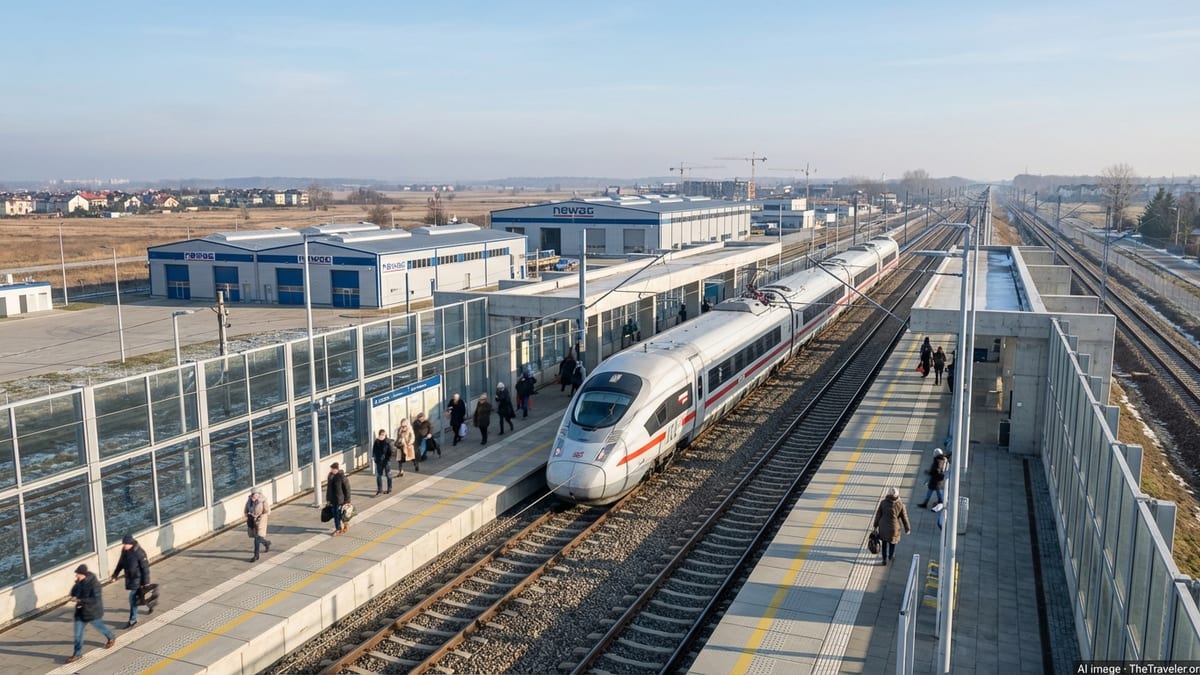
A Strategic Alliance for a New High-Speed Era
The memorandum of understanding signed by Siemens Mobility and Newag marks a decisive industrial play ahead of Poland’s largest-ever high-speed train procurements. The two manufacturers have agreed to work together on bids for upcoming KDP-branded high-speed lines, aligning Siemens’ experience in 300 to 320 km/h trainsets with Newag’s growing manufacturing base and political footprint inside Poland.
The agreement, announced in late January 2026, is framed as a preparatory step rather than a final commercial contract. It lays the groundwork for a more detailed division of labor that the companies aim to finalize later this spring. Industry analysts see the timing as calculated, coming just months after PKP Intercity and Centralny Port Komunikacyjny confirmed aggressive timelines for procurement of high-speed fleets serving both domestic trunk routes and the planned airport hub west of Warsaw.
For Poland, the Siemens–Newag pact is about more than rolling stock. It signals a deliberate effort to combine foreign technology with local content at scale, positioning the country not only to meet its own mobility needs but to become a serious player in Europe’s high-speed rail supply chain.
CPK and PKP Intercity Drive a Massive Train Order Pipeline
The new partnership takes shape against a backdrop of unprecedented rolling stock demand. Centralny Port Komunikacyjny, the state-backed company charged with building a new airport and a spiderweb of high-speed lines around it, is preparing tenders for a fleet of trains capable of 250 to 300 km/h. Government resolutions adopted since 2023 call for more than 100 electric multiple units to be bought and leased to operators through a dedicated rolling stock company.
CPK has confirmed that its tendering process will be split between true high-speed units and Aero Express and Regio Express fleets tailored to airport and regional services. The first competitive procedures are now targeted for 2026, with operations envisaged to start around the end of the decade as core “Y-line” routes linking Warsaw, Łódź, Poznań and Wrocław are completed.
At the same time, PKP Intercity has launched its own high-speed push, tendering for at least 20 trainsets capable of 250 to 320 km/h, with options that could significantly expand the order. These trains are designed to go beyond today’s 250 km/h Pendolino services and anchor new KDP-branded routes that will connect major Polish cities as well as cross-border corridors to Berlin, Ostrava and the Baltic region.
Combined, the CPK and PKP Intercity programs are expected to require dozens of high-speed units over the next decade. That order pipeline is precisely what Siemens and Newag are positioning themselves to capture, offering a mix of proven international technology and strong domestic participation that may appeal to policymakers in Warsaw.
Newag’s Evolution from Regional Builder to High-Speed Partner
For Newag, based in Nowy Sącz in southern Poland, the Siemens tie-up caps a rapid ascent from regional rolling stock specialist to potential co-supplier of Europe’s fastest trains. The company has long produced electric multiple units and locomotives for regional and intercity use, and it already collaborates with Siemens on Inspiro metro trains assembled for the Warsaw Metro and other systems.
In recent years Newag has secured a series of major contracts that expanded its technical and industrial capabilities. It is building 35 dual-mode multiple units for PKP Intercity, the first hybrid vehicles in the operator’s fleet, under a multibillion-zloty deal that includes a decade of maintenance support. It is also delivering additional Impuls electric units to regional operators under framework agreements that stretch over several years.
These contracts have helped Newag invest in facilities, testing infrastructure and workforce skills that will be critical if it moves into the high-speed space. The company operates its own electrified test track designed to handle different European power systems, giving engineers a platform to validate new equipment before it enters service.
By pairing with Siemens, Newag stands to gain access to high-speed platforms and subsystems that would be difficult to develop alone. In return, Siemens obtains a well-connected manufacturing partner in a country that is rapidly becoming one of Europe’s largest rail markets, with strong political incentives to keep as much production as possible on home soil.
Industrial Policy, Local Content and Regional Influence
The Siemens–Newag memorandum also speaks to a broader shift in European industrial policy. As countries from Spain to the Czech Republic expand or launch high-speed networks, governments are increasingly tying public investment to local manufacturing and technology transfer. Poland is no exception, and officials at CPK and the Ministry of Infrastructure have repeatedly highlighted the need for domestic industry to benefit from the high-speed program.
CPK’s Technical Dialogue Forum, launched to coordinate with rail and construction companies, has drawn hundreds of participants to workshops on standards, workforce development and best practices. The initiative is explicitly framed as a chance to build long-term industrial capacity as well as new transport links, with high-speed projects expected to drive innovation and align Polish suppliers with the latest European norms.
Within that context, a joint Siemens–Newag bid could offer a compelling balance between global expertise and local value creation. While Siemens would likely retain responsibility for core train designs, signaling interfaces and onboard systems, Newag could take on final assembly, component production, testing and perhaps parts of lifecycle maintenance within Poland.
Such an arrangement would support skilled jobs in regions like Małopolska, where Newag already has a strong presence, and could eventually position Polish plants as export bases for high-speed trainsets to neighboring markets. With new lines planned to reach border cities and connect toward Berlin, Vilnius, Riga and other hubs, Poland is aiming to sit at the center of a denser Central and Eastern European high-speed web.
Timelines, Competition and the Road to 2035
The path from memorandum of understanding to operating trains will not be quick. CPK’s own timelines suggest its first high-speed lines will not carry passengers until the early 2030s, following route design, land acquisition, construction and certification. Rolling stock procurement will have to be carefully sequenced with infrastructure readiness, with contract awards, factory ramp-up and type approval all compressed into a few demanding years.
The Siemens–Newag partnership will also face stiff competition. Other established high-speed suppliers already serve the Polish market and have deep European track records. They are expected to form their own local alliances, betting that alternative combinations of technology and domestic content can meet Warsaw’s expectations on cost, performance and industrial benefits.
Polish planners estimate that close to one hundred high-speed trainsets could be needed by the mid-2030s once today’s Pendolino fleet, new PKP Intercity KDP units and CPK’s dedicated trains are all accounted for. The precise mix will depend on service patterns and international agreements, but the numbers underscore how central rolling stock strategy is to the broader rail vision.
In that environment, the Siemens–Newag deal is best seen as the opening move in a longer contest. By locking in a framework for cooperation now, the partners hope to be ready with a concrete, locally anchored offer as soon as tenders are published, putting Poland in a strong position to turn ambitious high-speed blueprints into steel on tracks over the next decade.