

Flights have resumed at key airports in eastern Poland after a tense security operation that saw military jets race into the skies to counter potential threats linked to renewed Russian strikes on neighboring Ukraine, briefly disrupting civilian air traffic and unsettling travelers across the region.
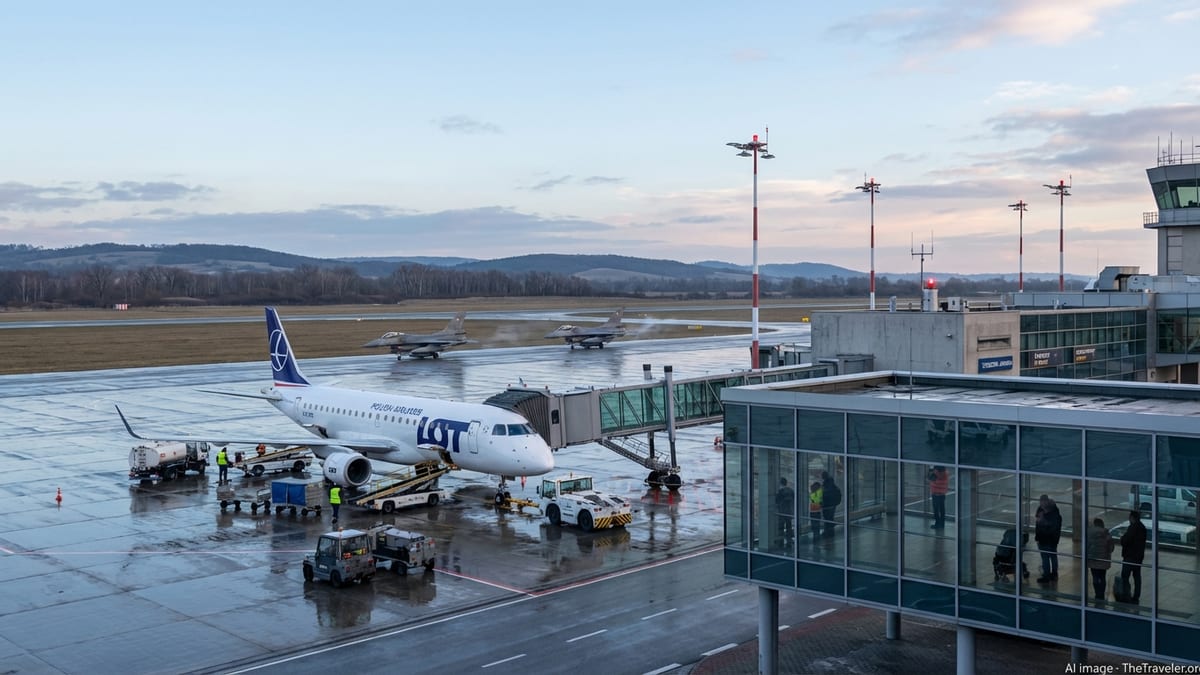
Airports at the Front Line of a Regional Security Scare
Poland’s Lublin and Rzeszow–Jasionka airports, both located close to the border with Ukraine, reopened to civilian traffic after authorities lifted an airspace closure imposed during an intense period of military aviation activity. The shutdown, ordered in the early hours of the morning, halted commercial flights and diverted aircraft as Polish and NATO forces responded to a new wave of Russian attacks on Ukrainian territory.
The Polish Armed Forces Operational Command said military aviation was activated to ensure the safety of national airspace as Russia conducted large-scale missile and drone strikes on western Ukraine. The operation included flights by allied NATO jets, which patrolled the skies while ground-based air defense systems were placed on heightened readiness. Officials emphasized that there had been no confirmed violation of Polish airspace, but argued that caution was essential given the proximity of the attacks to Polish territory.
The decision to ground civilian flights highlighted Poland’s increasingly delicate role as both a frontline NATO state and a major logistics hub for weapons and humanitarian aid flowing into Ukraine. Rzeszow–Jasionka, in particular, has served as a critical entry point for military cargo and allied personnel since the full-scale invasion began in 2022, making any disruption there closely watched by diplomats, defense planners and airlines alike.
For travelers, the closure translated into sudden delays, flight cancellations and diversions to airports further west in Poland or elsewhere in Europe. Aviation trackers recorded several inbound flights entering holding patterns or rerouting as the restricted airspace took effect, while airport operators issued urgent notices urging passengers to check the status of their flights before heading to the terminals.
How Military Jets Triggered a Civil Aviation Shutdown
The latest disruption was sparked when Poland’s early warning networks detected intensified Russian activity over Ukraine’s western regions, prompting what officials described as an “unplanned military operation” in Polish skies. NATO and Polish fighter aircraft were scrambled to reinforce air defenses, in line with procedures developed after a series of earlier drone incursions and missile fragments crossing into allied airspace.
According to statements by the Operational Command, allied aircraft including German and other NATO jets joined Polish fighters in patrolling the eastern and southeastern sectors of the country’s airspace. Air control authorities responded by carving out large zones reserved exclusively for military traffic, temporarily freezing commercial operations at Lublin and Rzeszow–Jasionka and restricting corridors used by overflying traffic bound for other European destinations.
A notice to airmen issued during the incident described the closures as necessary for “national security related military activity,” while state aviation agencies said the objective was to give armed forces “freedom of operation” without the added risk of sharing crowded corridors with civilian jets. The move reflects a broader shift in European airspace management since the start of the war, with countries bordering Ukraine repeatedly reshaping flight paths to deconflict military and commercial traffic.
Although no hostile aircraft or drones were reported entering Polish sovereign airspace during this specific episode, officials stressed that the pattern of Russian strikes so close to NATO territory justifies rapid, visible deterrent action. Defense planners argue that scrambling jets and closing airspace, even for a few hours, sends a signal that any violation would be met with an immediate and coordinated response.
Lessons from September’s Drone Incursion Over Poland
The return of military jets to Polish skies has revived memories of September 2025, when Russian drones crossed into Poland during a massive overnight assault on Ukraine, triggering the most serious airspace violation of a NATO member since the conflict began. On that night, between 19 and 23 Russian drones were tracked moving across eastern, central and northern Poland, with allied fighters shooting several down and debris later being located on Polish soil.
During that earlier crisis, authorities ordered the closure of airspace over four major airports, including Warsaw Chopin, Warsaw Modlin, Rzeszow–Jasionka and Lublin. Flights were halted or rerouted, and thousands of passengers were stranded as the government invoked NATO consultation mechanisms and described the incident as an “act of aggression.” The episode prompted fresh discussions within the alliance about deterrence, air defense gaps and the legal threshold for responding to repeated cross-border incursions.
For the aviation sector, that incursion served as a wake-up call. Airlines operating to and from Poland began factoring in the possibility of sudden airspace closures and diversions, especially to airports near the Ukrainian border. Industry sources say carriers have since adjusted schedules, crew planning and fuel policies to ensure they can loiter or reroute at short notice if military operations require corridors to be cleared.
The latest closure of Lublin and Rzeszow–Jasionka, while shorter and more localized than the September disruption, fits into this evolving pattern of risk management. Airports closest to the frontier are now treated as assets that may need to switch rapidly between civilian operations and priority access for military aircraft and cargo, sometimes with only a few hours of notice.
What Returning to “Normal Operations” Really Looks Like
By mid-morning on the day of the latest alert, Poland’s aviation authorities announced that “operations of military aviation in our airspace have been concluded” and that air defense and radar systems were returning to standard levels of readiness. Within minutes, notices were updated to show that Lublin and Rzeszow–Jasionka had reopened, and airlines began the process of resuming regular schedules.
Even so, the path back to normality was gradual rather than immediate. Aircraft and crews had been displaced, passengers had missed connections, and ground handling teams faced a compressed window to process backlogged departures and arrivals. Airport staff in Rzeszow and Lublin reported a surge of travelers seeking information at service desks, many of them unclear about whether security concerns had been resolved or whether further closures could follow later in the day.
Operators stressed that terminal facilities remained secure throughout, with no evacuation ordered and security checks continuing under reinforced protocols. For many travelers, the most visible sign of the crisis was the absence of aircraft movements outside the terminal windows and the appearance of military jets streaking high overhead, occasionally visible against the morning sky.
Travel industry analysts point out that while the operational impact of this closure was measured in hours rather than days, the psychological effect on travelers planning trips through Poland’s eastern regions may last longer. Tourists, business passengers and diaspora communities flying in to visit family are increasingly weighing geopolitical instability alongside more traditional concerns such as price and convenience when booking flights.
Advice and Expectations for Travelers Heading to Eastern Poland
For travelers with upcoming flights to or through Lublin and Rzeszow–Jasionka, airlines and airport authorities are emphasizing the importance of flexibility and real-time information. Passengers are being advised to monitor their airline’s mobile apps and updates from airport operators on the day of travel, as any renewed wave of attacks on Ukraine could again prompt rapid changes in airspace status.
Industry observers say that while large-scale, repeated closures remain unlikely, short-notice constraints of a few hours cannot be ruled out in a security environment that now routinely blends civilian and military aviation needs. Travelers connecting through Warsaw or other European hubs to reach Poland’s border regions might consider allowing more generous layover times in case of delays cascading down the network after any temporary shutdown.
Travel insurance policies that cover missed connections and security-related disruptions are becoming a more prominent consideration for visitors. Brokers report rising interest in products that specifically address conflict-adjacent travel, particularly among corporate clients and humanitarian staff who fly frequently into and out of Rzeszow, which has become a key staging point for aid operations into Ukraine.
On the ground, local tourism boards in eastern Poland are working to reassure visitors that daily life continues largely as normal in cities like Lublin and Rzeszow. Hotels, restaurants and cultural attractions remain open, and no civilian evacuations or curfews are in place. However, guests may notice an increased presence of uniformed personnel at key infrastructure sites, along with occasional overflights of military aircraft.
NATO’s Air Shield and the View From the Cockpit
Behind the scenes, the rapid scramble of military jets that temporarily grounded civilian flights is part of a broader NATO air shield that now stretches across Eastern Europe. Since Russia began targeting Ukraine with larger salvos of missiles and drones, alliance members have rotated fighter detachments, early warning aircraft and air defense batteries into Poland and neighboring states to reinforce the eastern flank.
Pilots involved in these missions typically operate under strict rules of engagement, with radar operators tracking every object that appears to cross into or fly close to allied airspace. When threat levels spike, commanders may request that civilian controllers clear specific flight levels or geographic sectors, allowing fighters to maneuver freely without risk of conflicting with commercial jets following scheduled routes.
Commercial pilots transiting the region describe a changed operating environment compared with prewar years. Reroutes around active conflict zones, more frequent altitude changes in response to military activity, and occasional holding patterns near the Polish border have become part of their routine. Crews stress that safety margins remain robust, but acknowledge that operations now require closer coordination with air traffic control centers juggling both civilian timetables and security imperatives.
Aviation safety experts note that while temporary airport closures are disruptive, they are also evidence of conservative risk management at work. By clearing airspace to give interceptors and surveillance aircraft room to operate, authorities reduce the chances of misidentification or accidental interaction between civilian and military aircraft during fast-moving security incidents.
Rising Hybrid Pressures Along Poland’s Eastern Border
The reopening of border airports comes against a backdrop of mounting hybrid pressures along Poland’s frontier with both Ukraine and Belarus. In recent weeks, Polish authorities have reported repeated incursions by small unmanned balloons from Belarus, some believed to be used for smuggling and others viewed as deliberate provocations intended to test air defenses and sow uncertainty.
These incidents, while far less dramatic than the September drone raid, have nonetheless forced the military to shut limited sections of airspace at night and scramble aircraft to visually identify slow-moving objects drifting on the wind. Officials describe this as part of a pattern of low-level harassment aimed at stretching surveillance resources and normalizing abnormal activity near sensitive borders.
For aviation planners, the convergence of high-stakes drone and missile threats from Russia with lower-level hybrid pressure from Belarus creates a complex risk picture. Airspace managers must differentiate between genuine threats that might require emergency closures and nuisance incursions that can be handled through routine monitoring, all while keeping disruption for airlines and passengers to a minimum.
Travelers passing through Poland’s eastern regions are unlikely to see most of this activity directly, but they are increasingly feeling its impact in the form of more frequent alerts, security messaging and occasional timetable changes. The latest reopening of Lublin and Rzeszow–Jasionka is a reminder that Europe’s busiest travel corridors now sit alongside some of its most heavily watched skies.
Balancing Open Skies With Frontline Security
As flights resume and departure boards in Lublin and Rzeszow once again fill with destinations across Europe, Polish officials are framing the episode as proof that the country can simultaneously safeguard its skies and keep its transport network running. Authorities insist that any decision to close airspace is taken only when absolutely necessary, and lifted as soon as military commanders judge that the immediate risk has subsided.
Airlines, for their part, are recalibrating how they communicate such events to passengers. Carriers are under pressure to provide clear explanations when flights are delayed for security reasons, without disclosing operational details that could compromise ongoing military activity. Several operators serving Poland say they are updating contingency plans and staff training so frontline workers can quickly assist passengers caught up in sudden airspace restrictions.
Looking ahead, experts expect that Poland’s border airports will continue to experience occasional, short-lived disruptions as long as Russian strikes remain a fact of life across the border. The question for the wider travel industry is how to normalize operations in a context where the line between routine and emergency can shift overnight. For now, the sight of military jets intercepting potential threats and the swift reopening of key airports underscore a new reality for travelers in Europe’s east: the journey may go ahead as planned, but the skies above are under closer watch than at any time in recent decades.