

More news on this day
Poland has launched a military evacuation operation to extract its citizens stranded across the Middle East, as war-related airspace closures around Iran and the Gulf disrupt travel through hubs such as Dubai and force emergency transit routes through Oman.
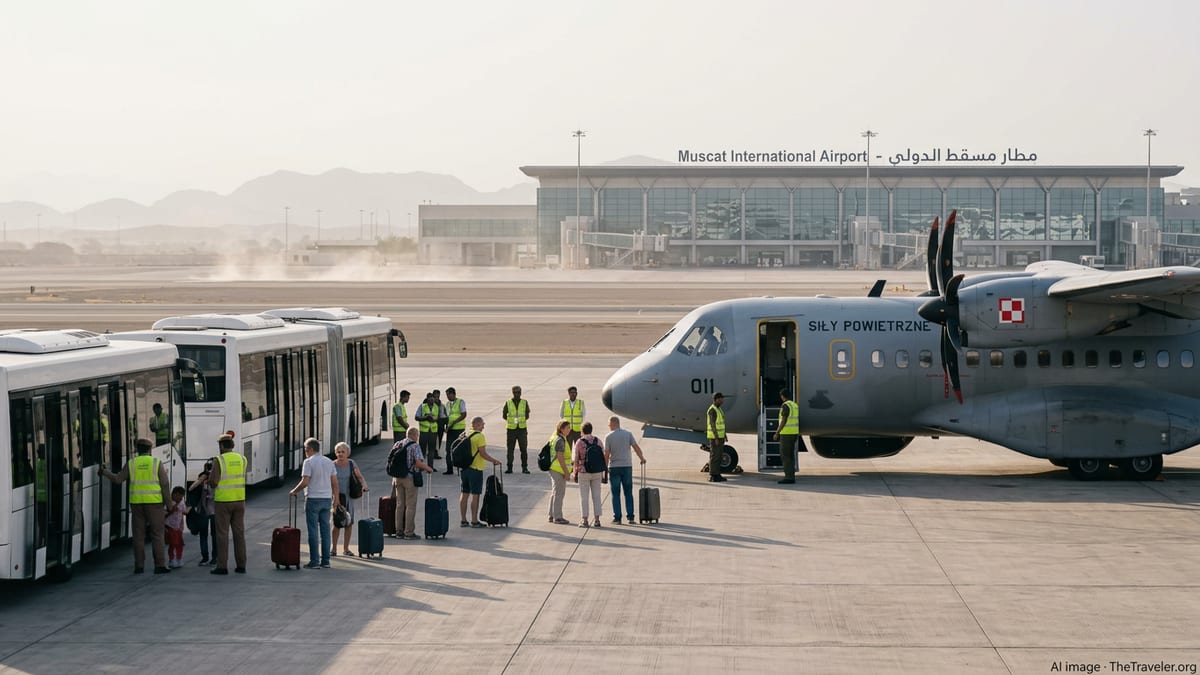
Warsaw Activates Military Contingent for Regional Airlift
The Polish government confirmed on Thursday that air force aircraft had departed for the Middle East to support the evacuation of nationals caught up in the fast-moving conflict and aviation shutdown. The Operational Command of the Armed Forces said the deployment is part of a formally designated military contingent focused on repatriation and medical support.
President Karol Nawrocki has authorized the use of up to 150 soldiers between March 5 and March 31 to assist evacuations from Saudi Arabia, Bahrain, Egypt, Israel, Qatar, Kuwait, Oman and the United Arab Emirates. The mission is framed as a humanitarian and consular operation, with priority given to vulnerable travelers and those with urgent health needs.
Prime Minister Donald Tusk, speaking after a crisis meeting in Warsaw, said the decision marked a shift from earlier caution about military involvement in civilian airlifts. Officials had initially relied on commercial carriers and travel agencies to move people out, but escalating attacks, airspace restrictions and cascading cancellations left “several thousand” Poles scattered through the region with few options.
Poland’s foreign and defense ministries are now coordinating around the clock with allied governments, airport authorities and airlines to secure landing slots, safe air corridors and onward connections. A crisis team at the Foreign Ministry, also attended by the sports and tourism minister, is updating destination lists and passenger manifests as new requests for assistance arrive.
Oman Emerges as Medical and Transit Hub
With major Gulf hubs still operating on a limited basis, Oman has become a critical staging ground for Polish evacuation flights. Officials in Warsaw say a dedicated medical-priority aircraft is scheduled to land in the sultanate to collect seriously ill or injured citizens who cannot remain in the region as tensions grow.
Consular teams have been dispatched to Omani airports to receive passengers arriving overland or on scarce regional services. Polish authorities describe a phased process, with citizens first moved from higher-risk locations to relatively calmer points such as Muscat and Salalah, then transferred onto military or specially arranged civilian flights bound for Warsaw and other Polish cities.
The pivot to Oman follows days of uncertainty in which airspace around the Gulf opened and closed in response to missile and drone attacks linked to the broader Iran conflict. Even as certain routes begin to reopen, aviation regulators and insurers remain wary, and governments are keen to route evacuation flights through airfields considered less exposed to potential strikes.
Travel industry sources say charter capacity out of Oman has tightened rapidly as European governments compete for slots to move their citizens. For Polish travelers accustomed to seamless connections through Gulf super-hubs, the sudden reliance on an improvised corridor via Oman has underscored how quickly regional geopolitics can reshape global mobility.
Stranded in Dubai as Limited Flights Resume
Dubai, usually one of the world’s most reliable long-haul gateways, has become a focal point of the crisis for Polish citizens and other Europeans. After initial closure of airports in the United Arab Emirates, authorities have cautiously restarted a small number of flights, prioritizing aircraft with pre-existing reservations and evacuation needs.
Polish consular officials in Dubai have organized overnight coach convoys to move citizens out of the city toward the Hatta border crossing into Oman. According to the Foreign Ministry in Warsaw, groups escorted by consular staff have already crossed into Omani territory and are now in the “next stage” of their journey home, awaiting onward flights arranged by the Polish state and tour operators.
National carrier LOT has suspended regular services to Dubai until at least March 6, alongside extended cancellations on routes to Tel Aviv and Riyadh. In the interim, travel agencies have cobbled together a patchwork of charter departures, some operating out of secondary Gulf airports where security conditions and air traffic control allow.
For ordinary travelers, the experience has been one of long queues at airline desks, rapidly changing itineraries and rising costs. While wealthier passengers have reportedly turned to private charter jets to escape the bottleneck, most Poles seeking to leave the region are relying on the government airlift and a narrow window of commercial seats negotiated in cooperation with Emirati and Omani partners.
Foreign Ministry Urges Registration and Patience
As the evacuations accelerate, Poland’s Foreign Ministry is urging all citizens in the broader Middle East to register with consular services, report their location and travel documents, and monitor official channels for instructions. Officials emphasize that the situation still varies sharply from country to country, with some airports slowly resuming operations and others subject to renewed closures without warning.
More than 2,000 people have already reached Poland on at least 11 flights in recent days, according to government tallies, but Warsaw acknowledges that an unknown number of citizens remain dispersed across Gulf states, Israel, Lebanon and Jordan. Some are tourists and business travelers, while others are long-term residents and seasonal workers who now face complicated decisions about whether to stay or attempt to leave.
Diplomats note that evacuation capacity is constrained by regional airspace rules and by guidance from European aviation regulators, which have advised carriers to avoid parts of the conflict zone. In practice this means that even with military assets deployed, flights may need to route via longer, more southerly paths, lengthening journeys and reducing the number of rotations aircraft can complete in a day.
Authorities are cautioning Poles not to attempt risky overland journeys without first consulting consular staff. In a region where border procedures can change overnight and certain highways pass near military sites, officials warn that improperly planned movements could expose civilians to greater danger than waiting for an organized convoy or flight.
Regional Turmoil Reshapes Travel Across the Middle East
The Polish operation unfolds against a backdrop of unprecedented disruption to Middle Eastern aviation. Since coordinated strikes by the United States and Israel on Iran in late February and subsequent Iranian retaliation, major hubs from Dubai and Abu Dhabi to Doha have seen wide-ranging cancellations, diversions and temporary closures.
Airports that normally serve as vital links between Europe, Asia and Africa have been operating at a fraction of their usual capacity, stranding hundreds of thousands of travelers. Many airlines have rerouted away from the Gulf and Iranian airspace entirely, adding hours to long-haul journeys or suspending routes outright until security assessments improve.
European governments are racing to mount their own evacuation efforts, chartering aircraft, negotiating humanitarian corridors and dispatching crisis teams to key transit points. Poland’s decision to deploy a dedicated military contingent, after initially ruling out such a move, reflects the speed with which a regional conflict has rippled through civil aviation and consular planning.
For travelers with future itineraries touching Dubai, Abu Dhabi, Muscat or other Gulf gateways, the message from Warsaw and other European capitals is to stay flexible, maintain close contact with airlines and tour operators, and be prepared for last-minute route changes. As the situation evolves day by day, Poland’s evacuation flights from Oman and the wider region have become a stark reminder that in the Middle East, geopolitical tensions can ground even the most routine holiday or business trip with little warning.