

Arriving in Poland is no longer just about a quick passport stamp. From Warsaw’s airports to its land crossings with Ukraine and Belarus, travelers are walking into one of Europe’s most ambitious high-tech border experiments, where fingerprints, facial scans and powerful databases are quietly rewriting what it means to cross a frontier.
A Frontline Testbed for Europe’s New Digital Borders
Poland has moved faster than most of its European partners to roll out the EU’s new Entry/Exit System, a biometric border regime designed to register every non-EU traveler entering or leaving the Schengen zone. Since the bloc-wide system’s launch in October 2025, Polish authorities have treated their long, exposed eastern frontier as a proving ground for the technology, combining physical fortifications with automated checks at airports, rail hubs and major road crossings.
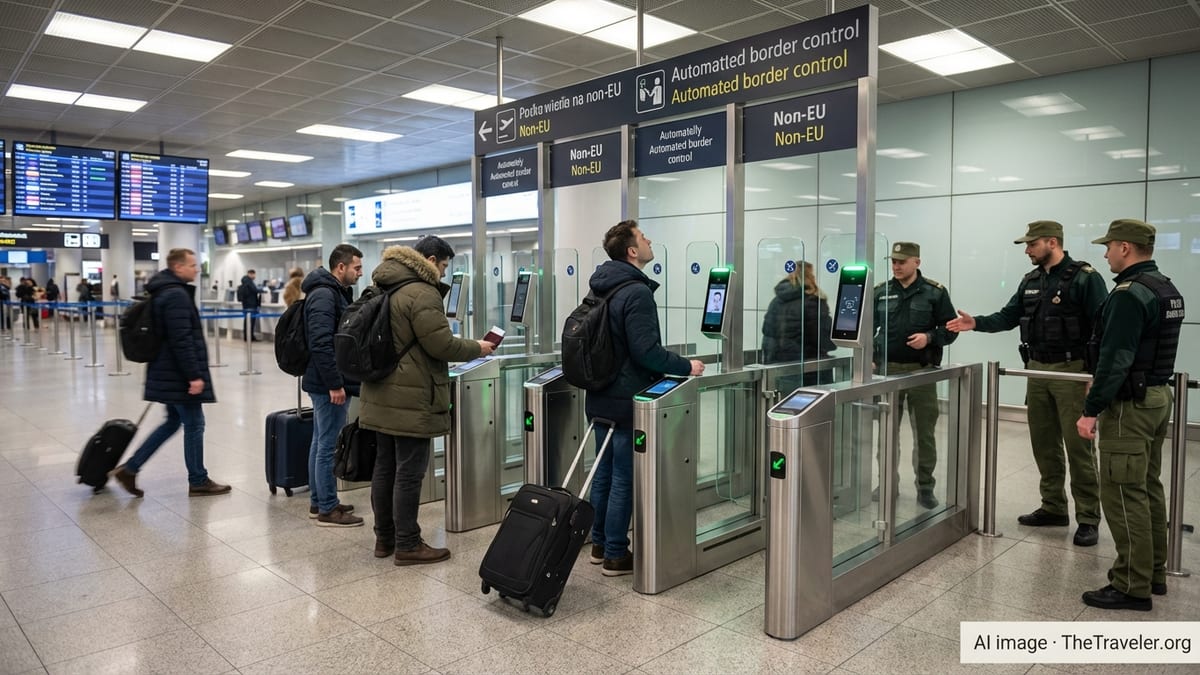
At Warsaw Chopin Airport, the country’s busiest air gateway, automated gates now guide many third-country nationals through a tightly choreographed process of document scans, fingerprinting and facial recognition. Border Guard officers say the system is already cutting paperwork and making it easier to spot overstays and forged documents, even as passenger volumes continue to rebound beyond pre-pandemic levels.
The digital overhaul is not confined to the capital. From Kraków-Balice Airport in the south to Gdańsk’s seaport on the Baltic, and at key road and rail corridors into Ukraine, Belarus and Russia’s Kaliningrad exclave, new biometric kiosks and e-gates are replacing the centuries-old ritual of inked passport stamps. The aim is a unified, data-rich border perimeter that feeds real-time information into European-wide security and migration systems.
Poland’s early embrace of the technology reflects its dual role as both a major entry point for tourists and workers and a frontline state coping with regional instability, migration pressures and what officials term hybrid threats from Moscow and Minsk. The new scanners are being sold domestically as much as a shield as a convenience upgrade.
From Pilot Projects to a Nationwide Biometric Switch-On
The shift did not happen overnight. Throughout 2025, Polish border units quietly tested the Entry/Exit System at a handful of crossings in the southeast, including Medyka-Shehyni on the road corridor to Lviv and the nearby Przemyśl-Mostyska rail link. Those pilots processed hundreds of thousands of travelers, ironing out glitches in fingerprint capture, facial imaging and data transmission before the technology was expanded nationwide.
By late November 2025, Polish officials felt confident enough to activate biometric checks simultaneously at dozens of airports, seaports, train stations and road gates. In practice, that meant that at one minute past midnight on the designated launch day, officers at 38 major border points began registering non-EU arrivals and departures using the new system, with more than a hundred secondary posts scheduled to follow within days.
The technology itself is designed for speed. First-time registrants typically present their passport at a kiosk, place four fingers on a glass scanner and look briefly into a high-resolution camera. The device pulls in name, nationality and document details, creates a biometric template and links it to an encrypted record of the person’s entry. Polish border officials say the entire enrolment can take under two minutes, while repeat visitors cleared through automated gates often pass in less than half a minute.
Under EU rules agreed during Poland’s presidency of the Council of the European Union, member states enjoy a phased start-up period in which they can gradually increase the share of travelers processed through the system. Nonetheless, Warsaw has opted to move quickly, seeing early, comprehensive use of the technology as a competitive advantage for its airports and a way to demonstrate readiness ahead of the linked ETIAS travel authorisation scheme due in late 2026.
What the New Scanners Actually Do With Your Data
For individual travelers, the most visible change is the ritual at the booth or kiosk. Instead of simply handing over a passport to be inspected and stamped, non-EU visitors to Poland are now enrolled into a shared European database that records each crossing of the external border. The system captures the biographic data from the passport, a facial image, fingerprints for most adults and the exact time and place of entry or exit.
Behind the scenes, this record becomes the reference for every subsequent trip. On a second or third visit, the biometric scanner compares the traveler’s live fingerprints and face with the stored template, confirming identity more reliably than a visual check against a photo. The database automatically calculates how long each person has spent in the Schengen area against the familiar 90 days in any 180-day period rule, allowing border services to flag potential overstays or identity fraud.
Importantly, the regime applies only to third-country nationals: non-EU travelers, whether they need a visa or not. Citizens of Poland and other EU or Schengen states remain exempt, passing instead through existing electronic passport gates or regular staffed counters. Children under 12 are generally spared fingerprinting, although their travel movements are still logged through their documents.
Polish officials insist that data protection safeguards have been built into the architecture from the start. Retention periods are limited, strong encryption is used for biometric templates, and access is confined to authorised border and law enforcement agencies. Nonetheless, privacy advocates across Europe are watching closely, arguing that the sheer scale of the repository, and the potential to cross-reference it with other databases, raises new questions about surveillance and proportionality that will only grow as usage expands.
Faster Queues or New Bottlenecks for Travelers?
Authorities in Warsaw, Brussels and other European capitals promote the Entry/Exit System as a way to speed up border processing by replacing manual stamps and short interviews with automated checks. Once enrolled, frequent visitors are expected to move more quickly through e-gates, while officers can focus their attention on higher-risk cases instead of repetitive paperwork.
The first months of the rollout across Europe, however, have shown that the benefits come with a learning curve. In several Schengen countries, including busy holiday destinations, the initial launch triggered long queues as passengers grappled with unfamiliar kiosks, technical faults and staff shortages. European airports and travel associations have warned of potential bottlenecks during peak seasons if infrastructure and staffing do not keep pace with the new requirements.
Poland’s experience has been mixed but comparatively smoother than some peers, thanks in part to its phased pilots on quieter eastern crossings and sustained investment in modern e-gates at major airports before the EU system went live. Even so, border officials caution that first-time users should allow extra time on arrival, especially at land crossings where coach groups and private cars can quickly overwhelm available kiosks.
For travelers, the bottom line is a new calculus: expect a slightly longer first visit to enrol biometrics, followed by potentially faster processing next time. Airlines and rail operators serving Poland are updating passenger guidance, advising non-EU customers to arrive earlier, keep passports and residence cards handy and to follow dedicated signage for the new system to reduce confusion at busy terminals.
A High-Tech Answer to Security and “Hybrid Threats”
Security, rather than convenience, is the driving argument behind Poland’s high-tech turn at its borders. Stretching along Belarus, Ukraine and Russia’s Kaliningrad region, the country’s eastern frontier has become one of the most closely watched edges of the European Union, with Warsaw accusing Moscow and Minsk of weaponising migration by funnelling third-country nationals towards the barrier.
In parallel with its biometric rollout, Poland has erected a tall steel fence along a significant stretch of the Belarusian border and completed an electronic barrier bristling with cameras, motion sensors and 24-hour monitoring. These physical defenses feed into command centres where officers can track movements in real time and dispatch patrols, integrating with the new digital identity checks at official crossings.
Officials argue that linking biometric border controls to this wider surveillance and defence infrastructure helps them respond more quickly to attempted illegal crossings, document fraud and organised smuggling. They also frame the investment as part of a broader deterrence strategy at a time when the country is increasing defence spending to among the highest levels in the European Union and preparing large-scale anti-drone fortifications along the same frontier.
The result is a border that is as much a network of sensors and databases as of fences and checkpoints. For legitimate travelers, that can translate into more predictable rules and fewer arbitrary decisions at the gate. For those seeking to evade controls or exploit loopholes, the space to operate is shrinking as information is shared more systematically across agencies and national lines.
How Poland Became a Pace-Setter for the EU
Poland’s role in the Entry/Exit System extends well beyond its own frontiers. During its recent presidency of the Council of the European Union, Warsaw was instrumental in brokering a political deal that allowed member states to roll out the technology gradually instead of switching it on everywhere at once. That compromise, pushed by Polish negotiators and endorsed by the European Parliament, gave capitals greater flexibility to balance security goals with operational realities.
At home, the interior ministry and Border Guard framed early readiness as a point of national pride. Senior officials have made high-profile visits to airports to showcase the new equipment, present it as an integrated solution for safer borders and reassure the public that officers are being retrained for the digital age of migration management. The government has also highlighted the investment as proof that European funds earmarked for security and border modernisation are being put to visible use.
By embracing the technology early and extensively, Poland hopes to shape how it is perceived and refined across the continent. If its airports and land crossings can demonstrate that biometric checks can be run at scale without chronic delays, Warsaw’s example will bolster arguments for lifting temporary border checks that some neighbours have reintroduced within the Schengen area. Conversely, serious or persistent disruption could strengthen critics who warn that the system risks turning Europe’s borders into permanent choke points.
Either way, Poland has placed itself at the forefront of the experiment, inviting scrutiny from civil liberties groups, travel industry bodies and other governments watching for lessons to apply at their own terminals and checkpoints.
What This Means for Your Next Trip to Poland
For most leisure and business travelers, the most immediate impact of Poland’s high-tech border scanners will be procedural rather than political. If you are a non-EU national arriving for a short stay, you can expect to be directed either to a staffed booth equipped with biometric readers or to a self-service kiosk before you reach the counter. Clear signage at airports like Warsaw Chopin and Kraków-Balice now distinguishes lanes for EU and non-EU passengers and for those using the new system.
On your first visit after the rollout, factor in a few extra minutes to complete the enrolment, particularly at busy times or during holiday peaks. Families should be prepared for the fact that adults will typically need to provide fingerprints while young children may only have their travel documents and photos checked. Keeping passports ready, removing hats or glasses when asked and following on-screen instructions at kiosks can all help smooth the experience.
Once your data is in the system, subsequent trips should feel more streamlined. Automated gates can confirm your identity using your face or fingerprints against the stored record, often more quickly than a manual glance at a passport. You will no longer receive physical stamps in your document, but your days in the Schengen area will be tracked digitally, making it easier to demonstrate compliance with stay limits if questioned by authorities or employers.
For frequent cross-border commuters, seasonal workers and students, this new reality means that travel histories will be more transparent and easily retrievable. Companies and universities that regularly send people through Polish borders are already updating internal guidance, advising travelers to keep an eye on their cumulative days in Europe and to expect occasional spot checks as the system beds in. Over time, if the technology functions as planned, the very notion of a border crossing could start to feel less like a bureaucratic ritual and more like an automated handshake between traveler and state.