

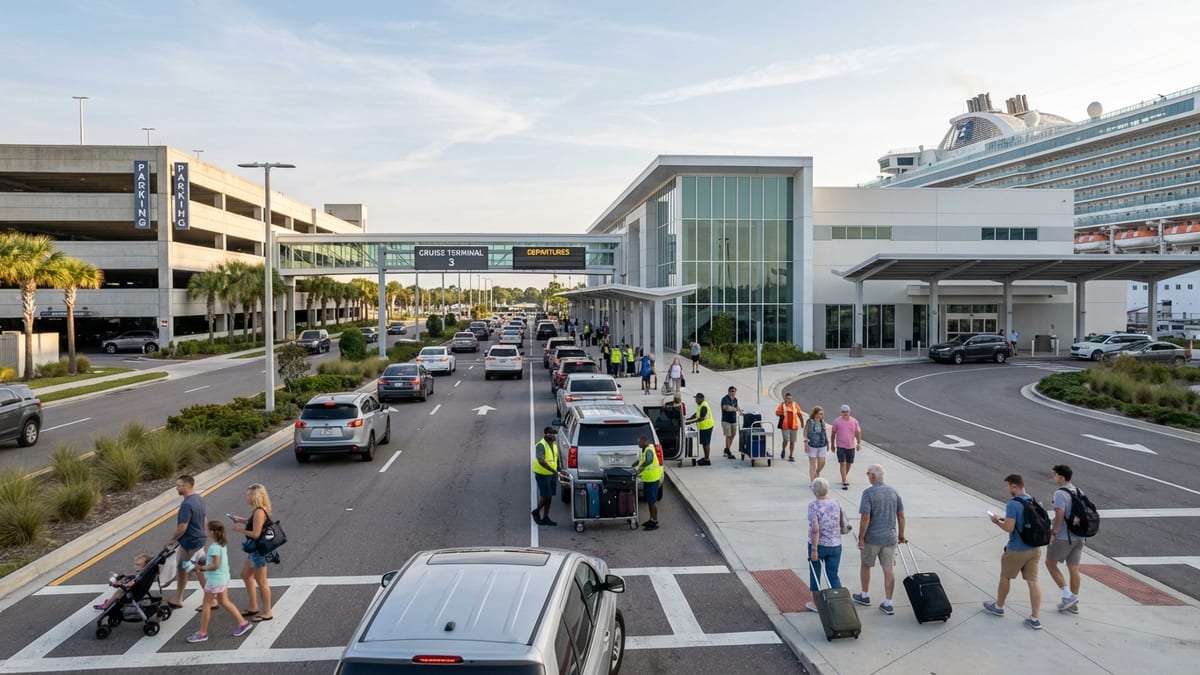
Port Canaveral has grown into one of the world’s busiest cruise homeports, with modern terminals designed to move thousands of passengers quickly between curb and gangway.
For first-time cruisers and repeat visitors alike, the sheer size of the port and the number of parking and drop-off options can feel overwhelming. Understanding how the terminals are laid out, what you will pay to park, where to drop your luggage and when to arrive for check-in can turn a stressful morning into the smooth start to your vacation you are hoping for.
Understanding Port Canaveral’s Cruise Terminals
Port Canaveral sits on Florida’s Space Coast, just east of Orlando, and is organized into several purpose-built cruise terminals on both the north and south sides of the harbor. The primary cruise terminals currently in use are Cruise Terminals 1, 3, 5, 6, 8 and 10. Different terminals are assigned to different cruise lines, with Carnival, Royal Caribbean, Disney Cruise Line, Norwegian, MSC, Princess and Celebrity all operating from the port. Your exact terminal can vary by ship and sailing date, so always verify the terminal number with your cruise documents or cruise line app in the week before departure.
Each terminal has its own dedicated parking garage or surface lot situated directly across the street or adjacent to the building. This design is intentional. The port authority emphasizes a “park and walk” model, where you pull a ticket or pay on arrival, unload your luggage curbside for porters, park your vehicle, then walk back along a marked pedestrian path to enter the terminal. There is no centralized parking structure or shared shuttle between terminals for official on-site parking, which helps reduce congestion and makes wayfinding simpler once you are within the port complex.
Terminals vary in size and age, with Cruise Terminal 3 and Cruise Terminal 1 among the newest and most modern, built to handle today’s largest ships. Terminal 8 and Terminal 10 are heavily used by Disney Cruise Line and other premium lines, with spacious check-in halls and covered drop-off zones. Terminal 5 and Terminal 6 on Charles Rowland Drive see a mix of Royal Caribbean, Norwegian, Carnival and other major brands. Although interiors differ slightly, the basic process for drop-off, check-in and security is similar across all terminals, which makes the advice in this guide broadly applicable regardless of which ship you are boarding.
Because Port Canaveral frequently hosts six cruise ships at once during peak weekends and holiday periods, traffic patterns inside the port can be busy. Electronic signboards and uniformed officers will direct vehicles toward the correct terminal entrance lanes. It is important to pay attention to these signs early, since it is not always easy to cut across multiple lanes of traffic at the last minute once you are deep inside the port. Knowing your terminal number in advance, and having it handy on your phone or printed documents, will make those last few turns much less stressful.
On-Site Parking: Garages, Rates and Practical Tips
Official port parking is the most convenient option at Port Canaveral. Parking facilities are located right next to each cruise terminal, which means you can walk between your car and the terminal in just a few minutes without waiting for a shuttle. As of late 2025, the port’s published parking rate is 20 dollars per day plus tax for standard vehicles and recreational vehicles. This daily rate is charged for both your embarkation and debarkation days, so a three-night cruise will be billed as four parking days, and a seven-night cruise will be billed as eight.
Payment for port-operated garages and lots is collected on arrival, not on departure. At the entrance to the terminal’s parking facility, you will either pay an attendant or use a pay-on-entry system that accepts major credit cards. The port does not accept cash for cruise parking, so plan ahead to have a working credit or debit card. In some facilities, particularly at newer terminals, electronic toll transponders such as E-PASS and SunPass are also being introduced as a payment method, which can further speed up entry.
Oversized vehicle parking, including larger RVs, buses and certain trailers, is available in designated areas and is billed at a higher daily rate than standard vehicles. Port tariff schedules indicate an oversize rate that is double the standard per-day fee. If you are driving a motorhome, tall van or a vehicle with an attached trailer, you should verify the current oversize parking policies directly with the port before departure, particularly if your vehicle exceeds typical garage height limits. Many of the cruise terminals rely on open-air surface lots for oversize parking rather than enclosed garages.
Port Canaveral’s parking facilities do not require or accept advance reservations for standard cruise parking, even during peak holiday sailings. Garages and lots typically open around 10 a.m. on embarkation day, coordinated with the clearance of returning ships. Although extremely rare, heavy traffic and construction can sometimes slow arrivals. For this reason, cruisers driving from longer distances are encouraged to build in extra time for possible delays. Accessible parking spots are widely available in each garage and lot, generally closest to elevators or pedestrian walkways toward the terminal, and the port offers waivers or reduced rates for certain vehicles equipped for disability access or bearing qualifying Florida plates or permits, subject to current policies.
Off-Site Parking & Park-and-Cruise Packages
While on-site port parking is the most convenient choice, it is also the most expensive. As parking rates have climbed to 20 dollars per day plus tax, a weeklong cruise can easily incur more than 150 dollars in parking costs. Budget-conscious travelers and larger groups often look to off-site parking operators around Cape Canaveral, Cocoa Beach and Merritt Island, which typically offer lower daily rates and include free shuttle transportation to and from the cruise terminals.
Several independent operators specialize in Port Canaveral cruise parking. Examples include Park Port Canaveral, Port Parking Space and Port Canaveral Parking, among others. These facilities generally advertise secure, paved lots with 24-hour surveillance, stadium lighting and perimeter fencing. Daily base rates commonly range from about 12 to 16 dollars per day, with periodic promotions that can lower the cost further, especially if you book online in advance. Many lots allow you to keep your keys, so your vehicle is not moved during your trip, which some travelers prefer.
All major off-site parking companies serving Port Canaveral operate courtesy shuttles to and from the terminals. Shuttle rides typically take 5 to 10 minutes depending on traffic and whether you are embarking from the north or south side of the port. Operators usually request that guests arrive within a certain arrival window, often between roughly 9:45 a.m. and 1:30 p.m., to allow time for check-in, luggage loading and transfer before your cruise’s assigned port arrival time. Some limit free shuttle seats to a set number of passengers per parking reservation, with a per-person fee for additional guests, while others include unlimited shuttle riders at no extra cost.
Many Cocoa Beach and Cape Canaveral hotels package cruise parking and shuttle service into “park and cruise” or “snooze and cruise” deals. If you plan to arrive the day before your sailing, these packages can be excellent value, bundling a pre-cruise hotel stay, parking for the duration of your cruise and round-trip shuttle service for your party. When comparing prices, take note of whether hotel packages include return transportation from the terminal and whether parking is on-site or at a separate facility. Because these offers are run by private businesses, terms and rates can change frequently, so it is wise to confirm current details directly with the property.
Arriving at the Port: Traffic Flow, Drop-Off and Pickup
On embarkation morning, Port Canaveral’s internal roadways become a busy but carefully orchestrated system of directional signs, police officers and port staff guiding vehicles toward the appropriate terminals. As you approach the port area on State Road 528 or State Road 520, overhead signs indicate exits for the cruise terminals. Once off the main highway, you will pass through security checkpoints staffed by port police or security officers who may ask about your destination terminal and quickly scan your vehicle as you enter the controlled port area.
Cruise terminals are clearly marked by number, and additional signs display the cruise line names or ship names assigned to each terminal that day. If you are being dropped off by a friend, family member, taxi, shuttle or rideshare, follow the “Departures” or “Cruise Drop-Off” signs, which route personal vehicles into a loop road in front of each terminal. Curbside porters are stationed in this area with luggage carts. Pull as far forward as directed, place your car in park, and quickly unload your tagged checked bags. The porters will take your larger luggage from the curb to the ship’s loading area. It is customary to tip porters in cash for this service.
Drivers who plan to park on-site should not remain at the curb for more than the few minutes it takes to unload luggage and passengers. After drop-off, follow signs immediately toward the terminal’s parking garage or lot entrance. Passengers can either accompany the driver to park the car and walk back to the terminal together, or most of the party can remain at the curb with carry-on bags while the driver parks and returns on foot. The latter approach sometimes works best for families with small children or guests with mobility limitations, since it minimizes time spent walking from the garage. However, curb space is limited, and port personnel will move vehicles along if they are idling too long.
For pickup after your cruise, the flow reverses. As you exit the terminal with your luggage, look for signs indicating “Passenger Pickup” or “Ride Share.” Most terminals have separate lanes for private vehicles, hotel shuttles, commercial buses and rideshare services, which helps control congestion. Because exact berthing positions and terminal assignments can change from one sailing to the next, confirm with your driver which terminal number you are arriving at when they head to meet you. On busy days, it is common for port staff to temporarily hold vehicles in staging areas outside the immediate terminal loop until curbside space becomes available, so build in a few extra minutes when planning airport transfers or long drives home.
Check-In, Security and Boarding: How the Process Works
Cruise lines have refined their terminal operations at Port Canaveral to keep passenger flows steady and lines moving. Most lines now assign guests a specific arrival window or check-in time, which is listed in your cruise documents and usually appears inside the cruise line’s mobile app. This assigned time indicates when you should plan to enter the terminal building, not necessarily when you will step onto the ship. Arriving significantly earlier than your assigned time can lead to waiting outdoors or in holding areas, while arriving substantially later may push your boarding closer to afternoon.
After you enter the terminal, you will first pass through security screening that is similar to an airport but usually faster and less intimidating. Carry-on bags are scanned, and you will walk through a metal detector. Items such as large bottles of alcohol and certain prohibited objects will be confiscated according to each cruise line’s policy, so review your line’s rules in advance. After security, you proceed to the check-in area, where staff will verify your boarding documents, passports or other identification and required health or travel forms. Many lines now allow you to upload photos, complete health questionnaires and link payment methods in advance, which shortens the in-terminal process.
Once check-in is complete, you may be directed to a seating area with boarding group numbers or status designations. Priority lanes and boarding groups usually exist for suite guests, top-tier loyalty members, passengers purchasing expedited boarding packages and guests who need special assistance. Announcements will invite each group to proceed toward the gangway in order. On a typical day, boarding at Port Canaveral begins somewhere between late morning and midday, after the previous cruise’s passengers have fully disembarked and the ship has been cleared by authorities. Many guests are on board, exploring the ship and eating lunch, several hours before the official sail-away time.
Cabins are typically not ready for occupancy until early to midafternoon, so pack a small carry-on with essentials such as medications, valuables, swimsuits, sunscreen and travel documents. Your checked luggage may not appear in the hallway outside your stateroom until later in the afternoon or early evening, especially on sailings with heavy embarkation volume. If you are traveling with children or older adults, consider how long they will need to stand in line during check-in and plan water, snacks and bathroom breaks accordingly. Port Canaveral’s newer terminals offer expansive seating and climate-controlled waiting areas, which make the process more comfortable even on hot or rainy Florida days.
Best Times to Arrive and Strategies to Avoid Stress
The ideal arrival time at Port Canaveral depends on your driving distance, whether you are parking on-site or off-site and your cruise line’s assigned check-in window. In general, arriving right at the beginning of your designated arrival window, often between around 11 a.m. and 1 p.m. for many sailings, is a good strategy. This timing lets you bypass the earliest rush of passengers eager to board as soon as possible, while still giving you plenty of time to clear security, complete check-in and enjoy lunch on the ship before cabins are ready.
If you are using an off-site parking lot or hotel shuttle, build in extra time beyond your terminal arrival window to account for potential shuttle waits and traffic inside the port. Many off-site operators recommend that guests plan to reach their lot before early afternoon, particularly on days when multiple large ships are sailing. Leaving your home or hotel early in the day also reduces the risk of missing the cruise if you encounter heavy traffic, road incidents or delays with rideshare services between Orlando and the coast.
Passengers flying into Orlando International Airport on the morning of their cruise should be especially cautious about timing. Many cruise-focused travel agencies and operators suggest booking flights that land no later than late morning, to allow time for baggage claim, ground transportation and the roughly one-hour drive from the airport to the port under normal traffic conditions. If your flight is scheduled to arrive after midday, consider arriving the day before sailing if at all possible. Port Canaveral is a high-volume embarkation port, and ships follow strict boarding cut-off times, generally requiring all passengers to be on board roughly 90 minutes before departure.
Regardless of when you plan to arrive, keep a close eye on your cruise line’s app or email communications in the days leading up to departure. Weather, port maintenance, ship delays or regulatory inspections can occasionally cause adjustments to terminal assignments or boarding times. A brief delay in ship clearance on the morning of your sailing can ripple through the entire check-in process, leading lines to hold guests outside the terminal for a short period, then process them more quickly once clearance is granted. Flexibility, patience and realistic expectations will help you navigate these adjustments without undue stress.
Accessibility, Families and Special Situations
Port Canaveral’s cruise terminals are built with accessibility in mind, featuring ramps, elevators, curb cuts and accessible restrooms throughout the facilities. Designated accessible parking spaces are provided near elevators or terminal walkways in every garage and lot. Passengers with limited mobility, using wheelchairs or scooters, or requiring additional assistance should notify their cruise line in advance so that appropriate support can be arranged at check-in and boarding. Many cruise lines at Port Canaveral offer wheelchair assistance from curb to cabin, subject to availability and advance request.
Families with young children can streamline the day by packing a well-organized embarkation day bag that covers snacks, diapers, wipes, lightweight entertainment, critical medications and a change of clothes. Strollers are permitted in the terminals and on the ship, though they may need to be folded for some security checkpoints or gangway ramps. When navigating drop-off zones, it often works best for one adult to handle the curbside luggage drop and child supervision while the other adult parks the car and returns on foot, rather than unloading everyone and then circling back to park with restless children in tow.
For guests with unique situations such as traveling with service animals, carrying medical equipment or following special dietary protocols, advance coordination is essential. Contact both your cruise line and, if necessary, the port authority well before your sail date to understand documentation requirements and on-site procedures. Port Canaveral’s terminals handle a large volume of passengers, and having the right paperwork at hand can make security screening and check-in much smoother. If you are traveling with mobility scooters or other battery-powered devices, confirm whether they must be powered down or disconnected at certain points during boarding.
Travelers who rely on rideshare services, taxis or private car services should remember that cell reception and network congestion can be inconsistent immediately outside large terminals when thousands of people are requesting rides simultaneously. Whenever possible, schedule return rides in advance or plan to move a short distance away from the densest pickup points after disembarkation to meet your driver. Many hotel and off-site parking shuttles stage in designated loading areas with clear signage, so follow instructions from port staff to locate your specific shuttle among the many vehicles circulating.
The Takeaway
Port Canaveral combines modern cruise infrastructure with high passenger volume, making it one of the most efficient but also busiest cruise ports in the United States. The keys to a smooth experience are knowing your terminal, understanding your parking and drop-off options, and timing your arrival to match your cruise line’s instructions. On-site parking remains the most convenient, sitting just steps from the gangway, while off-site parking and park-and-cruise packages offer meaningful savings for those willing to add a brief shuttle ride into their morning.
Once at the port, follow posted signs and staff directions for traffic flow, unload luggage quickly at the curb, and head directly to parking or check-in as directed. Keep your travel documents, identification and essential items in a carry-on that stays with you, and expect a straightforward series of steps: security screening, document verification, waiting in a boarding area and then walking the gangway to your ship. By preparing for each part of this sequence ahead of time and building in cushion for traffic and crowds, you can transform what might feel like a logistical challenge into a seamless prelude to your cruise vacation.
FAQ
Q1: How much does it cost to park at Port Canaveral’s official cruise terminals?
Parking at port-operated garages and lots is currently 20 dollars per day plus tax for standard vehicles, with the rate applied to both your arrival and departure days. Oversized vehicles are charged a higher daily fee, generally about double the standard rate, in designated oversize areas.
Q2: Do I need to reserve a parking space at Port Canaveral?
No. The official port garages and lots do not require reservations for standard cruise parking. Spaces are available on a first-come, first-served basis, and the facilities open on the morning of embarkation, typically around mid-morning once returning ships have cleared.
Q3: Are there cheaper off-site parking options near Port Canaveral?
Yes. Several private companies near the port offer off-site cruise parking with daily rates that are usually lower than on-site port parking. These lots include secured parking and free or low-cost shuttle service to and from the cruise terminals, and many allow advance online booking to guarantee a space.
Q4: When should I arrive at the cruise terminal for check-in?
Your cruise line will assign you a specific arrival or check-in window, which is usually displayed in your booking documents or app. Plan to arrive at the terminal within that window, often between late morning and early afternoon, to minimize waiting. All guests are generally required to be on board at least 90 minutes before the ship’s scheduled departure time.
Q5: What is the process for dropping off luggage at Port Canaveral?
As you approach your assigned terminal, follow signs to the departure or drop-off area and pull up along the curb where porters are stationed. Unload your tagged checked bags quickly, hand them to a porter, and tip for the service. After drop-off, either proceed directly to parking if you are keeping a car at the port or exit the loop if you are being dropped off and not parking.
Q6: Can I use rideshare services like Uber or Lyft at Port Canaveral?
Yes. Rideshare services, taxis and private car services can drop off and pick up passengers at designated lanes near each cruise terminal. Follow signage for rideshare or passenger pickup areas when you disembark, and allow extra time during peak hours when many passengers are requesting rides simultaneously.
Q7: Is Port Canaveral accessible for passengers with mobility challenges?
Port Canaveral’s cruise terminals include ramps, elevators, accessible restrooms and designated accessible parking spaces near terminal entrances or elevators. Most cruise lines also offer wheelchair assistance between curb and ship for guests who request it in advance, though availability can be limited and should be arranged before sailing.
Q8: What should I keep with me in my carry-on bag on embarkation day?
Pack all essential items in a carry-on that stays with you throughout check-in and boarding. This should include passports or other identification, cruise documents, medications, valuables such as electronics and jewelry, and items you might want before luggage delivery, like swimsuits, sunscreen and a light change of clothes.
Q9: How long does it take to board once I arrive at the terminal?
Boarding times vary depending on your arrival window, ship capacity and security processing speed. On many sailings, guests move from curb to onboard in roughly 45 minutes to 2 hours. Priority boarding status, arriving within your assigned window and having documents ready can shorten your wait significantly.
Q10: What happens if I arrive late to Port Canaveral on embarkation day?
If you arrive close to the final boarding time, you may experience rushed check-in and the risk of being denied boarding if you miss the cruise line’s cut-off, typically about 90 minutes before departure. If delays are unavoidable, contact your cruise line and, if applicable, your travel agent as soon as you realize you may be late, but understand that ships are required to depart on schedule and may not be able to wait.