

More news on this day
Poland’s most ambitious transport investment in decades, the newly rebranded Port Polska, is moving from political slogan to construction reality, with planners targeting a 2032 opening for a next-generation air and rail hub designed to redraw the continent’s travel map.
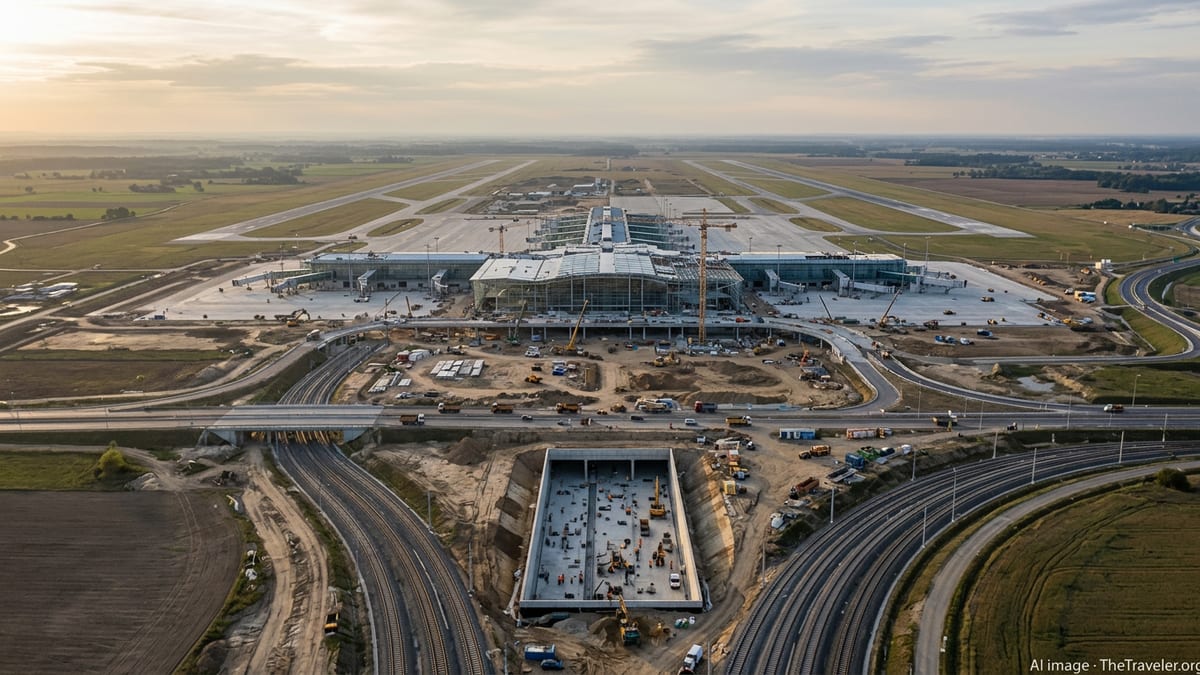
From CPK to Port Polska: A New Identity for a Mega-Hub
Previously known as Centralny Port Komunikacyjny, or Central Communication Port, the project has been rebranded as Port Polska as the government seeks to reset its image and signal a broader national role. Officials present the hub as a flagship public investment that will anchor Poland’s growth, interlink regions and integrate the country more tightly with European transport corridors.
The new airport and multimodal node will be built near Baranów, roughly halfway between Warsaw and Łódź. The location is intended to relieve pressure on Warsaw Chopin Airport, which is being expanded only as an interim solution until the end of the decade, and to pull long-haul traffic into a purpose-built facility capable of handling tens of millions of passengers a year.
Government documents and recent investment roadmaps point to a phased construction programme beginning around 2026 and running through 2031, with certification and operational readiness targeted in time for a 2032 start of commercial flights. A multi-year funding programme stretching to 2032 has been adopted, underlining a political commitment to keep the project on track despite earlier delays and critical audits.
The name Port Polska is also intended to distance the hub from partisan disputes that surrounded its first iteration. While the concept of a central air and rail gateway remains, officials now frame it as a long-term, cross-party nation-building project rather than the flagship of a single government.
Airport Design, Scale and Passenger Ambitions
Port Polska is planned as one of the largest airports in Central and Eastern Europe, with initial capacity estimates in the range of more than 40 million passengers annually once the first phase is fully operational. The masterplan provides for expansion in stages, allowing additional runways and terminal modules to be added as traffic grows.
The terminal concept, which recently cleared key design milestones and entered a competitive process to select a general contractor, follows a modular, pier-based layout to streamline transfers between Schengen and non-Schengen flights. The first wave of construction will focus on deep foundations and core structures, with contracts for these works expected to be signed around 2026 and physical works scheduled through 2027 and beyond.
Beyond sheer size, the airport is being designed as a transfer hub that can compete with established gateways like Frankfurt and Vienna for long-haul and regional connections. Planners are targeting short minimum connection times and a unified terminal footprint to encourage airlines to develop hub-and-spoke networks concentrated at Port Polska, potentially reshaping traffic patterns now split between Warsaw Chopin and secondary airports.
Sustainability features are expected to play a visible role, from energy-efficient terminal architecture to rail-first access and room for future low-emission ground operations. With European climate policy tightening, positioning the hub as a modern, lower-footprint alternative to dispersed point-to-point flying is part of the long-term pitch to carriers and regulators.
High-Speed Rail Spine: The “Y” Line and Beyond
What sets Port Polska apart from many other airport projects is its integration with an entirely new high-speed rail network. At the core of this plan is the so-called “Y” line, which will link Warsaw, the new airport and Łódź by 2032, before extending further to Wrocław and Poznań in the following years. Recent contracts for signalling and tunnel systems around Łódź underscore how closely the rail timeline is tied to the airport’s debut.
The hub will sit above a new underground rail station, with a six-kilometre tunnel and associated infrastructure now in the tendering stage. Completion of the tunnel and station works is targeted for the end of 2031, shortly before the airport’s expected opening, to ensure that high-speed and regional trains can feed passengers directly into the terminal from day one.
In total, Polish and international planning documents envisage close to 2,000 kilometres of new or upgraded high-speed lines forming a star-shaped network around Port Polska. Travel times between key cities are forecast to shrink dramatically, with Warsaw to Łódź projected at under an hour via the airport, and later links reducing journeys to cities such as Wrocław, Poznań and potentially the German border.
For many smaller and mid-sized cities, the high-speed programme associated with Port Polska is as significant as the airport itself. Political debate has focused on how quickly these rail benefits can be delivered and whether parts of the network can be accelerated so that communities are not left waiting until 2032 and beyond for improved connections.
Funding, Politics and Public Debate
As with any mega-infrastructure project, Port Polska’s path has been shaped by shifting political winds and intense scrutiny of costs. Poland’s state auditor has previously highlighted delays, planning gaps and governance weaknesses in the earlier phase of the programme, warning that there was no firm guarantee the hub could be delivered on the original timetable without reforms.
In response, the current government has launched audits, refreshed leadership at the state-owned project company and adopted a new multi-year financial framework. State guarantees and treasury-backed instruments are due to provide the backbone of funding, supplemented by private capital for selected components and, potentially, European financing for rail segments that fit wider EU corridors.
Public opinion has generally leaned in favour of continuing the investment, with polls showing a majority of respondents supporting the idea of a central hub and modern rail system, although scepticism remains about execution risks and final costs. Environmental groups and some regional leaders have called for more emphasis on upgrading existing airports and rail lines rather than concentrating resources in a single mega-node.
For now, the government’s position is that interim upgrades at Warsaw Chopin and other airports will bridge the capacity gap into the late 2020s, while Port Polska remains the strategic long-term solution. Securing visible progress on site preparation, contracts and early works by the middle of this decade will be critical to maintaining public and investor confidence.
What Port Polska Could Mean for Travelers and the Region
If delivered to plan, Port Polska could materially change how travellers move through Central Europe by the early 2030s. For international passengers, the promise is a new one-stop hub with extensive long-haul options, competitive fares and seamless rail transfers to major Polish cities and neighbouring countries.
Domestic travellers may see the biggest transformation. Instead of flying short-haul routes into a congested urban airport, many will be able to reach the hub within a few hours by high-speed train, check in or transfer without leaving the station, and benefit from more frequent and reliable connections. This model aims to make rail the default mode for medium-distance trips, with aviation reserved for longer journeys.
For Poland’s regions, Port Polska is also framed as an economic stimulus. Construction spending on runways, terminals, tunnels and rail lines is expected to generate thousands of jobs, while the completed hub could attract logistics centres, hotels, conference facilities and aviation-related businesses to the broader corridor between Warsaw and Łódź.
Much work remains before the first aircraft uses the new runways, but the past year has marked a shift from concept to implementation. With tenders advancing, funding envelopes in place and a clearer brand in Port Polska, the next few years will determine whether Poland can deliver the integrated airport and rail system it has promised by 2032.