

More news on this day
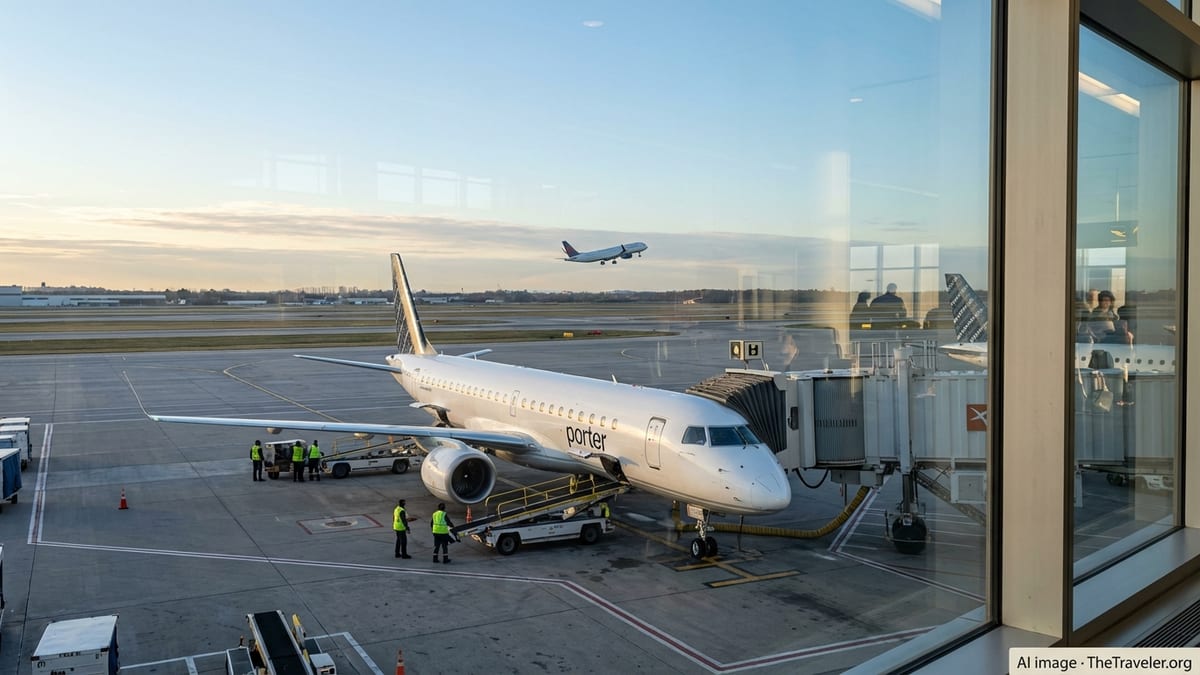
Porter Airlines is set to shake up transborder travel between Canada and the United States this spring, announcing new year-round nonstop service between Toronto Pearson International Airport and Austin-Bergstrom International Airport that positions the Toronto-based carrier as a fresh rival to Air Canada and United Airlines on the increasingly important Toronto–Austin corridor.
New Toronto–Austin Route Launching in May 2026
Austin-Bergstrom International Airport confirmed that Porter Airlines will become its newest carrier when it launches nonstop service from Toronto Pearson International Airport on May 21, 2026. The flights will run five times weekly on a year-round basis, adding a new Canadian player to one of Texas’s fastest-growing air travel markets.
The route, operated with 132-seat Embraer E195-E2 aircraft, is designed to give Central Texas travelers a direct link to Canada’s largest city and a major global hub for business, finance and culture. For Porter, it marks another step in a wider North American expansion strategy anchored around its growing jet fleet and multi-airport presence in the Greater Toronto region.
Airport leaders in Austin describe the service as a critical addition to the airport’s international network, citing strong demand for direct links to Canada even amid a softer overall U.S.–Canada travel environment. The flights are scheduled as year-round rather than seasonal, signaling Porter’s confidence that both business and leisure demand can support the route beyond peak travel months.
Tickets for the new service are expected to go on sale shortly through Porter’s usual sales channels, giving both Canadian and U.S. travelers time to incorporate the new option into summer and fall travel plans.
Challenging Air Canada’s Lead and United’s One-Stop Network
Porter’s arrival on the Toronto–Austin route puts it in direct competition with Air Canada, which currently operates the only nonstop service between the two cities. Airline schedule data for May 2026 show Air Canada providing several thousand weekly seats in the market when Porter begins operations, underscoring how much of the existing nonstop capacity flows through the country’s largest carrier.
United Airlines does not operate a nonstop Toronto–Austin flight but is a major one-stop player in the corridor, connecting passengers via its U.S. hubs. Travelers currently see multiple United itineraries linking Toronto and Austin with connections through airports such as Newark, Washington Dulles or other hub cities, offering schedule flexibility but adding time and the risk of missed connections.
By inserting a second nonstop operator into the market, Porter is effectively challenging Air Canada’s dominance on point-to-point Toronto–Austin traffic while also presenting an attractive alternative to United’s connecting services. Travel industry analysts expect this competitive dynamic to place downward pressure on fares, particularly in economy cabins, as airlines vie for both high-yield business travelers and price-sensitive leisure passengers.
The route also highlights a broader contest for share in the transborder Canada–U.S. market, where Air Canada remains the capacity leader and United is a powerful partner through the Star Alliance network. Porter’s rapid growth is forcing incumbents to rethink how they deploy aircraft and price services on routes that connect fast-growing U.S. cities with Canadian hubs.
Porter’s Expansion Strategy and the Embraer E195-E2 Advantage
The Austin announcement forms part of a wider Porter expansion built around the Embraer E195-E2, a new-generation narrowbody jet that has enabled the airline to extend beyond its original short-haul turboprop network. Porter has placed firm orders for dozens of E195-E2 aircraft, with additional purchase rights, and has been steadily adding routes from Toronto Pearson and other Canadian gateways as deliveries continue.
The E195-E2 gives Porter a cost and comfort platform suited to mid-range markets like Toronto–Austin. The aircraft’s lower fuel burn and quieter operation reduce operating costs and environmental footprint, while the all-economy two-by-two seating configuration eliminates middle seats and supports the carrier’s premium-leaning value proposition.
Porter has been leveraging this fleet to pivot from a primarily regional player into a North American operator with reach into the southern United States, the Caribbean and Latin America. Recent launches such as Toronto–Cancún and Toronto–Phoenix illustrate how the airline is using the E195-E2 to attack leisure and business routes historically dominated by larger legacy airlines.
With Austin, Porter is applying the same playbook to a tech and creative economy corridor, betting that its product differentiation and efficient jets can win over travelers who might otherwise default to Air Canada, United or another U.S. carrier.
Passenger Experience: A Different Take on Economy Travel
Porter has built its brand around offering an upgraded experience within an all-economy cabin, and the Toronto–Austin service is expected to showcase that formula. Onboard the E195-E2, passengers will find two service tiers: PorterClassic, which includes complimentary snacks and beverages, and PorterReserve, an all-inclusive option with additional legroom, priority services and fresh meals on longer flights.
The airline emphasizes small but tangible perks such as free beer and wine served in glassware, a touch that sets it apart from many North American carriers that have pared back in-flight offerings in economy cabins. Fast, complimentary Wi-Fi and power outlets at every seat are designed to appeal to business travelers heading to or from Austin’s thriving tech ecosystem, as well as leisure passengers looking to stay connected.
Importantly for many travelers, the absence of middle seats on the E195-E2 creates a more comfortable cabin layout compared with traditional single-aisle aircraft configured three-by-three. This layout can be particularly attractive on a flight of around three and a half hours between Toronto and Austin, where personal space becomes a key factor in carrier choice.
Porter executives argue that this combination of comfort and value allows the airline to compete head-to-head with full-service incumbents while still offering pricing that appeals to cost-conscious travelers. The new Austin service will be an early litmus test of how that positioning plays in a market where premium leisure and tech-centric business traffic are both in strong supply.
Austin’s Growing Global Profile and Why Toronto Matters
Austin has rapidly evolved from a regional Texas capital into a major international destination for technology, culture and live music. The city’s airport has been hunting for additional transborder and long-haul routes to keep pace with robust population growth and surging visitor numbers, making Porter’s entry a timely addition.
For local tourism officials, a nonstop link to Toronto is particularly valuable. Toronto is not only Canada’s largest urban center and financial hub but also a significant origin point for international visitors heading to the United States. A direct Austin connection positions the Texas city to capture more Canadian and international travelers who might otherwise route through larger U.S. gateways like Dallas, Houston or Chicago.
City and tourism leaders in Austin have highlighted how easier access from Canada could boost visitor numbers for major events such as music festivals, technology conferences and sports fixtures. They also point to Austin’s growing reputation among Canadian travelers as a year-round destination for food, culture and outdoor recreation in the Texas Hill Country.
On the Canadian side, the new route gives Toronto-area residents and businesses a more convenient way to access Austin’s innovation economy. Technology companies, startups and corporate travelers can now move more efficiently between the two ecosystems, strengthening a corridor that has already seen increasing cross-border investment and collaboration.
How the Route Reshapes Competition for Air Canada and United
Porter’s move into the Toronto–Austin market arrives at a complex moment for transborder air travel. Overall demand for Canada–U.S. flying has been under pressure, with some Canadian carriers trimming certain U.S. routes. Against that backdrop, Porter is moving in the opposite direction, placing a bet that targeted growth into high-potential U.S. cities can pay off even as other segments soften.
For Air Canada, the immediate impact is a direct rival on a route where it has enjoyed first-mover advantage. The flag carrier will face a competitor that offers a differentiated onboard experience and a smaller, more flexible fleet that can adjust capacity without the same overheads associated with larger mainline jets. Air Canada may respond with pricing, schedule tweaks or loyalty program incentives to defend its share of the corridor.
United’s position is more nuanced. While it does not offer a nonstop Toronto–Austin flight, it is a key connector in the market through its U.S. hubs, and it benefits from feed generated by its partnership with Air Canada. Porter’s nonstop option could siphon off some passengers who prefer to avoid connections, particularly among business travelers for whom time and reliability are paramount.
At the same time, Porter’s codeshare relationship with American Airlines, agreed in 2025, could gradually reshape connecting flows in favor of American’s U.S. network. As Porter grows its Pearson operation and adds more southern U.S. destinations, travelers from cities like Austin may increasingly use American’s hubs and spokes via Porter’s Canadian feed, adding another layer of competitive complexity in the broader North American market.
Network Synergies: Chicago, Deer Lake and Beyond
The Austin launch is one of three new routes Porter is adding in 2026 as it deepens its North American footprint. Alongside Toronto–Austin, the airline will start seasonal Ottawa–Deer Lake service in June and shift its long-standing Toronto City–Chicago route from Midway to Chicago O’Hare in September, increasing frequencies in the process.
These moves are interconnected. By moving Chicago flights to O’Hare and adding more daily frequencies, Porter strengthens its connectivity at both ends of the route, making it easier to build itineraries that link regional Canadian markets with major U.S. cities via Toronto. Austin slots neatly into that network, giving travelers more options to connect through Pearson while also feeding traffic onto Porter’s growing roster of sun and leisure destinations.
For Austin, the route opens fresh one-stop access to a range of Canadian cities that Porter serves beyond Toronto, as well as to newer vacation markets in Mexico and the Caribbean. This enhances Austin’s appeal as both an origin and destination point for Canadian travelers who prefer to remain on a single carrier where possible.
From Porter’s perspective, combining Austin with Chicago O’Hare and Deer Lake in the same wave of announcements underscores its strategy of balancing business-heavy routes with leisure and regional services, allowing the airline to smooth demand and optimize aircraft utilization across seasons.
What Travelers Can Expect as Launch Date Approaches
With just a few months until the first Toronto–Austin flight, travelers on both sides of the border will be watching closely for schedule specifics, introductory fare levels and potential loyalty tie-ins. Porter has a history of using sharp launch pricing to stimulate demand on new routes, particularly when entering competitive markets.
Corporate travel managers and conference organizers may also look to lock in group or negotiated rates on the new service, especially for events that draw significant Canadian participation to Austin. The city’s tech sector, university community and cultural institutions are expected to be early adopters of the route, using the nonstop link to streamline cross-border collaboration.
Operationally, the use of the E195-E2 should support a robust on-time performance profile, provided airport congestion and air traffic constraints are managed effectively at both Pearson and Austin-Bergstrom. The combination of modern aircraft, free onboard connectivity and Porter’s cabin service model is likely to become a core part of the airline’s marketing message as it courts travelers who have grown accustomed to tradeoffs between price and comfort.
For now, what is clear is that Porter’s entrance into the Toronto–Austin market adds a new layer of competition and choice in a corridor that links two of North America’s most dynamic cities. How Air Canada, United and their partners respond will help determine whether the new status quo results in lower fares, improved service or a fresh round of network realignments across the transborder landscape.