

More news on this day
Portland, Maine has adopted a substantial increase in per-passenger cruise fees, sharpening a regional debate over how New England ports balance booming visitor numbers with strained waterfront infrastructure and rising environmental concerns.
Get the latest news straight to your inbox!
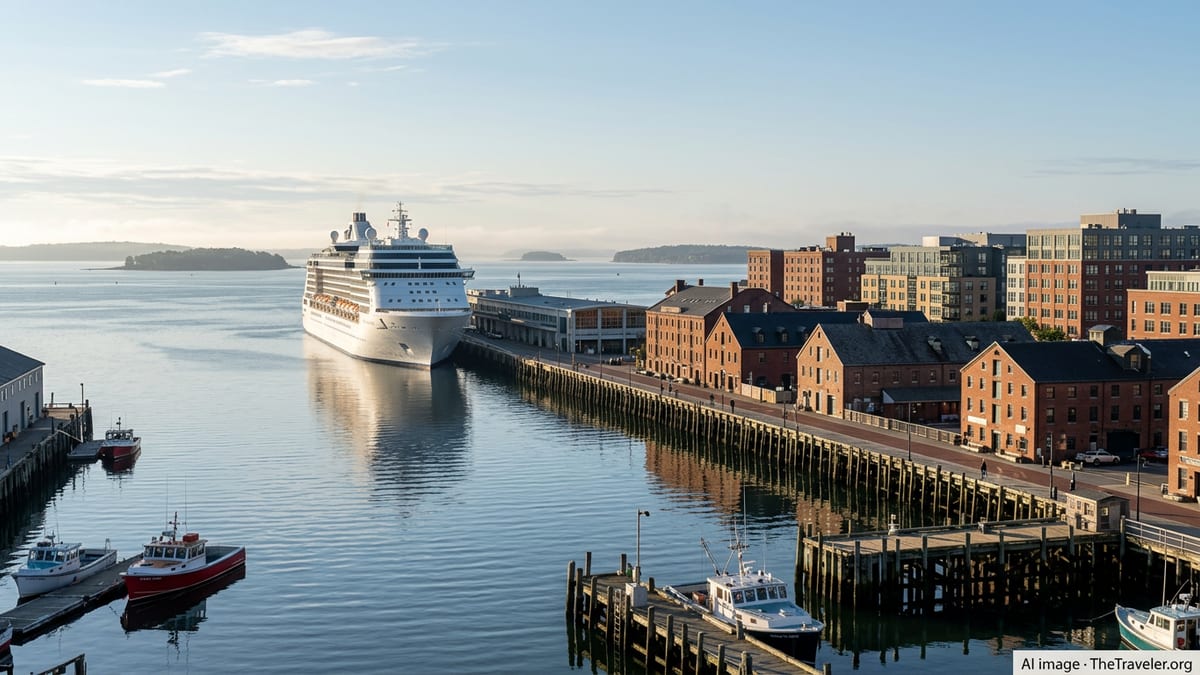
New Fee Structure Targets Large Cruise Vessels
Publicly available tariff documents for the Port of Portland indicate that per-passenger charges on larger cruise ships will rise from 18 dollars in 2024 to 19 dollars in 2025 for vessels carrying more than 1,000 passengers. The fee is made up of a 17 dollar passenger charge and a 2 dollar infrastructure component, according to those published schedules, and applies to manifested passengers upon arrival.
The latest schedule, adopted through the city’s harbor tariff process, extends a pattern of steady increases that has accelerated in recent years. Port data sheets show that in 2019, the total per-passenger charge for large vessels stood at 14 dollars, increasing in small annual steps before jumping from 16 dollars in 2023 to 18 dollars in 2024, and now 19 dollars for the 2025 season.
For smaller vessels, a parallel structure applies, with a lower base passenger fee but the same 2 dollar infrastructure charge. Earlier city budget materials describe cruise revenues as a significant line item supporting the maintenance and operation of municipal waterfront assets, including the Ocean Gateway International Marine Passenger Terminal on the eastern waterfront.
Although one dollar per passenger may appear modest, the increase is significant at the scale of contemporary cruise traffic. Portland’s busiest days see multiple large ships in port, collectively bringing several thousand visitors and generating six-figure fee totals over the course of a single week in the peak season.
Growing Cruise Arrivals and Strain on the Working Waterfront
The fee hike comes as Portland’s cruise calendar has expanded into a months-long season centered on late summer and fall foliage voyages along the New England and Canadian Maritimes coast. Cruise industry information and local tourism campaigns increasingly highlight Portland as a marquee stop, thanks to its historic Old Port district, restaurant scene, and access to Casco Bay and inland excursions.
City budget documents and regional economic studies referenced in local coverage have attributed tens of millions of dollars in annual spending to cruise passengers and crew, including retail purchases, dining, guided tours, and transportation. Supporters of the sector argue that these visitors help smooth seasonal swings in the tourism economy and support jobs at the working waterfront, from longshore and security staff to tour operators and small retailers.
At the same time, the growth in calls has highlighted capacity constraints along Commercial Street and the narrow streets of the Old Port. Residents and business owners have described crowding on peak days, increased traffic from tour buses idling near the piers, and pressure on public spaces such as piers, parks, and waterfront promenades. Commenters in local forums frequently point to days when the combined capacity of ships at berth approaches or exceeds 8,000 passengers, roughly a tenth of Portland’s population.
These pressures have fueled debate over whether the city should continue to court more and larger vessels or pivot toward fewer, higher-value calls. The new fee schedule is emerging as one tool for managing that balance, with the potential to generate more revenue per passenger while testing the willingness of cruise lines to absorb or pass on the higher charges.
Environmental Concerns Shape Policy Discussions
Alongside economic arguments, the latest fee increase is unfolding amid heightened concern about the environmental footprint of cruise tourism in Casco Bay. Regional and national reporting on cruise emissions has drawn attention to air quality impacts from ships burning heavy fuel oil at berth, as well as the role of exhaust scrubbers that can shift pollution from air to water.
Portland-based advocacy groups, including local climate action networks, have circulated petitions calling for additional pollution-related fees on visiting ships. Public discussions documented in meeting materials and community campaigns have raised ideas such as charging for emissions, restricting the use of open-loop scrubbers in port waters, and requiring ships to use cleaner distillate fuels or plug into shoreside power when docked.
Environmental advocates argue that per-passenger increases should be explicitly linked to mitigation measures, including investments in air quality monitoring, electrification of the waterfront, and protections for Casco Bay’s sensitive marine ecosystems. Some point to the scale of modern vessels, noting that a single large cruise ship can temporarily rival small cities in population and energy use when alongside the pier.
Cruise industry representatives, in their public materials, highlight ongoing efforts to modernize fleets, improve fuel efficiency, and explore alternative fuels. They also emphasize the economic benefits that ships bring to ports like Portland, asserting that partnerships with local authorities can fund greener infrastructure over time.
Regional Context: New England Ports Reassess Cruise Economics
Portland’s decision to approve higher cruise passenger fees reflects a broader reassessment of cruise economics across New England. In Bar Harbor, voters previously endorsed strict daily limits on disembarking passengers, while town leaders continue to refine disembarkation rules and licensing frameworks in the face of litigation and industry pressure. Other Maine communities, such as Belfast, have moved to sharply restrict cruise traffic, citing navigational constraints and the desire to preserve small-town character.
Beyond Maine, debates over cruise-related fees and regulations have also surfaced in ports such as Newport, Rhode Island, where state legislation has allowed the city to consider tripling its cruise head tax. In that case, business groups and some local leaders have warned that steeper fees could prompt cruise lines to drop the port in favor of alternative New England calls, underscoring how price-sensitive itineraries can be in a competitive regional market.
Portland sits somewhere between these models, continuing to welcome a substantial cruise presence while gradually increasing charges and exploring potential environmental conditions. The city’s mix of commercial fishing, ferry operations, recreational boating, and cruise activity means that decisions about fee structures and operating rules ripple across a diverse working waterfront.
Analysts following the sector note that ports which successfully align cruise policies with community expectations often pair higher fees with clear reinvestment plans, visible air and water quality improvements, and strong communication about the benefits and limits of cruise tourism. Observers in Portland are watching whether the latest fee increase will be accompanied by similarly concrete measures.
What Higher Fees Could Mean for Future Seasons
The immediate financial impact of Portland’s higher per-passenger cruise fees is likely to be increased revenue for waterfront operations and capital projects, assuming current call volumes hold. Over time, that additional income could help fund seawall repairs, terminal upgrades, and potential electrification projects that allow ships or adjacent facilities to draw on shore power rather than running auxiliary engines at berth.
Whether cruise lines will adjust itineraries in response remains an open question. Industry commentary on other ports suggests that marginal fee increases are often absorbed into broader pricing strategies, particularly when the underlying destination is considered highly marketable to passengers. Portland’s reputation as a picturesque, walkable city with easy access to coastal scenery may help preserve its place on popular Canada and New England routes even as costs rise.
For residents, the effect of the new structure is likely to be measured less in ticket prices and more in how the city chooses to allocate new revenues and refine operating rules. Advocates for stricter controls hope that higher fees will support stronger environmental safeguards and more robust enforcement of idling, waste management, and navigation rules. Business groups, meanwhile, are watching closely to ensure that policy changes do not discourage visitors who sustain seasonal employment in hospitality and retail.
As Portland prepares for the next cruise season under the updated tariff, the city’s experience will offer a test case for medium-sized ports trying to reconcile a growing share of global cruise traffic with climate commitments and quality-of-life priorities along historic waterfronts.