

More news on this day
Portugal has joined a fast-growing club of destinations, including Panama, the Dominican Republic and Estonia, that are using new visas, tax tweaks and upgraded infrastructure to lure travelers who want more than a two-week vacation.
Get the latest news straight to your inbox!
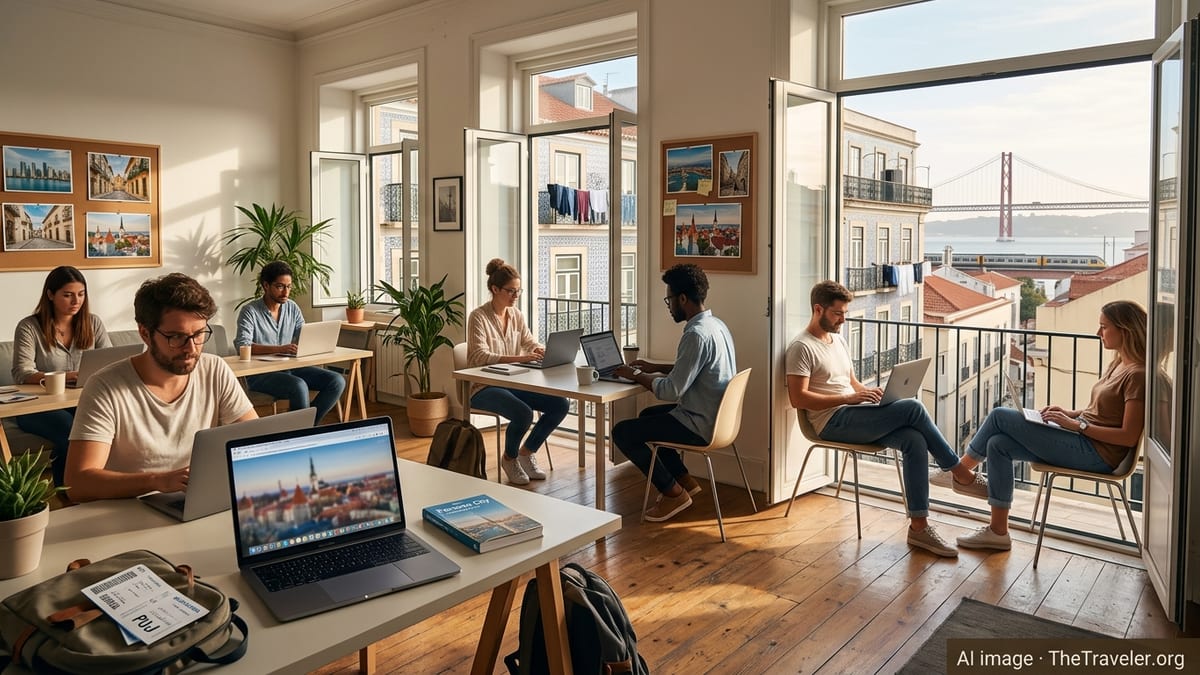
Portugal’s New Playbook: From Weekend Break to Working Base
Once known mainly for city breaks in Lisbon and Porto or beach holidays in the Algarve, Portugal is now positioning itself as a long-stay base for remote workers and slow travelers. Publicly available information shows that since late 2022 the country has offered a dedicated remote work visa that allows non European Union citizens to live in Portugal while earning income from abroad, provided they meet minimum income thresholds and carry health insurance.
Policy changes in 2024 and 2025 have altered some of the tax incentives that previously drew a surge of foreign residents, but recent guidance and relocation reports indicate that the country still offers a comparatively attractive mix of lifestyle, safety and cost of living. While a popular tax regime for new residents has been phased out for most applicants, newer frameworks continue to target certain skilled professionals and remote workers, keeping Portugal on the radar for globally mobile talent.
For travelers, the appeal goes well beyond paperwork. Portugal combines compact geography with strong rail and air links, making it easy to pair a week of surfing in Ericeira with wine country in the Douro or hiking in the Azores. Remote work hubs in Lisbon, Porto and coastal towns have seen coworking spaces, coliving projects and English language services expand in step with demand, according to recent relocation and property market analyses.
All this means that Portugal is shifting from a short-stay destination to a place where visitors can realistically test life in Europe for six months or longer. For anyone looking to turn a bucket list city into a temporary home, the country’s evolving visa options, dense transport network and growing international communities make it one of 2026’s defining “work from anywhere” experiments.
Panama: A Tax-Friendly Bridge Between Oceans
On the other side of the Atlantic, Panama has been refining its pitch as a strategic base between North and South America. Government information and independent visa guides describe a Short Stay Visa for Remote Workers that lets eligible foreigners live in the country for up to nine months, with a possible extension, while working for employers or clients abroad. Income requirements are clearly defined, and applications are routed through the national immigration service.
What sets Panama apart is its long-standing territorial tax system, under which foreign-sourced income is generally not taxed locally. Comparative tax indexes and digital nomad rankings in 2025 highlight this framework as one reason the country regularly appears near the top of lists of cost-efficient bases for remote professionals. English is widely spoken in business districts and tourism corridors, and the use of the US dollar alongside the local balboa simplifies everyday spending for many visitors.
Infrastructure is another part of the story. Reports on transport and connectivity point to Panama City’s role as a major air hub, with extensive connections throughout the Americas and beyond, as well as strong broadband coverage in urban areas. This combination makes it easy for travelers to blend regional exploration with frequent trips back to North America or Europe.
For bucket list planners, Panama offers more variety than its corporate skyline suggests. Within a few hours of the capital are Caribbean islands, Pacific surf beaches and highland coffee towns, all reachable while keeping a stable home base in the city. For travelers who value ease of access, predictable tax rules and year-round tropical weather, the country is increasingly framed as a practical alternative to more saturated hotspots.
Dominican Republic: Mass Tourism Upgrades With a Connectivity Edge
The Dominican Republic has long been synonymous with all-inclusive resorts, but recent tourism and aviation coverage shows that it is moving to become a more connected regional gateway. Government and industry reports highlight record visitor numbers in 2024 and note that total arrivals now exceed the country’s population, cementing its status as one of the Caribbean’s most visited nations.
According to published coverage of air services negotiations, the Dominican Republic is pursuing new and updated agreements with a range of countries in Europe, the Middle East and the Americas to expand direct flight options. The World Economic Forum’s latest travel and tourism competitiveness data cited in local media place the country near the top of regional rankings for tourism infrastructure and prioritization, underscoring investments in airports, roads and services.
For travelers, this focus on connectivity translates into more non-stop routes to resort areas such as Punta Cana and Puerto Plata, but also to cities that are better suited to extended stays and cultural exploration, including Santo Domingo and Santiago. Urban neighborhoods are seeing a rise in boutique hotels, serviced apartments and restaurant openings that cater to visitors who want to experience the country beyond resort enclaves.
At the same time, safety advisories and regional security reports encourage visitors to stay informed and choose neighborhoods and operators carefully, especially when venturing beyond established tourist areas. For those willing to plan ahead, the payoff can be substantial: colonial architecture, mountain landscapes, music scenes and coastal escapes within a few hours’ drive of major airports. Combined with improving air links, these factors are pushing the Dominican Republic higher on many travelers’ lists for both short, affordable escapes and longer winter stays.
Estonia: Europe’s Digital State Turns Visitors into Stakeholders
Far from the tropics, Estonia is redefining what it means to welcome international visitors by treating them as potential participants in its digital state. The country’s e-residency program, introduced in 2014, allows foreigners to establish and manage Estonian companies online, and recent statistics cited by European remote work platforms indicate that more than 100,000 people worldwide have obtained this status.
Complementing e-residency, Estonia was among the first in Europe to roll out a formal digital nomad visa in 2020. Recent policy summaries describe short- and long-term options for remote workers who earn a minimum monthly income and can show contracts or business documents tied to clients outside Estonia. In 2025, coverage by visa and relocation services noted the launch and refinement of additional permits for foreign experts and startup founders, positioning the country as a broader hub for knowledge workers.
For travelers, Tallinn’s medieval old town, Baltic coastline and growing food scene are the visible draw, but Estonia’s digital infrastructure may be the bigger differentiator. Public services from tax filing to medical records are largely online, and this digital-first approach has become a showcase for visiting entrepreneurs and technology professionals. Coworking hubs in Tallinn and Tartu often blend local startups with foreign founders who first connected to the country through e-residency or the nomad visa.
As a result, Estonia appears in many 2026 rankings as a place where a short visit can evolve into a more permanent relationship, whether through a remote work stay, a startup venture or simply ongoing business ties. For travelers who want their bucket list trip to open professional doors, it offers an unusually direct path from tourist to stakeholder.
Why These Destinations Are Changing the Game
Seen together, Portugal, Panama, the Dominican Republic and Estonia illustrate a broader shift in global travel. Instead of viewing visitors solely as short-term tourists, these countries are redesigning visas, tax systems and infrastructure to attract people who might stay for months, build businesses or return regularly. Remote work is the common thread, but each destination adds its own angle, from Panama’s tax model to Estonia’s digital state, Portugal’s lifestyle proposition and the Dominican Republic’s air connectivity.
For travelers, the practical effect is a wider range of choices about how to experience a place. A bucket list trip no longer has to be a one-off holiday; it can be a pilot project for a new base, a season of remote work or the start of a multi-year relationship with a country. With policy experiments and infrastructure upgrades accelerating into 2026, these four destinations have moved from niche picks to trendsetters in how travel, work and life abroad intersect.