

More news on this day
Portugal is rolling out a new smartphone app at Lisbon Airport designed to speed up border checks for non-EU travellers, positioning the country at the forefront of Europe’s efforts to digitise passport controls and ease chronic congestion at one of the continent’s busiest tourist gateways.
Get the latest news straight to your inbox!
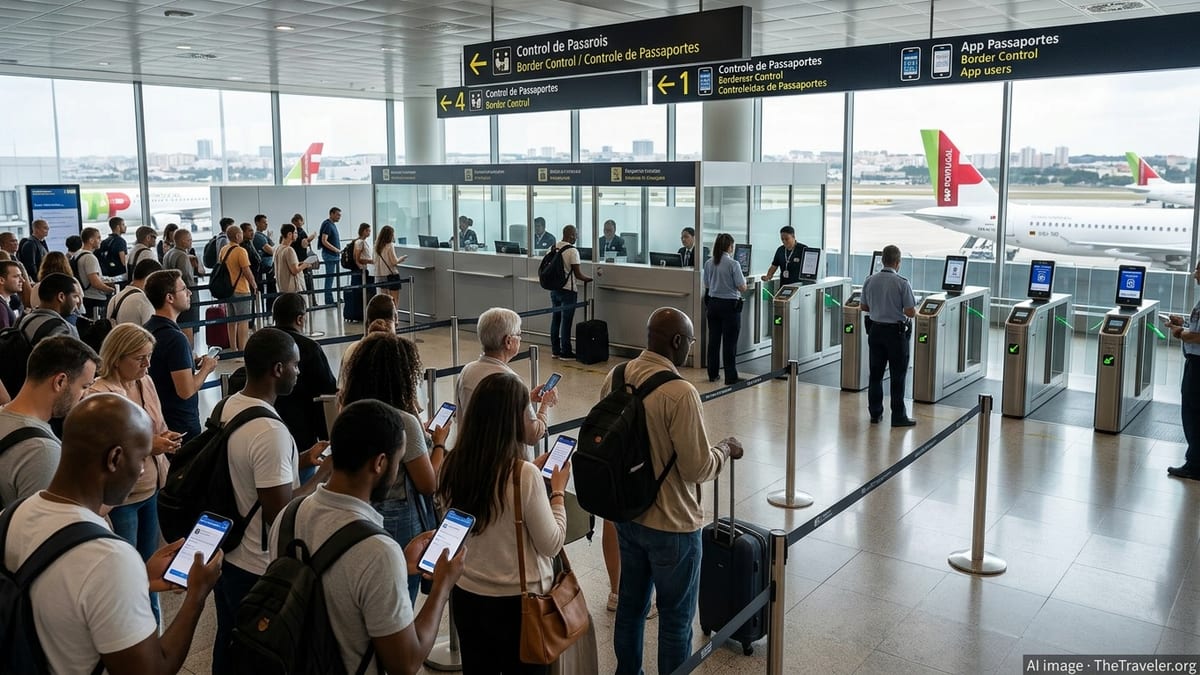
New Digital Tool Targets Long Queues at Lisbon Arrivals
The new "Travel to Europe" mobile application allows non-EU passengers arriving in Portugal to pre-register key information needed for Schengen border checks before they land in Lisbon. Publicly available information indicates that the app, developed under a wider European Union initiative, is being introduced first at Humberto Delgado Airport before a gradual expansion to other Portuguese airports.
Reports describe the app as a pre-check tool that lets travellers input passport details and biometric data in advance, with the goal of reducing the time spent at manual booths on arrival. Once in the terminal, users are directed to dedicated lanes where border officers can access the pre-submitted data, completing only the final verification steps in person.
The launch comes after months of headline-grabbing queues at Lisbon’s passport control, particularly since the phased introduction of the EU’s Entry/Exit System for non-EU nationals in late 2025. News coverage has pointed to waits of several hours during peak periods, alongside concerns about staffing levels and terminal capacity, turning border control into one of Lisbon’s main passenger pain points.
According to published coverage in Portuguese and international outlets, the government has already committed several million euros to new equipment and e-gates at Lisbon, but implementation is staggered over the next few years. The app is being framed as a near-term measure that can be deployed more quickly than large-scale infrastructure changes, while still aligning with the long-term shift to biometric border management across the Schengen area.
How the Travel to Europe App Works for Passengers
Guidance available to travellers indicates that the Travel to Europe app is aimed primarily at non-EU citizens who will be subject to biometric registration under the Entry/Exit System. Before travelling, users download the app, create a profile and scan their passport, after which they can submit required data ahead of arrival at an external Schengen border such as Lisbon.
The app reportedly supports digital capture of biometric identifiers, such as facial images and fingerprints, so that much of the data entry normally undertaken at a border kiosk can be completed remotely. At Lisbon Airport, this is intended to shorten each individual interaction at the booth, allowing officers to process more travellers in the same time frame without cutting corners on security checks.
Once on the ground, passengers who have completed pre-registration are expected to follow specific signage to queues configured for app users, similar in concept to the way some airports separate holders of trusted-traveller or mobile passport programmes. The system still requires a face-to-face check and physical presence at the border, but removes part of the manual form-filling and on-the-spot biometric enrolment that has slowed lines since the new rules took effect.
Compared with earlier digital initiatives focused mainly on customs declarations, this new app is integrated with Europe’s broader Entry/Exit architecture. Travel industry analysis suggests that, if the technology functions as planned, it could become a template for other high-traffic Schengen hubs that have struggled with the transition to fully biometric controls.
Lisbon Airport as a Testbed for Europe’s Smart Borders
Lisbon has a long track record as an early adopter of border technology, having previously hosted European pilot projects for so-called smart borders and biometric e-gates. Airport operator ANA and technology partners have already introduced a separate "Biometric Experience" app for select departing passengers, allowing them to pass through security and boarding using facial recognition instead of paper boarding passes.
Public information from ANA shows that this biometric boarding programme began at Lisbon and Porto in early 2024 before extending to Faro, Madeira and Ponta Delgada, giving Portugal a head start in handling large volumes of biometric data in an airport setting. The new Travel to Europe border-control app sits on the arrivals side of the journey, effectively complementing these earlier departures-focused trials.
Industry publications have highlighted Lisbon as one of several major gateways that the European Border and Coast Guard Agency, Frontex, is using to test digital tools intended to make the Entry/Exit System workable at scale. The city’s combination of heavy seasonal tourism, growing intercontinental traffic and a compact, capacity-constrained terminal has made it an important proving ground for technology that must cope with real-world surges in passenger numbers.
If the Lisbon rollout demonstrates meaningful reductions in wait times without compromising border security, analysts expect the app to be extended rapidly across Portugal’s other international airports and recommended to partner states. In that scenario, travellers transiting Europe in 2026 and 2027 could encounter similar pre-registration options at multiple gateways, making the experience more predictable across the Schengen zone.
Balancing Passenger Experience and Security Concerns
The introduction of the app comes against a backdrop of intense scrutiny of border procedures at Lisbon Airport. In late 2025 and early 2026, European assessments and media reports drew attention to both overcrowded arrival halls and operational shortcomings in security processes, prompting Portuguese authorities to authorise additional investment, temporary deployment of military personnel and a wider review of infrastructure.
Travel and tourism bodies have warned that persistent bottlenecks risk damaging Portugal’s reputation as a convenient entry point to Europe, particularly among long-haul visitors who often arrive exhausted from overnight flights. For airlines and tour operators, the knock-on effects include delayed departures, missed connections and increased customer service workloads when passengers are held up at border control.
Proponents of the new app argue, in public commentary, that shifting part of the data-collection burden out of the arrival hall can help reconcile security requirements with a smoother passenger experience. By enabling border agencies to receive and pre-screen information earlier, the system is intended to focus the in-person check on verifying identity and travel intent rather than typing details into terminals or coaching first-time visitors through unfamiliar forms.
Nevertheless, some observers caution that digital tools can only partly offset constraints such as physical space, staffing and the complex rules that govern who can use automated e-gates. For the app to achieve its goals, it will need to be supported by clear communication, reliable hardware at the border line and enough personnel to handle both pre-registered and traditional passengers during peak hours.
What Travellers Should Expect in the Coming Months
For now, the Travel to Europe app is described as an optional convenience rather than a mandatory requirement. Non-EU passengers planning trips to Lisbon in the coming months are being encouraged, by travel advisers and online forums, to download and experiment with the tool while still budgeting generous time for passport control, especially during summer and holiday peaks.
Those who do not use the app will continue to be processed under existing procedures, which combine manual booths with a limited number of e-gates that are only available to certain nationalities and passport types. As the Entry/Exit System moves toward full enforcement in 2026, travellers can expect more widespread use of fingerprint and facial scans, regardless of whether they opt into mobile pre-registration.
Travel industry coverage suggests that further changes are likely at Lisbon Airport as new e-gates are installed, additional booths are brought online and staff from the Public Security Police receive extra training and equipment funded through recently approved multi-year budgets. Passengers may notice periods of transition as works are carried out, systems are tested and signage is updated.
For visitors, the key message emerging from current reports is to be prepared for a more digital border experience. Having documents ready, understanding eligibility for e-gates and considering tools such as the Travel to Europe app can all help minimise delays, even as Lisbon Airport and its partners work through the complex task of modernising border control at one of Europe’s most popular city gateways.