

Driving across Portugal is one of the most rewarding ways to experience the country’s wildly varied landscapes, from vine-covered valleys and medieval hill towns to windswept Atlantic cliffs and golden southern beaches. Compact, safe and threaded with good highways and scenic back roads, Portugal is ideal for a one or two week road trip that links its greatest hits with quieter corners most visitors never see.
How Long You Need And When To Go
The classic road trip across Portugal runs roughly north to south between Porto and the Algarve, with Lisbon and the Alentejo in between. To enjoy it without rushing, plan at least 10 days. With a full two weeks you can add time in the Douro Valley, detours to historic monasteries in central Portugal, and slower days in small towns. If you only have a week, focus on Porto, the Douro, Coimbra, Lisbon and nearby coastal stops, then fly or take a fast train to the Algarve at the end.
Spring and autumn are the best seasons to drive this route. From April to early June, the countryside is green, river levels are high and the Atlantic coastline feels fresh rather than blustery. September and October often bring warm seas in the Algarve, grape harvest buzz in wine regions and generally clearer roads after the peak of August holidays. July and August are very busy along the coast and in major cities, with higher prices and heavier traffic on main highways, especially around Lisbon and Porto.
Winter road trips are entirely possible, though you will meet rain, cooler temperatures and shorter days. On the plus side, major sights are quieter and accommodation is usually cheaper outside Christmas and New Year. The northern interior can feel chilly and damp, but southern Portugal, particularly the Alentejo and Algarve, often enjoys crisp blue skies and mild days, which work well for hiking and coastal walks.
Regardless of the season, build in at least one slower day every three or four driving days. Distances in Portugal are not huge, but detours to viewpoints, wineries, small villages and coastal lookout points always take longer than they look on the map. Allowing extra time lets you respond to the unexpected: a village market you stumble upon, a viewpoint you decide to hike to, or a beach you do not want to leave.
Driving Basics, Tolls And Rental Tips
Portugal’s main highways are modern and generally well maintained, and driving is on the right-hand side with standard European road markings. Speed limits typically sit around 50 km/h in towns, 90 km/h on rural roads and up to 120 km/h on motorways unless otherwise signed. It is compulsory for all occupants to wear seat belts, and mobile phones can only be used hands-free while driving. Roundabouts are common; vehicles already on the roundabout have priority, and you are expected to signal both lane changes and your exit.
The majority of long-distance routes rely on tolled motorways. These use a mix of traditional toll booths and fully electronic systems where overhead gantries record your license plate. Rental companies usually offer a Via Verde transponder, which automatically registers your tolls and bills them to your contract at the end of the rental. This is by far the easiest solution, especially if you will be using roads such as the A1 between Lisbon and Porto or electronic-only stretches in the north and Algarve.
If you decline a transponder, you may still be able to pay traditional tolls with cash or card at booths, while electronic tolls must be settled separately within a short time window at post offices or designated shops. This can be inconvenient for visitors who are constantly on the move, so it makes sense to clarify the toll policy at the rental desk and budget an additional amount for toll fees on top of fuel and rental costs. Highway fuel stations are frequent, with more rural stretches requiring a bit of advance planning so you do not run low while exploring the interior.
When you collect your car, carefully photograph existing damage, check that required safety equipment such as reflective vests and a warning triangle are on board, and program your first destination into your navigation system before leaving the lot. In cities like Porto and Lisbon, traffic can feel fast and parking is often tight. It is often easier to pick up the car as you depart a city rather than on arrival, or to use central garages and avoid narrow old-town lanes altogether. In rural regions and coastal stretches, by contrast, driving is usually relaxed and enjoyable, with light traffic outside of holiday weekends.
Day 1–3: Porto And The Douro Valley
Begin your road trip in Porto, a characterful city on the Douro River with steep cobbled streets, tiled facades and historic wine lodges. Spend at least one full day without the car here, exploring on foot and by tram, riding the riverside promenade and crossing the famous iron bridge that links the city with Vila Nova de Gaia. The old center is compact, but its hills can be demanding, so allow time to simply linger in riverfront cafes and soak up the atmosphere before you start driving.
Once you pick up your car, your first major excursion should be into the Douro Valley. As you drive east out of Porto, the landscape begins to fold into terraced hillsides lined with vines and olive trees. The most scenic stretches hug the river between towns such as Peso da Régua and Pinhão, where roads wind between steep slopes and viewing pullouts give sweeping perspectives of the valley. Plan at least one overnight in a rural guesthouse or wine estate so you can enjoy tastings without worrying about driving and watch the light change over the terraces at sunset.
In the Douro, daily driving distances do not need to be long. You might base yourself in Pinhão or nearby villages and spend a day following quiet roads that climb above the river to tiny hamlets, chapels and miradouros, or viewpoints. Boat trips along the Douro add another perspective and help you understand how challenging this terrain once was for transport before modern infrastructure. Keep in mind that local roads can be narrow and winding, sometimes without guardrails, so drive slowly, use lower gears and yield courteously to local traffic.
After two nights in the Douro, make your way back toward the coast or south into central Portugal. You can return to Porto directly if you want another night in the city, or you can cut south through the interior toward Lamego and Viseu. This route gives you more varied scenery and positions you well for the next leg to Coimbra and the central heartlands.
Day 4–5: Coimbra, Central Portugal And The Silver Coast
From the Douro or Porto, drive south toward Coimbra, an atmospheric river city known for one of Europe’s oldest universities. The highway route is straightforward and relatively quick, while slower national roads pass through small towns and agricultural landscapes if you prefer a more leisurely pace. Plan to arrive in Coimbra by mid-afternoon, drop your car at a hotel with parking and explore the compact historic core on foot, from the hilltop university quarter to the riverside promenade.
Coimbra makes a convenient base to explore central Portugal’s cultural highlights. Within a reasonable driving radius lie several of the country’s most important monasteries and pilgrimage sites. To the west, you reach the so-called Silver Coast, a stretch of Atlantic shoreline punctuated by fishing towns, broad sandy beaches and dramatic surf spots. You could spend a morning inland browsing Coimbra’s traditional shops and cafes, then drive out to a coastal town later in the day for a walk along the waterfront and a relaxed seafood dinner before returning to the city.
Alternatively, you might devote a day to the monumental monasteries of inland central Portugal. Driving south you can detour to a series of historic complexes and fortified towns that reveal how deeply history is layered into the landscape here. Even a single stop at a large Gothic monastery or walled town will give a sense of the region’s former strategic importance and religious influence. Distances are modest, but many visitors underestimate how long it takes to fully appreciate these vast stone complexes and their surrounding towns.
Overnight again in Coimbra or in a smaller nearby town depending on your preferences. If you favor nightlife, student energy and a range of dining options, Coimbra has more to offer. If you prefer quiet evenings, consider a rural inn in the hills or a coastal guesthouse on the Silver Coast. Either way, aim to be positioned within an easy morning drive of your next major destination: Lisbon.
Day 6–8: Lisbon And Surrounds
From Coimbra, continue south toward Lisbon on the main north-south motorway or via slower coastal roads. Arriving in Lisbon, it is wise to choose accommodation with secure parking or to drop your car at a rental office and rely on public transport within the city. Lisbon’s core neighborhoods are compact but hilly, with trams, funiculars and elevators linking different levels of the city. Driving in older areas brings steep, narrow streets and limited parking, which most visitors find more stressful than useful.
Devote at least two full days to Lisbon itself. Wander the historic quarters, taking in viewpoints that open toward the river and the red-tiled roofs of the city. Visit riverside districts where Portugal’s Age of Discoveries is commemorated in grand architecture, and explore newer neighborhoods that showcase the country’s contemporary culture, food and design. Evenings are best spent in lively squares and restaurant-lined lanes, sampling regional dishes and listening to live music in intimate venues.
Once you are ready to leave the city, collect your car again if you returned it on arrival, or simply drive out from your Lisbon base to the surrounding region. West of the capital, a string of beach towns and resort villages face the Atlantic, while inland, forested hills hide palaces and estates built as summer retreats for nobility. This area is extremely popular at weekends and in high season, so visit early in the day if you can, and park in official lots rather than trying to force your way into congested historic centers.
At the end of your Lisbon stay, you can either continue driving south into the Alentejo or, if you are short on time, drop the car and take public transport toward the Algarve. For a full road trip across the country, though, keeping the car and heading into the open scenery of the Alentejo adds some of the most memorable days of the journey.
Day 9–10: Alentejo Plains, Hill Towns And Wine Country
Leaving Lisbon, cross the broad river and watch as the urban landscape fades into cork oak forests, wheat fields and vineyards. This is the Alentejo, a vast, sparsely populated region of rolling plains, whitewashed villages and fortified hill towns. The driving shifts here from busy multi-lane highways to longer, quieter stretches where you may go many kilometers without passing another car. Keep an eye out for slow-moving tractors, roadside livestock and stretches without frequent fuel stops, and enjoy the sense of space and big skies.
One of the most satisfying ways to experience the Alentejo is to choose a central hill town as a base and explore in a slow loop. Many towns have historic centers encircled by medieval walls and crowned with castles. From these ramparts, you can often gaze across a patchwork of fields, olive groves and reservoirs. Days here tend to take on a gentle rhythm: coffee in a village square, a leisurely drive to another small town, a long lunch under vine-shaded terraces and a late-afternoon stroll through narrow lanes glowing warm in the low sun.
Wine tourism is increasingly well developed in parts of the Alentejo, with estates offering tastings, cellar visits and accommodation set amid vineyards. If you plan to sample generously, arrange tours that include transport or designate a non-drinking driver. Alternatively, limit your tastings and bring back bottles to enjoy later at your accommodation. Rural guesthouses and converted farm stays are an excellent choice in this region, delivering quiet nights, starlit skies and often excellent home-style cooking that showcases local olive oil, pork dishes and seasonal produce.
After two nights in the Alentejo, you will be perfectly placed to continue south toward the Algarve. You can either follow the main inland motorway all the way to the south coast, or angle southwest onto smaller roads that reach the Atlantic first, then follow the shore into the Algarve. This decision shapes the feel of your final days, so consider whether you crave more open countryside or are ready to meet the ocean again.
Day 11–14: Algarve Coast, Cliffs And Villages
The Algarve is Portugal’s most famous coastal region, stretching along the country’s southern edge with a series of fishing towns, modern resorts and dramatic cliffs. Approaching from the north or northwest, you will first meet quieter stretches where small villages sit near undeveloped coves and the coastline feels wild and exposed. Farther east, around more built-up areas, the atmosphere becomes livelier, with promenades, marinas and clusters of hotels and apartments catering to holidaymakers.
Allow at least three nights in the Algarve to unwind at the end of your road trip. Base yourself according to your interests. If you want surf, windswept headlands and fewer crowds, stay toward the western side or along the less-developed Atlantic stretch. For calmer waters, wide sandy beaches and more amenities within walking distance, choose a town on the central or eastern coast. Everywhere, you will find seafood-focused restaurants, beachside bars and a relaxed, sun-drenched rhythm of life devoted to the sea.
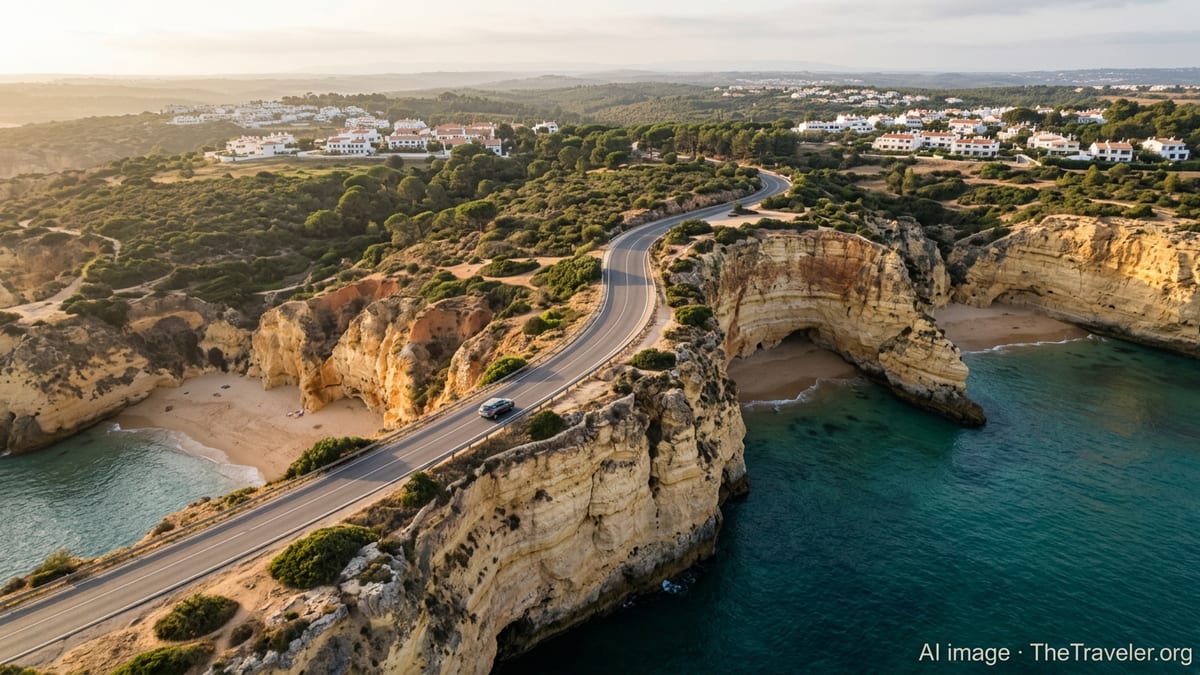
During the day, drive short distances along the coast, stopping at viewpoints where the cliffs drop steeply into clear water and natural arches and sea stacks punctuate the shoreline. Simple parking lots near trailheads lead to short walks along the cliff tops, where you can look back along the coast and see how far you have come. Boat trips from various towns offer access to sea caves and sheltered bays that are difficult to approach by land, and in good weather, kayaking or stand-up paddleboarding opens yet another perspective.
On your final day, you can either drive east to the border before looping back to your departure airport, or simply choose one last favorite beach and do very little. Many travelers finish their trip in a city with a well-connected airport, dropping their rental car before a final evening stroll and dinner. Others loop back north on the motorway to Lisbon or even Porto if they have additional days. However you end the journey, building in a buffer day for rest and practicalities such as laundry and packing helps you return home feeling restored rather than exhausted.
The N2: A Scenic Alternative Spine
Parallel to the fast motorways, Portugal has a legendary national road that runs almost the entire length of the country from the north to the Algarve. Often compared to other iconic long-distance routes, this road threads through the interior rather than hugging the coast, linking spa towns, river valleys, plateaus and rural communities that many travelers never see. It is slower than the highways but rewards patience with a constant stream of local color and varied scenery.
Driving this route from end to end is best suited to those with at least two weeks, or to return visitors who have already explored the main coastal and urban highlights. Surface conditions are generally good, but there are still winding stretches, occasional roadworks and narrow passages through villages. This is a route to linger on, stopping for coffee at simple roadside cafes, chatting with shopkeepers and staying overnight in family-run guesthouses where your arrival may be a small event.
You can also weave the national road into the broader itinerary rather than following it continuously. For example, from the Douro you might dip onto a particularly scenic segment that snakes through terraced vineyards before rejoining the motorway toward Coimbra. In the Alentejo, a stretch of the route carries you past reservoirs, cork forests and small towns with whitewashed houses and vivid trim, giving you a different perspective from the straighter, busier expressways.
Because the national road crosses a wide range of regions, weather, traffic and services can vary along its length. In high summer, interior sections can feel very hot in the afternoons, while in winter, fog or rain can slow driving and limit visibility. Check your fuel level often, especially if you have been meandering off into side roads, and remember that in many small towns, supermarkets and petrol stations may close earlier on Sundays or during mid-day breaks.
Practical Tips For A Smooth Road Trip
A successful Portugal road trip blends planned highlights with room for spontaneity. To strike this balance, book accommodation for your main bases, especially in Porto, Lisbon and key coastal areas, while leaving some nights flexible in between. This allows you to adjust your pace if you find a region you love and want to stay longer, or if weather prompts you to move on sooner than expected. In busier months, flexibility is easiest in the interior, where visitor numbers are lower and last-minute rooms are more readily available.
Navigation is straightforward with modern mapping apps, but it helps to verify driving times against those estimates. Short distances on the map can still take time because of winding terrain, unexpected roadworks or small-town traffic. Keep some coins or a back-up card on hand for parking meters and smaller fuel stations, and be prepared that not every rural business will accept international cards. Learning a few basic Portuguese phrases for greetings and thanks goes a long way, particularly in regions less accustomed to international tourism.
Always carry water and small snacks in the car, especially when driving in warmer months or over long distances through sparsely populated areas. Rest areas on major highways are frequent, but smaller roads may have fewer formal stops. Take advantage of village cafes to pause, stretch your legs and experience everyday local life. When parking, avoid leaving valuables visible in the car and use guarded lots where possible in larger cities and resort towns.
Finally, remember that the enjoyment of a road trip across Portugal lies as much in the journey as in the destinations. Some of your strongest memories will likely come from unplanned detours, roadside viewpoints discovered on a whim and quiet evening walks through towns you had barely heard of before you arrived. By building a solid backbone itinerary and allowing space for such moments, you give yourself the best chance of a trip that feels both efficient and richly textured.
FAQ
Q1. How many days do I need for a Portugal road trip from north to south?
Most travelers are comfortable with 10 to 14 days for a full route from Porto to the Algarve, which allows time in the Douro, central Portugal, Lisbon, the Alentejo and the southern coast without constant rushing.
Q2. Is it better to start in Porto or Lisbon?
Starting in Porto and ending in the Algarve via Lisbon creates a natural north to south flow, but you can easily reverse the route; in practice, availability of flights and rental car deals usually decides where you begin.
Q3. Do I really need a car for this itinerary?
You can connect major cities by train and bus, but a car gives far more flexibility to explore wine regions, small villages, beaches and viewpoints that are difficult or slow to reach with public transport.
Q4. How expensive are tolls on Portuguese highways?
Toll costs vary by distance and route, and can add up on long motorway segments; it is sensible to set aside a dedicated portion of your budget for tolls and to ask your rental company how charges will be handled.
Q5. Is driving in Portugal safe for visitors?
Most visitors find driving in Portugal straightforward, with good road conditions on main routes; the main challenges are adjusting to local driving habits in cities and taking extra care on narrow rural roads.
Q6. What type of car should I rent for this trip?
A compact or mid-size car is usually ideal, offering enough space for luggage while remaining easy to maneuver and park in older towns with tight streets and limited parking space.
Q7. Can I do this road trip in winter?
Yes, you can drive this route year-round; winter brings more rain and shorter days, especially in the north, but it also means quieter attractions and often mild, sunny conditions in the Alentejo and Algarve.
Q8. Is it difficult to park in cities like Porto and Lisbon?
Parking in historic centers can be challenging and expensive, so it is usually easier to choose accommodation with parking or to leave the car in a secure garage and explore central neighborhoods on foot or by public transport.
Q9. Should I book accommodation in advance along the route?
In peak months and in very popular coastal areas, advance booking is wise, while in the interior and outside high season you can often combine some planned stays with a few flexible nights for spontaneous detours.
Q10. Can I end my trip in a different city from where I started?
Yes, many rental companies allow one-way rentals within Portugal, so you could, for example, start in Porto and drop the car in Faro or Lisbon, though a one-way fee may apply and should be factored into your budget.