

Portugal and Greece both promise sun-soaked shores, whitewashed villages and long, lazy evenings over seafood and local wine. Yet they deliver very different versions of a Mediterranean (and Atlantic) dream. One is a compact country at Europe’s western edge with wild surf and soulful cities; the other a sun-bleached mosaic of islands and ancient sites in the Aegean and Ionian seas. If you are torn between Portugal and Greece, understanding how their beaches, culture, food scenes and travel logistics compare will help you pick the coastal escape that fits you best.
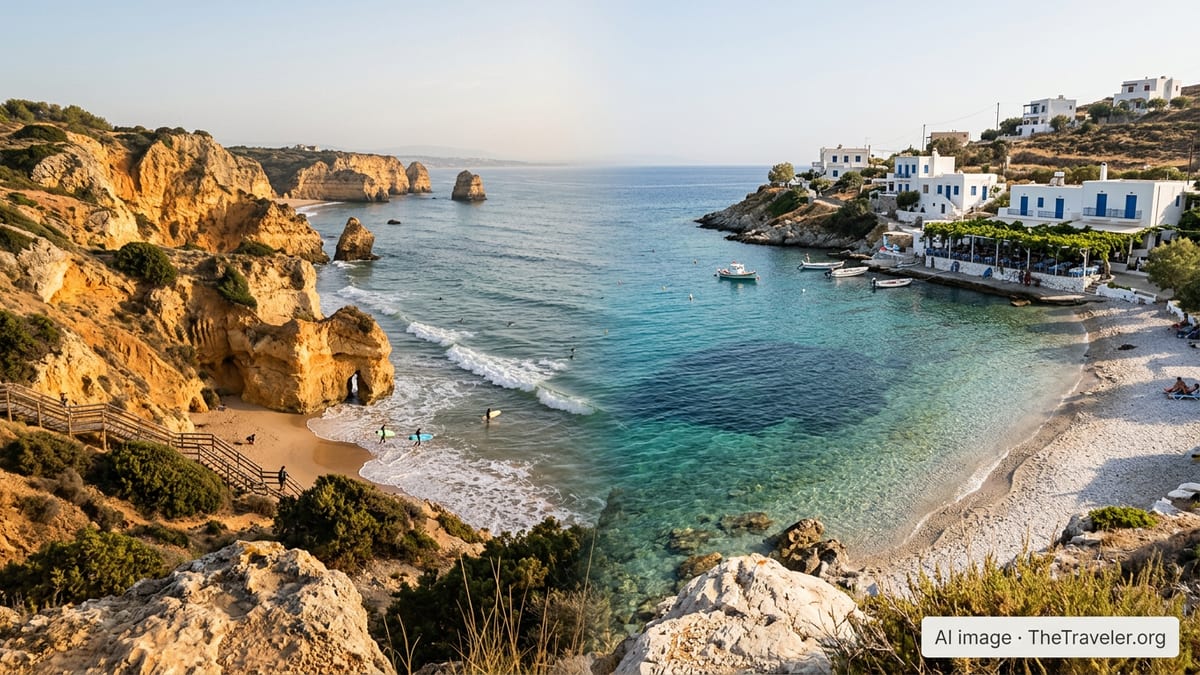
Coastlines in Contrast: Atlantic Drama vs Island Dreamscapes
Portugal’s coast runs for roughly 1,800 kilometers including islands, facing the open Atlantic. The result is a landscape of big skies, strong swells and sculpted cliffs, especially in the Algarve and along the Alentejo coast. Signature beaches such as Praia da Marinha near Caramujeira, framed by orange limestone cliffs and clear water, showcase the country’s dramatic geology and have frequently appeared in global “most beautiful beaches” lists. Further north, long, wind-brushed strands near Porto and Vila Nova de Gaia appeal to walkers, surfers and travelers who prefer space to sprawl over tight coves.
Greece is the opposite in character: thousands of islands and islets scattered across the Aegean and Ionian seas, with deeply indented coastlines and a patchwork of coves, bays and lagoons. Crete alone offers everything from pink-sand Elafonissi and the lagoon at Balos to more rugged, wave-exposed shores. In the Ionian Sea, islands such as Zakynthos and Kefalonia are home to the cliff-backed beaches that dominate postcards and social feeds. Navagio (Shipwreck) Beach, Myrtos and Porto Katsiki are classic examples, where glowing turquoise water meets sheer white rock.
For beachgoers, this means a different feel from the moment you arrive at the water. Portugal’s Atlantic setting brings a sense of openness and power, often with larger waves and cooler temperatures that appeal to surfers and strong swimmers. Greek beaches, particularly on sheltered islands, tend to offer calmer seas, warmer water in high summer and an enveloping sense of enclosure, with cliffs or hillsides forming a natural amphitheatre around many bays.
The choice between them often comes down to personality. If you want broad horizons, surf culture and a mix of urban and natural waterfronts, Portugal’s coast will likely speak to you. If you dream of hopping among islands, anchoring in protected coves and swimming in bathtub-warm shallows, Greece’s fragmented shoreline is hard to beat.
Beach Experiences: Surf, Seclusion and Signature Sands
On the ground, a typical beach day plays out differently in Portugal and Greece. In Portugal, the Atlantic waves shape both activities and atmosphere. The country has become one of Europe’s key surf destinations, from beginner-friendly breaks around Lagos and Sagres to the spectacular big-wave arena of Nazaré, where winter swells attract elite surfers and spectators. Even in more relaxed resort areas, beach kiosks advertise surf lessons and board rentals alongside sun loungers.
Many Portuguese beaches are wide and open, backed by dunes or cliffs with wooden boardwalks and small cafes at the top. Praia da Marinha and its neighbors in the central Algarve are more intimate, reached by staircases cut into cliffs, but the prevailing feel is still of strong nature rather than a sheltered lagoon. Away from the Algarve, the Costa Vicentina in the southwest and the less-developed Silver Coast north of Lisbon offer more secluded sands, coastal trails and fishing villages that feel worlds apart from high-rise tourism.
In Greece, the hero beaches are often protected coves or shallow lagoons with milder waves and a decidedly laid-back rhythm. On Crete, Elafonissi’s pale, sometimes pink-tinted sand and knee-deep water are ideal for families and less confident swimmers, while Balos Lagoon offers a Caribbean-like palette of white sand and blue-green shallows. On the Ionian side, Myrtos and Porto Katsiki combine striking views from above with clear, deep water below, rewarding both photographers and swimmers willing to navigate stairs or winding access roads.
Season also matters. Both countries are busiest in July and August, but Portugal’s Atlantic breeze can keep peak heat slightly more bearable, especially in the north. Greece’s island beaches can feel very hot and still in high summer, so early-morning and late-afternoon swims become part of the culture. Shoulder seasons, particularly May, June, September and early October, are attractive in both countries for smaller crowds and pleasant sea temperatures, with Greece generally holding warm water later into autumn.
Beach Infrastructure, Accessibility and Sustainability
Infrastructure around the coast has grown in both Portugal and Greece, but in subtly different ways. Portugal’s beaches, particularly near urban centers, often combine modern amenities with deliberate accessibility features. Projects such as those at Albarquel Beach near Setúbal illustrate a national push toward inclusive beaches, with multilingual signage, solar-powered audio guides and plans for accessible walkways, showers and amphibious wheelchairs so that travelers with limited mobility can reach and enjoy the water.
Blue Flag certification is another lens for comparison. Portugal’s compact coastline includes hundreds of Blue Flag beaches, reflecting regular water-quality testing, lifeguard presence in season and basic facilities like toilets and waste management. This is especially visible around the Algarve, Cascais and the Porto coastline, where well-managed beaches sit close to residential areas and public transport links. Travelers who prioritize lifeguards, showers and nearby services will find it relatively easy to match those expectations in Portugal.
In Greece, beach infrastructure varies dramatically from island to island and even bay to bay. Popular spots on Mykonos, Santorini and along the Athens Riviera can feel highly organized, with pre-bookable sunbeds, beach clubs, loud music and food delivery to your lounger. Elsewhere, particularly on less developed islands in the Cyclades, Dodecanese or Northern Aegean, you will still find beaches with a single taverna or no built facilities at all, where you bring your own shade and supplies.
Sustainability is emerging as a shared concern. Greece has faced localized issues such as jellyfish blooms in some gulfs and pressure on marine ecosystems near heavily visited islands, prompting more conversation about visitor caps, protected marine parks and better waste management. Portugal has been wrestling with coastal erosion on exposed Atlantic stretches and the cumulative impact of record tourism numbers on small seaside towns. In both countries, choosing operators that respect protected areas, carrying out your own litter and following local guidance on dune protection are increasingly important parts of responsible beach travel.
Cultural Atmosphere: Everyday Life by the Sea
Although many visitors focus first on water and sand, the cultural backdrop of each coastline shapes the experience in ways that are hard to quantify but easy to feel. In Portugal, the beach is a natural extension of everyday urban life. In Lisbon, locals jump on trains to Cascais or Costa da Caparica for afternoon dips, while in Porto, tram lines lead toward the Atlantic-front beaches of Foz do Douro and the long stretch of sands in Vila Nova de Gaia. You can spend a morning in a museum or azulejo-tiled church, then be watching surfers within an hour.
There is a reflective, even nostalgic thread that runs through much of Portuguese coastal culture. Fishing villages that reinvented themselves as holiday towns, like Nazaré, still celebrate religious processions and traditional dress, even as surfers arrive for competitions. In seaside taverns you may hear fado, the country’s signature musical form, telling stories of longing and the sea. Even in busier resorts, there is often a mix of locals and visitors that keeps the social fabric more blended than in purely seasonal destinations.
Greek coastal culture, by contrast, feels more explicitly shaped by island life and seasonal rhythms. Many tavernas and small hotels along the water open for the tourist season and then close again as ferries thin out in autumn. On the Cycladic islands, daily life still pivots around the harbor: fishing boats unloading at dawn, cafes filling with both residents and travelers, and evening promenades along the quay as the heat lifts. Traditional music and dance spill into village squares during festivals, with islanders and visitors often joining long lines of dancers to the sound of violins and lutes.
Religion and history are also woven into the shorelines differently. In Greece, tiny white chapels dot headlands and hilltops above beaches, and sacred sites from antiquity through Byzantium sit within reach of coastal resorts. In Portugal, the Catholic tradition emerges in processions, hilltop sanctuaries and seaside pilgrimages, but much of the historic architecture that visitors see lies in inland cores of cities like Lisbon, Porto, Évora and Coimbra rather than directly on the sand.
History, Heritage and Day Trips Beyond the Beach
For travelers who want more than a week on a sunbed, both Portugal and Greece offer deep cultural reserves within day-trip distance of many beaches. Portugal’s strength lies in the ease of combining city and sea within a compact territory. From Lisbon’s center, you can reach the resort town of Cascais, the surf breaks of Ericeira or the palaces of Sintra in under an hour. Similarly, visitors based on the Algarve coast can drive inland to whitewashed hill towns, citrus orchards and megalithic sites in the Alentejo region, seeing a completely different side of the country without long transfers.
Portuguese cities themselves are part of the coastal narrative. Porto’s riverfront, with its port wine lodges in Vila Nova de Gaia and easy access to nearby Blue Flag beaches, allows you to move fluidly between urban culture and the Atlantic. Smaller coastal towns, from Aveiro with its canals to Setúbal beside the Sado estuary, offer slow-paced alternatives with strong local identities and easy access to nature reserves, dolphin-watching trips and hiking trails.
In Greece, the weight of antiquity is often a central reason to visit, even on a beach-focused holiday. Athens, with the Acropolis and its surrounding archaeological sites, pairs naturally with the so-called Athens Riviera, where seaside suburbs and nearby islands provide swimming spots after days spent among ruins and museums. On the Peloponnese peninsula, resorts sit within striking distance of classical sites such as Epidaurus, Mycenae and Olympia, allowing travelers to alternate mornings on the sand with afternoons among amphitheatres and temples.
Many islands layer their own histories atop the coastal scenery. Rhodes and Corfu mix medieval fortifications with beaches; Crete combines Minoan sites and mountain villages with coastal lagoons; and in the northern Aegean and Dodecanese you will find monasteries, Ottoman remnants and neoclassical mansions within a short walk or drive of the sea. Consequently, Greece may appeal slightly more to travelers whose ideal beach holiday always includes a significant measure of historical sightseeing.
Food, Wine and Coastal Dining Culture
Food is often the tie-breaker between close contenders, and both Portugal and Greece make strong cases rooted in fresh seafood and sun-ripened produce. In Portugal, Atlantic fisheries and a long seafaring tradition shape daily menus near the coast. Grilled sardines, octopus, clams and cod appear in countless variations, with each region adding its own twist. Simple seaside restaurants might serve clams with garlic and coriander, grilled dourada (sea bream) and rice stews rich with shellfish.
Wine culture is also highly visible in Portugal, even on the coast. From crisp vinho verde in the north to the white wines of Alentejo and the fortified ports of the Douro, bottles in beachside restaurants often come from vineyards only a few hours inland. Recent years have seen a surge in interest in regional gastronomy, with festivals and events celebrating local produce, including seafood-focused celebrations in Algarve towns that are otherwise known more for nightlife than for culinary tradition.
Greece’s coastal food culture centers on simplicity and freshness. On islands and seaside villages, lunch might be a table of shared mezze plates: fried zucchini, fava spreads, grilled octopus, tomato and cucumber salads glistening with local olive oil, and just-caught fish displayed on ice for you to choose. Tavernas near the beach typically spill onto sand or stone terraces, and meals often stretch for hours as the sun dips and families linger over carafes of local wine or chilled ouzo.
Both countries have seen creative, modern restaurants emerge alongside traditional spots, especially around capital cities and established resort hubs. However, you are still likely to find excellent, unpretentious food within a short walk of many beaches in both Portugal and Greece, often at prices that feel reasonable compared with other Western European coastal destinations. Travelers with dietary restrictions will generally find more explicit vegan and gluten-free labeling in larger Portuguese and Greek cities than in smaller village tavernas, where communicating needs directly with staff remains important.
Costs, Crowds and Seasonal Patterns
When comparing budgets, Portugal and Greece often come out as more affordable than some neighboring Mediterranean countries, but costs vary by region and season. Portugal’s coastal cities and popular Algarve resorts have grown busier and more expensive in peak months as tourism numbers surge, yet overall costs for meals, public transport and mid-range accommodation still tend to undercut many parts of Western Europe. Inland and less-known coastal stretches generally offer lower prices and fewer crowds, particularly outside school holidays.
In Greece, daily costs can swing sharply depending on your island or region of choice. Famous names like Mykonos and Santorini command premium prices for accommodation, beach-club sunbeds and dining, especially in July and August. By contrast, many lesser-known islands or mainland seaside towns remain comparatively budget-friendly, with modest family-run pensions and tavernas that have not fully adjusted to international demand. Ferries, domestic flights and island transfers add another cost layer that is less of a factor in compact Portugal.
Crowd patterns differ too. Portugal’s beaches near major cities serve both locals and visitors year-round, so weekends can be busy even in shoulder seasons. The Algarve can feel heavily seasonal, but many towns retain a year-round population that keeps services open. In Greece, visitor flows track closely with the island ferry timetables. Some islands feel lively from late spring to early autumn and then quiet dramatically; others with larger resident populations remain active, but with far fewer open beach businesses after October.
If your dream is a quiet cove in high summer, both countries require more research and perhaps a willingness to travel farther from main airports and resort belts. If you are flexible on dates, visiting in late May, June, September or early October can dramatically change not just prices but the character of your trip, especially in Greece, where the sea often stays warm well into autumn.
Which Destination Suits Which Traveler?
Because Portugal and Greece share broad appeal but differ in texture, it helps to match each destination to your travel style. Portugal tends to work well for first-time visitors to Europe, families and city lovers who want a straightforward combination of culture and coast without complex logistics. The distances are short, public transport is relatively simple to navigate, and you can base yourself in one or two hubs while sampling multiple beaches and inland sights on day trips.
Portugal may also suit travelers who prioritize surfing, cooler air in peak summer, and a blend of urban and small-town experiences. If you envision splitting time between a characterful city apartment in Lisbon or Porto and a few days on the Algarve or Alentejo coast, Portugal’s compactness plays strongly in your favor.
Greece, on the other hand, is ideal for travelers drawn to island-hopping, boat trips and extended stays in one or two seaside villages. It rewards those willing to plan ferry routes, connect flights and navigate more fragmented geography in exchange for that iconic blend of whitewashed houses, deep-blue sea and archaeological ruins. If you are especially interested in classical history or want your beach days punctuated by visits to ancient theatres and temples, Greece arguably has the edge.
Ultimately, both countries can cater to luxury travelers and backpackers alike. Upscale resorts with private beach access and spa facilities sit within reach of humbler guesthouses and simple rooms to let. The main decision is less about budget than about how much logistical complexity you are comfortable with, how important surf or calm water is to you, and whether city culture or island atmosphere feels more essential to your holiday.
The Takeaway
Choosing between Portugal and Greece for a beach-and-culture escape is less about finding a winner and more about understanding two distinct coastal personalities. Portugal offers Atlantic drama, world-class surf and the ease of combining soulful cities with nearby sands. Its beaches feel grounded in everyday life, and its compact geography allows you to cover a lot of ground without long transfers.
Greece presents an altogether different canvas: a scattering of islands and peninsulas where coves, lagoons and historical sites lie side by side. It is particularly compelling if you dream of island-hopping, long seaside dinners in taverna courtyards and day trips that move smoothly from ruins to rock pools. Its waters tend to be warmer and calmer in summer, and its range of islands means you can tailor a trip from party-heavy to completely tranquil.
For many travelers, the ideal solution is not “Portugal versus Greece” but “Portugal now, Greece next” or the reverse. Both destinations reward repeat visits and deeper exploration. Whether you start with Atlantic waves or Aegean coves, you will find a rich interplay of beach life and culture that makes either choice feel like the right one.
FAQ
Q1. Which destination has better beaches overall, Portugal or Greece?
Both countries have outstanding beaches, but Greece offers more variety in sheltered coves and island lagoons, while Portugal excels in dramatic Atlantic strands and surf-friendly shores.
Q2. Is Portugal or Greece better for families with young children?
Greece often suits families with very young children thanks to its calmer, shallower waters on many island beaches, though Portugal’s organized Blue Flag beaches also work well for family stays.
Q3. Where will I find better surfing, Portugal or Greece?
Portugal is the stronger surfing destination, with consistent Atlantic swells, dedicated surf schools and renowned breaks from the Algarve to Nazaré and the central west coast.
Q4. Which country is generally more affordable for a beach holiday?
Both can be good value, but Portugal often has slightly lower everyday costs in popular regions, while Greece can be very affordable on lesser-known islands away from marquee destinations.
Q5. Is it easier to combine city sightseeing with beach time in Portugal or Greece?
Portugal makes this particularly simple, as cities like Lisbon and Porto sit close to good beaches and can be paired easily with coastal resorts on short journeys.
Q6. Which destination is better if I care most about ancient history and archaeology?
Greece has the edge for classical history, with iconic sites in and around Athens and on the Peloponnese, as well as important ruins scattered across many islands.
Q7. How do crowds compare between Portugal and Greece in peak season?
Both draw heavy summer crowds in famous areas, but in Greece the contrast between busy hotspots and quiet lesser-known islands can be especially pronounced.
Q8. Can I rely on public transport to reach beaches in both countries?
In Portugal, trains and buses link major cities to nearby beaches; in Greece, ferries are crucial for island travel, and local buses or rental vehicles often serve specific beach areas.
Q9. Which is better for food lovers focused on seafood and local cuisine?
Both excel in seafood, but Portugal emphasizes grilled Atlantic fish and regional wines, while Greece leans toward shared mezze, island specialties and simple preparations by the water.
Q10. If I have only one week, should I favor Portugal or Greece?
With a single week, Portugal offers an easier mix of city and coast in one itinerary, while Greece is ideal if you prefer settling on one island or region rather than moving around.