

More news on this day
Portugal is rapidly transforming its clean energy progress into a tourism advantage, using free electric vehicle schemes, low‑carbon mobility perks and a heavily renewable grid to market the country as a laboratory for sustainable travel.
Get the latest news straight to your inbox!
From Green Grid To Travel Incentive
Portugal has spent the past decade overhauling its energy mix, and that shift is now intersecting directly with the way visitors experience the country. Publicly available data shows that the share of electricity generated from renewable sources such as wind, solar and hydro has surged, with targets for 80 per cent renewable power in the national mix brought forward to the middle of this decade. Analysts note that this gives Portugal an unusual selling point: the kilowatt‑hours that charge a car or power a hotel air conditioner are increasingly low carbon.
Travel coverage in Europe highlights how this cleaner grid is being woven into tourism narratives. Reports indicate that rail investments between Lisbon and Porto, including new energy‑efficient electric trains, are being promoted not only as upgrades to capacity and comfort but also as part of a broader climate strategy. For international visitors, that means long‑distance journeys which would once have required high‑emitting flights or rental cars can now be made using electric traction on a grid dominated by renewables.
Environmental policy reviews from multilateral bodies describe Portugal’s tourism strategy as explicitly linked to climate goals, citing government plans that push operators to cut emissions and improve resource efficiency. In practice, that creates a feedback loop for travelers: the more the country decarbonises its electricity and transport, the more compelling its pitch becomes as a destination where leisure spending aligns with climate‑conscious values.
Free Electric Cars And Village Charging Hubs
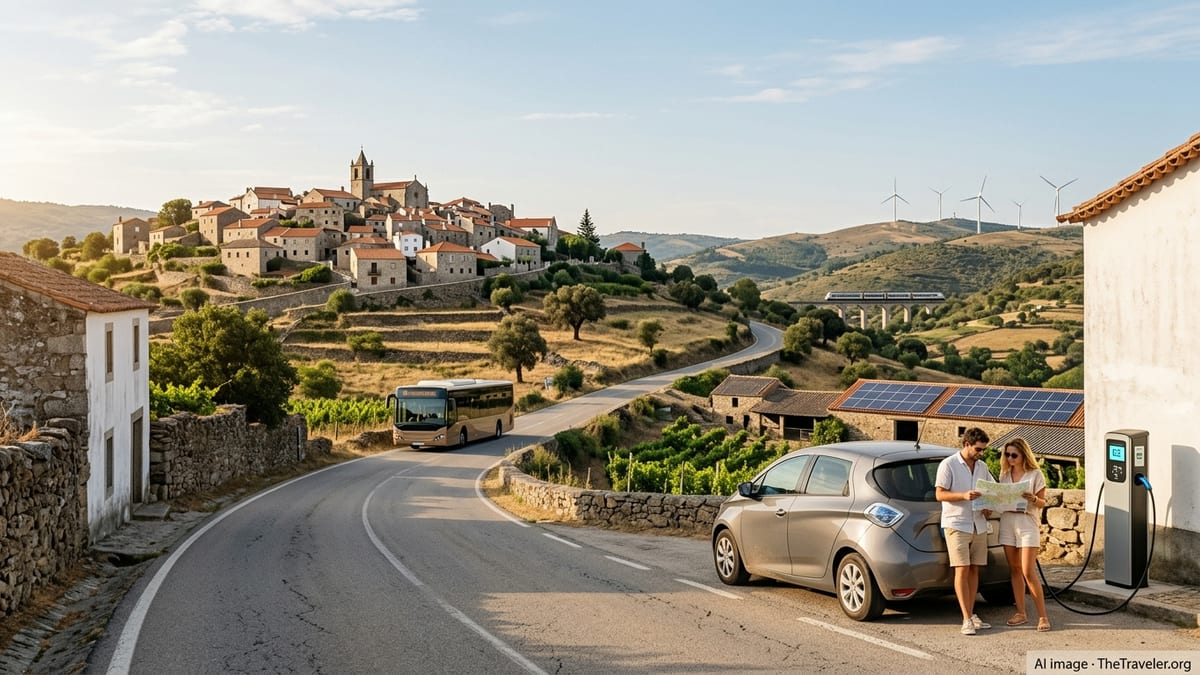
One of the clearest examples of free electricity being turned into a tourism asset is emerging not in Lisbon or Porto, but in rural Beira Interior. Travel features from 2025 describe a scheme in the Aldeias Históricas network of fortified hilltop villages where visitors can borrow an electric car at no charge for day trips around the region. The vehicle use is free for eligible guests, and the power that fuels it is supplied through a network of public chargers in and around the villages, effectively offering tourists free electricity on wheels.
According to those reports, the initiative is framed as a sustainable urban mobility project adapted to a rural context. Guests arriving by train can pick up the electric car in Castelo Novo, then navigate a circuit of medieval settlements using mapped charging points. The cost of the electricity is absorbed by the programme, leaving visitors with a zero‑fare, zero tailpipe emission way to explore remote landscapes that are hard to reach by conventional public transport.
Local sustainability assessments describe how this model tackles several challenges at once. It reduces car traffic from combustion engines, distributes tourism flows beyond the usual hotspots and encourages longer stays in inland areas that often struggle to capture visitor spending. For travelers, the incentive is straightforward: they can experience dramatic countryside and historic architecture while relying on free, quietly delivered electric power rather than petrol stations.
Portugal’s Patchwork Of Free Mobility Experiments
Beyond individual projects, Portugal has become a test bed for wider free or heavily subsidised mobility schemes that indirectly turn electricity into a public good for residents and visitors. In Cascais, on the Atlantic coast west of Lisbon, municipal information describes a Free Mobility Program that eliminated fares on public buses for registered residents, students and local workers. Although tourists do not receive universal free rides, the resulting network of electric and low‑emission buses often provides the same infrastructure used by visitors with standard tickets.
Urban mobility briefings from European institutions detail national measures that include free public transport passes for young people and funding to expand electric vehicle fleets. While many of these subsidies are targeted at residents, they also shape the experience of tourists, who encounter more frequent services, modern rolling stock and cleaner vehicles powered by a decarbonising grid. In cities such as Évora, digital ticketing and integrated payment systems have been deployed alongside newer buses, with sustainability cited as a core objective.
Specialist transport coverage adds that Portuguese cities are tightening access rules for fossil fuel cars in historic centres, particularly in Lisbon, where new low‑emission zones and 30 kilometre per hour speed limits are being introduced in key tourist districts. Visitors arriving by car are nudged toward park‑and‑ride facilities, shared bikes or trams, while those who rely on electricity‑powered transport benefit from quieter streets and cleaner air. The effect is to reframe free or cheap public mobility as part of the cultural experience rather than a purely functional service.
Nature Routes, Cross‑Border EV Trails And Cheap Rail
Portugal’s embrace of electricity as a tourism tool is also visible in nature‑based and cross‑border projects. A European initiative along the Spanish‑Portuguese frontier, documented in sustainability coverage, offers tourists access to electric vehicles to roam a network of protected natural parks with zero tailpipe emissions. Charging is included as part of the experience, allowing visitors to complete long itineraries without paying for fuel or adding local air pollution to sensitive ecosystems.
National tourism strategies promoted by Turismo de Portugal position the country as a destination for cycling, walking and low‑carbon travel, pointing to thousands of kilometres of trails and routes marketed as carbon‑free. Cheap long‑distance rail offers, such as monthly passes that cap ticket costs across regional and intercity lines, have been framed by European media as another way to electrify tourism at scale. While these rail products are not universally free, their pricing, combined with the renewable electricity that powers many services, makes them a central plank of Portugal’s sustainable mobility narrative.
The shift is partly a response to wider European debates over overtourism and climate responsibility. As protests in neighbouring countries put pressure on traditional aviation‑led city breaks, Portugal’s policymakers and tourism bodies are emphasising arrival by train, movement by tram or electric bus, and accommodation supplied by a grid that is progressively shedding fossil fuels. That context helps explain why niche experiments such as free electric car hire in rural hamlets attract outsized attention from travel media.
What This Means For Future‑Focused Travelers
For visitors planning trips in 2026 and beyond, Portugal’s free electricity perks and mobility experiments translate into specific choices. Travelers willing to forgo conventional rental cars can seek out destinations and accommodation partners that participate in free EV schemes or provide complimentary charging, effectively turning the country’s renewable electricity into a tangible on‑the‑ground benefit. In cities, tourists can align with local policy shifts by favouring metro, tram and bus networks that increasingly run on electric traction.
Industry commentators argue that these developments position Portugal as a kind of prototype for how destinations might integrate energy transition goals with tourism growth. Instead of simply offsetting emissions on paper, the country is building physical systems that let visitors experience decarbonisation in daily routines, from tapping a contactless card on an electric bus to gliding silently through vineyard‑lined valleys in a battery‑powered car.
The model is not without constraints. Many of the most generous free electricity offers are geographically limited pilots rather than nationwide entitlements, and debates continue over funding, equity for local residents and the risk of encouraging new forms of overuse in fragile areas. Yet the direction of travel is clear: as Portugal’s grid becomes greener, the incentive to convert that clean power into visible, visitor‑facing benefits will only grow, reinforcing the country’s reputation as a sustainable travel laboratory on Europe’s Atlantic edge.