

More news on this day
Portugal is accelerating plans for a modern high-speed rail network that will slash journey times between its marquee cities, promising travelers a faster and greener way to experience the country’s most compelling urban destinations.
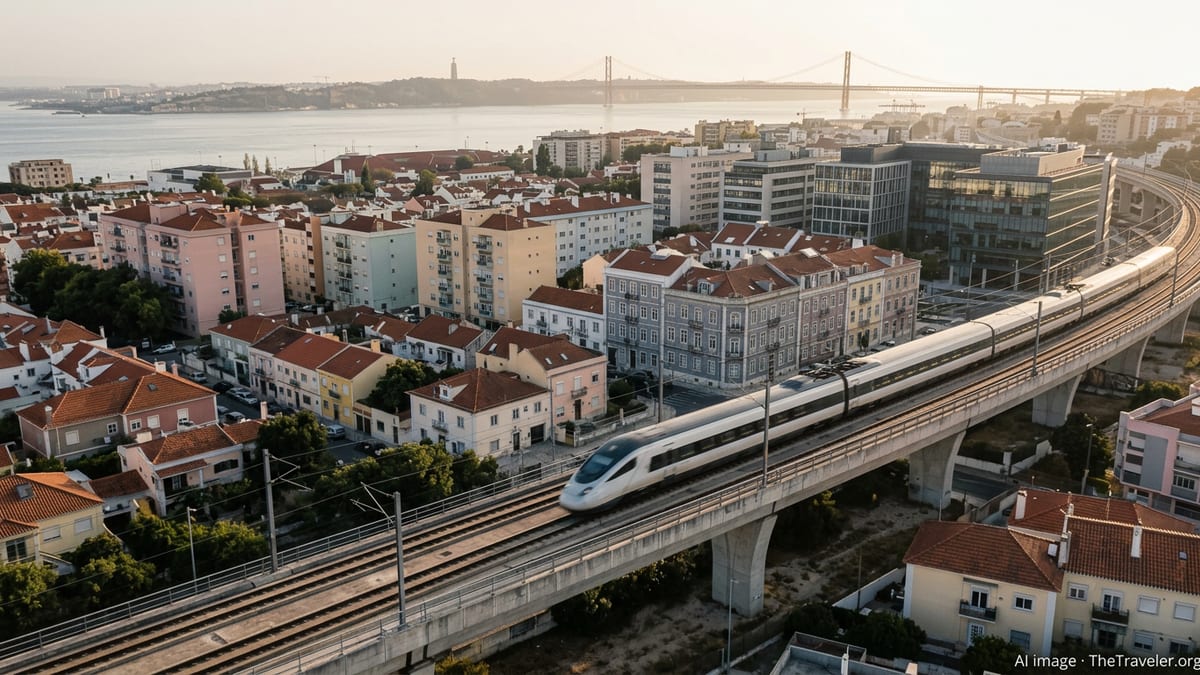
A New Era of Fast, Low-Carbon Travel
For years, Portugal’s backbone for long-distance journeys has been the Alfa Pendular service, tilting trains that already link Lisbon, Porto, Braga and Faro at up to 220 kilometers per hour. By 2026, these services remain the country’s premium option for quick, comfortable trips, carrying visitors between the capital and Porto in just under three hours while sharply undercutting the carbon footprint of a domestic flight.
Now the country is preparing to go further. The government has revived long-discussed true high-speed projects, centered on a dedicated Lisbon–Porto line designed for speeds up to 300 kilometers per hour, along with onward connections to Vigo in Galicia and to Madrid via the eastern border. Officials frame the rail build-out as central to meeting European climate targets and shifting travelers from planes and highways to electric trains powered increasingly by renewable energy.
Political backing has solidified over the past two years, with Lisbon emphasizing high-speed rail as both an environmental commitment and an economic catalyst. Investment plans running to the end of this decade bundle new tracks, upgraded signaling and modernized stations into a national infrastructure push, aiming to integrate Portugal more tightly into the wider Iberian and European rail map.
For visitors planning multi-city itineraries, that evolution means a rapid move away from internal flights towards rail-based journeys that promise shorter station-to-station times, easier city-center access and a smoother, lower-stress way to traverse the country.
Lisbon–Porto: A Flagship Corridor for City Breaks
The Lisbon–Porto corridor is the heart of Portugal’s rail ambitions and already one of Europe’s most scenic city-to-city routes. On today’s Alfa Pendular trains, the journey between the capital’s Oriente or Santa Apolónia stations and Porto’s Campanhã hub typically takes about two hours and forty-five minutes, with onboard Wi-Fi, reclining seats and café service providing an easy alternative to domestic flights or long highway drives.
The upcoming dedicated high-speed line is designed to almost halve that travel time. Government projections and recent technical studies suggest that, once the full Lisbon–Porto route opens in stages over the next decade, journeys could drop to close to one hour and fifteen minutes. Early works on the northern sections and financing packages for additional stretches have been moving forward, even as alignment changes and environmental reviews around Porto continue to generate local debate.
For travelers, the impact would be dramatic. A sub-90-minute rail link between the two largest cities effectively turns Lisbon and Porto into twin bases for a single trip. Visitors could stay in one city and day-trip to the other for galleries, food tours or riverfront strolls, returning in time for dinner. Travel planners already anticipate more flexible itineraries, with three-night breaks that combine Lisbon’s historic neighborhoods and cultural institutions with Porto’s wine cellars and contemporary architecture, all without a domestic flight.
The high-speed investment also folds into wider upgrades along the traditional Linha do Norte, improving reliability and capacity for regional and intercity trains that serve intermediate hubs such as Coimbra and Aveiro. That means better options not only for express travelers but also for visitors who want to hop off and explore university towns, coastal lagoons and river valleys along the way.
New Cross-Border Links: From Lisbon to Madrid and Vigo
Portugal’s high-speed push is not confined within its borders. On the eastern frontier, new tracks between Évora, Elvas and the Spanish city of Badajoz are being built as part of a corridor that will eventually form a high-speed connection between Lisbon and Madrid. Recent reports from infrastructure operators on the Spanish side confirm that the route across Extremadura has been electrified and prepared for higher speeds, a key step toward trimming journey times between Madrid and the Portuguese border.
In Portugal, this first high-speed section toward the frontier is positioned as the country’s initial true 300 kilometer per hour line, with activity reports from engineering and construction groups describing a design aimed at sharply reducing travel times and transport costs. Once signaling systems and cross-border timetables are in place, travelers could see significantly faster services eastward, linking the Portuguese capital with Spain’s high-speed network and opening new multi-country rail itineraries.
To the north, work continues on the long-envisioned high-speed link between Porto and Vigo. While Spanish regional authorities in Galicia warn that bureaucratic delays on their side of the border could push completion into the late 2030s, Lisbon and Madrid both continue to describe Vigo–Porto as a strategic segment of the Atlantic corridor. For travelers, the eventual payoff would be the opportunity to pair northern Portugal’s cities with the Rías Baixas coastline and Santiago de Compostela using fast, climate-friendly trains.
In the interim, conventional and upgraded rail lines are still enabling cross-border journeys, albeit at slower speeds. Tour operators and independent travelers are increasingly promoting combined Portugal–Spain itineraries that rely on rail for the bulk of intercity travel, positioning high-speed projects under construction as a reason to return later in the decade when the network is more fully realized.
What High-Speed Means for Experiencing Portugal’s Cities
Shorter rail journeys are expected to reshape how both international visitors and locals experience Portugal’s cities. With journey times between Lisbon, Porto, Coimbra and Faro already relatively compact on existing fast services, travelers are using trains as moving base camps, stringing together two- and three-night stays rather than anchoring an entire holiday in a single location.
As dedicated high-speed sections open, that trend is likely to accelerate. A visitor landing in Lisbon could spend a morning in the capital’s riverfront districts, catch a midday train to Porto for an afternoon of tasting in Vila Nova de Gaia’s wine lodges, and be back in Lisbon or onward to Coimbra by evening. Similarly, Portugal’s second city stands to strengthen its role as a gateway to the Douro Valley, Minho region and Galicia for travelers who prefer to avoid rental cars and domestic flights.
Improved frequencies and modern rolling stock are also part of the appeal. Recent transport guides for 2026 highlight near-hourly Alfa Pendular departures on the main axis, with advance-purchase discounts making first-class upgrades accessible to many visitors. High-speed investment is expected to free capacity on existing lines, opening the way for more regional trains that reach mid-sized cities and coastal resorts while fast services handle express demand between the biggest hubs.
The convenience advantage over short-haul flights is substantial. City-center stations and minimal security queues translate into door-to-door times that already rival flying for domestic hops. As future high-speed lines compress journey times even further, rail is positioned to become the default mode for visitors combining multiple Portuguese cities in a single trip.
Greener Tourism and the Future of Iberian Rail
Beyond speed and comfort, Portugal’s high-speed rail vision is tied directly to its climate agenda. The country has leaned heavily into renewable power over the past decade, and electrified intercity rail is seen as a way to leverage that cleaner grid by shifting travelers out of cars and short-haul aircraft. European Union funding streams, framed around decarbonization and cross-border connectivity, are helping to underpin the economics of Portugal’s new lines.
Tourism officials are beginning to fold rail into their sustainability messaging, encouraging visitors to choose trains where possible and highlighting the emissions savings compared with driving or flying. Accommodation providers in Lisbon and Porto increasingly promote proximity to major stations as a selling point, anticipating a future in which rail is the principal way international guests move between cities.
The wider Iberian picture reinforces that trend. Spain already operates one of the world’s largest high-speed networks, and the emerging Portuguese links are designed to plug directly into that system, whether via Badajoz for Madrid or via Vigo for northern Spain. As testing ramps up on new sections over the next few years, travelers can expect more through-ticketing options, coordinated timetables and the possibility of high-speed journeys that start in Lisbon and end in Barcelona, Seville or even southern France with only train changes along the way.
For now, visitors heading to Portugal in 2026 will still rely mainly on the existing Alfa Pendular and Intercidades services for fast domestic travel. Yet construction sites along key corridors, shifting tender documents and evolving station plans are clear signs that the country is on the cusp of a high-speed transformation. For travelers willing to plan around rail, that promises a future in which exploring Portugal’s best cities is not only faster and more convenient, but also a more sustainable way to see the country.