

More news on this day
Departures at San Diego International Airport faced delays after a suspected engine problem on an American Airlines flight triggered an emergency response on the airfield, prompting ground holds and schedule disruptions for several evening departures.
Get the latest news straight to your inbox!
Incident on Taxiway Sparks Emergency Response
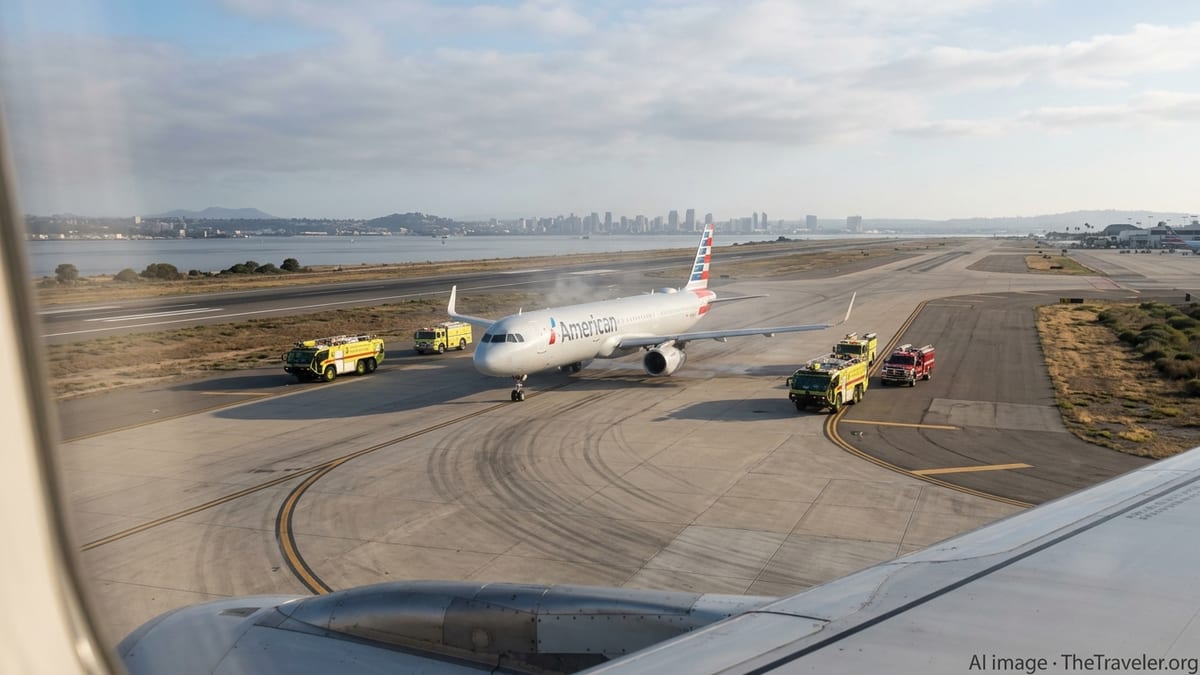
Initial reports from flight tracking data and passenger accounts indicate that an American Airlines narrowbody jet preparing for departure at San Diego International Airport experienced what was described as a potential engine fire while on the ground. The aircraft, operating from the airport known by its code SAN, was reportedly taxiing for takeoff when crew members called for assistance and stopped the aircraft on a taxiway.
Publicly available photos and video circulating on social media show the aircraft surrounded by airport fire vehicles with personnel positioned near one of the engines. Some images appear to capture light smoke in the vicinity of the engine nacelle, although the exact source of the smoke and the extent of any fire activity have not been formally detailed in technical documentation.
According to tracking information, the flight did not depart as scheduled and instead remained stationary for an extended period while emergency crews attended to the situation. Passengers on nearby aircraft reported through online posts that their own departures were halted while the response unfolded close to the active runway.
Delays Ripple Across Departures at SAN
The response to the suspected engine issue had an immediate operational impact on San Diego International, which functions with a single primary runway and limited parallel taxiway space. When an aircraft stops on or near a runway intersection for an emergency check, ground movements can quickly become constrained, and even short-duration events can translate into broader delays.
Flight status boards for several airlines serving SAN showed a cluster of departure delays during the period of the incident. Data from flight tracking platforms suggests that some outgoing flights departed significantly behind schedule, while at least one inbound aircraft executed holding patterns or minor reroutes before sequencing in to land once the taxiway was clear.
Passengers described extended waits on board aircraft already lined up for takeoff, with flight crews referencing an issue ahead involving another aircraft and emergency vehicles on the field. In the compact airfield layout at SAN, such events tend to be highly visible from terminal windows and from aircraft taxiing to the runway, heightening awareness and concern among travelers.
What Is Known About the Suspected Engine Fire
As of the latest publicly available information, the exact nature of the technical issue on the American Airlines aircraft has not been fully detailed. References to a potential engine fire stem largely from passenger descriptions, images suggesting smoke near the engine, and indications that airport fire services treated the event as a precautionary engine-related emergency.
Commercial jet engines are equipped with multiple safety layers, including fire detection loops within the nacelle and fire extinguishing systems that can be activated from the cockpit. An indication of abnormal temperature or smoke can lead crews to shut down an engine immediately, request emergency assistance and keep the aircraft stationary until responders verify the situation externally.
In many past ground incidents described in public aviation records, what is initially reported as an engine fire sometimes turns out to be smoke from an oil or hydraulic leak, a minor fuel burn-off, or even an issue in an auxiliary power unit rather than the main engines. Definitive technical findings typically appear later in formal maintenance or regulatory documents rather than in initial airport reports.
Passenger Experience and Rebooking Efforts
Passengers affected by the disruption reported through social media posts that they were held on board during the emergency response and later returned to the gate after the aircraft was deemed unable to depart as planned. For many travelers, the event meant missed connections at onward hubs and the need for same-day or next-day rebooking.
Publicly accessible flight status data indicates that the American Airlines flight at the center of the incident was ultimately canceled or substantially rescheduled, with passengers moved to alternative departures where space permitted. In similar prior cases at other airports, airlines have typically provided meal vouchers or hotel accommodations depending on the length of the delay, although exact customer care measures in this instance have not been fully detailed in public documentation.
For travelers already in the terminal, the sight of fire trucks surrounding an aircraft and a line of jets waiting for departure added to the sense of unease. Online accounts from the evening describe long queues at customer service counters and crowded gate areas as multiple flights adjusted departure times in the aftermath of the incident.
Safety Context at a Busy Single-Runway Airport
San Diego International handles a high volume of commercial traffic on a single main runway tightly bordered by downtown, San Diego Bay and surrounding neighborhoods. This configuration leaves limited room for operational flexibility when an aircraft becomes immobilized on or near critical taxiways, so precautionary responses can have outsized effects on the schedule even when an event is contained and non-injurious.
Aviation safety records show that engine-related alerts on the ground are not unusual across global airline operations. The majority result in precautionary shutdowns, inspections and maintenance actions rather than structural damage, and events are generally resolved without injuries. The combination of onboard fire suppression systems, rapid response from airport fire services and established cockpit procedures is designed to manage exactly the kind of scenario reported at SAN.
Investigative or maintenance follow-up for the American Airlines aircraft involved is expected to focus on confirming whether any actual fire occurred in the engine nacelle, the cause of any visible smoke and the integrity of engine components and associated systems. Any notable findings commonly appear later in technical service bulletins, airline reliability reporting or, in more serious cases, summaries posted by regulatory agencies.
For travelers, the event reinforces both the disruption that even a single aircraft emergency can create at a constrained airfield like San Diego and the reason such responses are intentionally conservative. Ground stops, diversions and delayed departures are inconvenient, but they form part of a system designed to prioritize safety whenever a potential engine fire or similar anomaly is detected.