

Malaysia rewards curious travelers with big-city skylines, lush highlands, tropical islands and villages rich in tradition. To enjoy all of that without unnecessary stress, it pays to understand how to move around the country, what to expect on arrival, and how daily life actually works on the ground. The following guide focuses on practical, current tips for traveling across Malaysia in 2026, so you can spend less time figuring things out and more time soaking it all in.
Understanding Entry Requirements and Arrival Formalities
Before you even book flights to Malaysia, check the latest entry rules for your nationality through official government channels or your nearest Malaysian mission. Many visitors from Europe, North America and parts of Asia receive visa free stays of between 30 and 90 days, while others must apply for an eVisa in advance. Rules for different passports can change with little notice, and in early 2025 Malaysia extended limited visa free stays for some nationalities from India and China, highlighting the importance of checking current guidance rather than relying on older anecdotes.
Most short term visitors now need to complete the Malaysia Digital Arrival Card, an online arrival form, within a few days before entering the country. This system has gradually replaced older paper cards and is intended to speed up immigration checks, but failure to complete it can still cause delays at the border and occasionally denied boarding. Build in extra time before your trip to fill it out carefully, keep a screenshot or printout of your confirmation, and use the official government platform rather than third party websites that may charge unnecessary fees.
On arrival, immigration procedures at Kuala Lumpur International Airport and other gateways are generally straightforward. Your passport should be valid for at least six months beyond your date of entry, and you may be asked to show proof of onward travel and sufficient funds. Lines can be long at peak times, especially on evenings and weekends when regional flights from across Southeast Asia arrive in clusters. If you are transiting through Kuala Lumpur on a separate ticket, allow generous connection times to clear immigration and check in again.
Health related checks are lighter than during the pandemic years, as Malaysia has lifted most Covid 19 specific requirements. Still, you may be subject to temperature scans or asked to declare recent illnesses, and carrying digital or paper proof of routine vaccinations is sensible. Travel insurance that covers medical care and trip disruption remains highly recommended, especially if you plan to dive, hike in remote areas or drive long distances.
Navigating Malaysia’s Domestic Transport Network
Malaysia is large enough that you need to think carefully about how you will move between regions. For long distances, domestic flights remain the fastest and often most economical way to cover ground, especially between peninsular Malaysia and East Malaysia on the island of Borneo. Several full service and low cost carriers link Kuala Lumpur with Penang, Langkawi, Kuching, Kota Kinabalu and many secondary cities. Booking early usually yields lower fares, and you should account for checked baggage fees on budget airlines when comparing prices.
On the peninsula, the intercity rail system provides a more scenic but slower option. The electric KTM ETS trains connect Kuala Lumpur with towns such as Ipoh, Butterworth for Penang, Padang Besar near the Thai border, and Gemas to the south. Seats are reserved and sell out on weekends and holidays, so buying tickets online ahead of time is wise. While the network is not as extensive or as punctual as some travelers might expect from other parts of Asia, it offers comfortable, air conditioned carriages and a relaxed way to watch the countryside roll by.
Intercity buses fill many of the gaps that trains do not cover. A web of private operators links Kuala Lumpur with destinations like Melaka, the Cameron Highlands, east coast towns, and border crossings. Quality varies between companies, so choose reputable operators when possible, especially for overnight services. Main bus terminals can be busy and confusing at first encounter, but staff and fellow passengers are generally helpful if you ask clearly where to go.
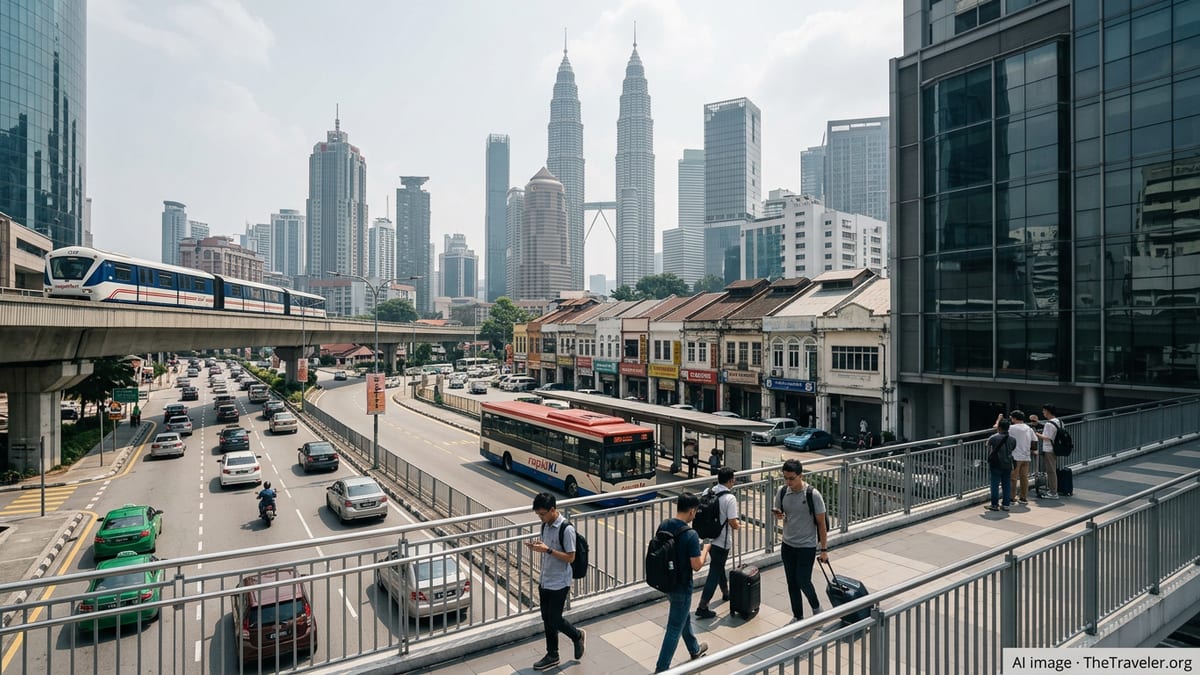
Within big urban areas, especially around Kuala Lumpur and the Klang Valley, you will encounter a patchwork of public transport. Light rail, metro and monorail lines criss cross the capital, joined by commuter rail and a network of buses. The integrated system looks impressive on a map, but in practice you should allow margin for delays, transfers and occasional service disruptions. Many residents combine trains with ride hailing for the first or last leg of a journey, and that approach often makes sense for visitors too.
Using Public Transport, Ride Hailing and Local Taxis
Kuala Lumpur’s LRT, MRT and monorail lines are the backbone of public transport for most visitors. Fares are distance based and relatively inexpensive by international standards. To ride, you can buy single journey tokens at station machines or use a stored value Touch n Go card that also works on many buses and toll roads. For frequent city travel, visitors can consider a daily MyCity pass, which offers unlimited rides on Rapid KL operated trains and buses for a flat price. This pass does not cover the airport rail link or national rail services, so it is most useful if you plan multiple hops around the metropolitan area in one day.
Buses extend coverage into areas not served by rail, but routes and schedules can be harder to grasp at first. Journey planning apps, including the official operator app and popular global mapping tools, have improved coverage of Kuala Lumpur’s system in recent years. Expect longer waits at off peak times, and be prepared for buses that may bunch together or run behind schedule. In many cases, taking a train for the main trunk of the journey and a short bus or ride hailing trip for the final stretch offers the best balance of cost and time.
Ride hailing, particularly through platforms such as Grab, has become one of the most convenient ways for travelers to move around Malaysian cities. Fares within central Kuala Lumpur are often modest, and the app based system reduces the need to negotiate prices or explain exact locations in an unfamiliar language. Surge pricing applies during rush hours, heavy rain or major events, so costs can temporarily spike. If several of you are traveling together, splitting a ride can be cheaper and faster than taking multiple public transport tickets, especially at night when train frequencies drop.
Conventional taxis still operate in many areas but are less dominant than a decade ago. Booking metered taxis through an app or an official stand at malls and airports is safer and more transparent than hailing one on the street. If you do flag a taxi, ask the driver to use the meter and be willing to walk away politely if they insist on a flat fare that seems unreasonable. Compared with some neighboring countries, outright taxi scams in Malaysia are less common, but occasional overcharging does occur in tourist heavy zones.
Money, Costs and Everyday Practicalities
Malaysia uses the ringgit, and cash remains useful, although card and mobile payments are widely accepted in cities and major tourist areas. You will find ATMs in airports, malls and town centers, but machines in more rural areas can sometimes run out of cash or decline certain foreign cards. Notify your bank of your travel plans before departure, and carry at least a modest emergency stash of physical currency in case of network outages or card issues.
Contactless payments via major card networks and digital wallets are increasingly common in urban Malaysia. Many cafes, mid range restaurants, supermarkets and ride hailing apps accept international credit and debit cards. However, small family run eateries, wet markets, rural guesthouses and some taxi drivers often operate on a cash only basis. Keeping a mix of low denomination notes is particularly handy for tolls on highways, temple donations, street food and bus fares outside main cities.
Prices in Malaysia are generally lower than in Western Europe or North America, though the gap is narrowing in prime tourist hotspots and during peak seasons. Accommodation, food and transport in Kuala Lumpur, Penang and popular islands have edged upward in recent years, reflecting strong demand and a growing focus on higher spending visitors. You can still eat affordably at hawker centers and local kopitiams, where basic meals may cost the equivalent of just a few US dollars, but imported coffee, alcohol and international cuisine are often closer to global big city prices.
Electricity runs at 230 volts with the three pin rectangular plug standard also used in the United Kingdom. Many hotels provide multi standard sockets, but you should still pack a suitable adapter and a small power strip if you travel with multiple devices. Local SIM cards and eSIM options are easy to obtain at airports and malls, with several operators offering tourist packages that bundle data and domestic calls at reasonable rates. Coverage across the peninsula is generally strong along main transport corridors, while some remote inland or island locations may have weaker or intermittent signals.
Safety, Health and Respectful Travel
Malaysia is considered a relatively safe destination, and recent official advisories from several governments maintain a broad recommendation to exercise normal safety precautions. Petty crime such as bag snatching and pickpocketing does occur, particularly in crowded areas, nightlife districts and around busy transport hubs. Keeping valuables out of sight, using cross body bags, and avoiding putting phones or wallets in back pockets are simple measures that reduce your risk. At night, favor well lit streets and reliable transport over walking through unfamiliar lanes.
Traffic is a more significant hazard than crime for many visitors. Road accident statistics remain sobering, especially on highways and during festive seasons when many people travel at once. If you choose to drive, familiarize yourself with left side driving, local speed limits and common habits like sudden lane changes or motorbikes filtering through tight gaps. For longer journeys, consider daytime travel and regular rest breaks, or use reputable bus and train services instead of self driving if you feel unsure.
On the health front, Malaysia’s major cities have good medical facilities and a growing private healthcare sector that attracts regional medical tourists. Travel insurance that covers treatment at private hospitals, emergency evacuation and trip changes is strongly advised. Tap water quality varies, and while some locals drink it filtered, visitors are often more comfortable with bottled or boiled water, especially outside major cities. Mosquito borne illnesses can be present in certain regions, so using repellent, wearing light long sleeves at dusk, and choosing accommodation with screens or air conditioning are sensible precautions.
Culturally, Malaysia is a diverse society with Muslim, Chinese, Indian and Indigenous communities, among others. Dress codes are relaxed in many urban settings, but modest clothing that covers shoulders and knees is appreciated in smaller towns and essential when visiting mosques or temples. Alcohol is available in many hotels, bars and Chinese or Indian restaurants, though it is restricted or absent in some states and predominantly Muslim neighborhoods. Avoid public displays of intoxication and be discreet with affection in public spaces to show respect for local norms.
Planning Itineraries Across Regions
With limited time, it helps to group destinations by region to minimize backtracking. The usual international entry point is Kuala Lumpur, which offers a mix of skyscrapers, heritage neighborhoods and food markets. From there, many travelers either head north toward Ipoh, Penang and Langkawi, or south toward Melaka and coastal towns before potentially crossing into Singapore. Choosing one main direction for a weeklong trip reduces time spent in transit and allows for a more relaxed pace.
The west coast is better connected by rail and major highways, making independent travel simpler. Penang combines historical architecture with a famous street food scene, while Langkawi and other islands offer beaches and resorts. Inland, the Cameron Highlands and other hill stations provide cooler temperatures and trekking opportunities among tea plantations and forests. Buses and private transfers link these highland areas to lowland cities, though narrow, winding roads can feel slow compared with expressways.
The east coast of peninsular Malaysia feels more laid back and traditionally Malay, with towns such as Kota Bharu and Kuala Terengganu and islands known for diving and snorkeling. Public transport options can be more limited, especially off season or during the monsoon months, so you may need to plan around less frequent buses or arrange private transfers. Weather patterns matter: sea conditions and rainfall vary significantly between coasts, and islands on the east coast typically have a defined season when most accommodation and boat services operate.
East Malaysia, encompassing Sabah and Sarawak on Borneo, offers a different side of the country, with rainforests, river journeys, wildlife watching and distinct cultural traditions. Reaching these states normally involves a domestic flight from Kuala Lumpur or another major city. Once there, you may combine short flights, long distance buses and riverboats to move between towns and national parks. Some coastal areas in eastern Sabah periodically appear in foreign travel advisories due to security concerns, so it is important to check current guidance and work with reputable local operators for island or diving trips.
Food, Culture and Everyday Etiquette on the Move
Malaysia’s food is both a highlight and a window into its cultural mix. As you travel, you will encounter Malay, Chinese, Indian, Nyonya and various regional cuisines, often side by side in the same food court. Basic food hygiene is generally good in busy hawker centers where turnover is high, but you can reduce the chance of stomach upsets by favoring stalls with many local customers and freshly cooked dishes. If you have allergies or dietary restrictions, learning a few key phrases in Malay and keeping them written down can help communicate your needs clearly.
While English is widely spoken in cities, tourist hubs and many hotels, you will still gain goodwill and occasional smiles by using simple Malay greetings and thanks. A friendly “selamat pagi” in the morning or “terima kasih” when paying for a meal goes a long way. When entering homes and some smaller shops or guesthouses, you may be expected to remove your shoes, especially if you see a collection of footwear at the door. In religious sites, follow posted instructions, cover up appropriately and ask permission before photographing people at prayer or ceremonies.
Queueing etiquette in Malaysia can vary between very orderly and somewhat fluid, depending on the situation. At metro stations, people generally line up behind marks on the platform, but at bus stops or busy stalls you may need to stand your ground politely. Timekeeping is flexible in many social contexts, yet organized tours and long distance transport usually depart close to schedule once boarding is complete. When in doubt, arrive slightly early for departures and be patient if things take a little longer than expected at the other end.
As a visitor, you can show respect by dressing in a way that fits the setting, speaking calmly even when frustrated, and being sensitive about topics such as religion, race and politics, which can be complex and strongly felt. Malaysia has seen political rallies and protests at various points in recent years, particularly in major cities. Foreigners are generally advised not to participate in demonstrations and to move away from any large gathering that starts to feel tense, both for legal reasons and personal safety.
The Takeaway
Traveling across Malaysia in 2026 combines the convenience of modern infrastructure with the occasional unpredictability of a rapidly changing, diverse country. From digital arrival cards and expanding metro lines to the enduring appeal of intercity trains, hawker stalls and island ferries, the practical details shape how smoothly your journey unfolds. A bit of advance planning around entry requirements, regional seasons and core routes pays off many times over once you are on the ground.
If you keep your itinerary flexible, use a mix of public transport and ride hailing, and approach local customs with curiosity and respect, Malaysia becomes easier to navigate with each passing day. Safety aware but not anxious, budget conscious but open to the occasional splurge, you will be well placed to enjoy everything from street food breakfasts in Kuala Lumpur to sunset ferries, kampung lanes and forest trails. With thoughtful preparation and the tips above, your trip across Malaysia can be both logistically straightforward and richly rewarding.
FAQ
Q1. Do I need a visa to visit Malaysia for tourism?
Requirements depend on your passport. Many travelers receive short visa free stays, while others must apply for an eVisa. Always check current official guidance for your nationality before you travel.
Q2. What is the Malaysia Digital Arrival Card and when should I complete it?
The Malaysia Digital Arrival Card is an online form required for most foreign visitors. Complete it within a few days before arrival, keep proof of submission, and use only the official platform.
Q3. Is Malaysia safe for solo travelers, including women?
Malaysia is generally considered safe, and many solo travelers, including women, visit without issues. Take normal city precautions, avoid isolated areas at night, and use reputable transport options.
Q4. What is the best way to get around Kuala Lumpur without a car?
A combination of LRT and MRT trains, buses, and ride hailing services is usually most efficient. For frequent city travel, consider a daily public transport pass to cut costs.
Q5. Can I drink tap water in Malaysia?
Tap water quality varies. Many visitors prefer bottled or boiled water, especially outside major cities. Using filtered water for drinking and brushing teeth is a cautious but simple habit.
Q6. How expensive is Malaysia compared with neighboring countries?
Malaysia is often slightly more expensive than some nearby destinations for accommodation and alcohol, but everyday food and local transport can be very affordable, especially away from major tourist hotspots.
Q7. When is the best time of year to travel across Malaysia?
Weather varies by region. The west coast is more visitable year round, while parts of the east coast have a defined monsoon season when seas are rough and some islands partly close. Check regional patterns when planning.
Q8. Is it worth renting a car in Malaysia?
Renting a car can be useful for exploring rural areas and smaller towns, but city traffic can be heavy and driving styles may feel assertive. Many travelers rely on trains, buses and ride hailing instead, especially for shorter stays.
Q9. How should I dress to respect local culture?
In cities you can dress casually, but clothing that covers shoulders and knees is advisable for religious sites and smaller towns. Lightweight, breathable fabrics that are not too revealing work well in the climate.
Q10. Are credit cards widely accepted in Malaysia?
Credit and debit cards are widely accepted in hotels, malls and many restaurants in cities. However, carry cash for small shops, markets, rural areas and some local transport, where card facilities may be limited.