

Set on the north shore of the St. Lawrence River between Kingston and Montreal, Prescott, Ontario blends a revitalized waterfront with deep military history and easygoing small-town life.
Visitors find riverfront parks and trails, a 19th century fort guarding the shipping lane, and cultural attractions that feel far larger than the town’s modest size. This overview introduces Prescott’s waterfront, Fort Wellington, and the nearby historic sites and local experiences that define this gateway along the Great Lakes Waterfront Trail.
The St. Lawrence Setting and Waterfront Experience
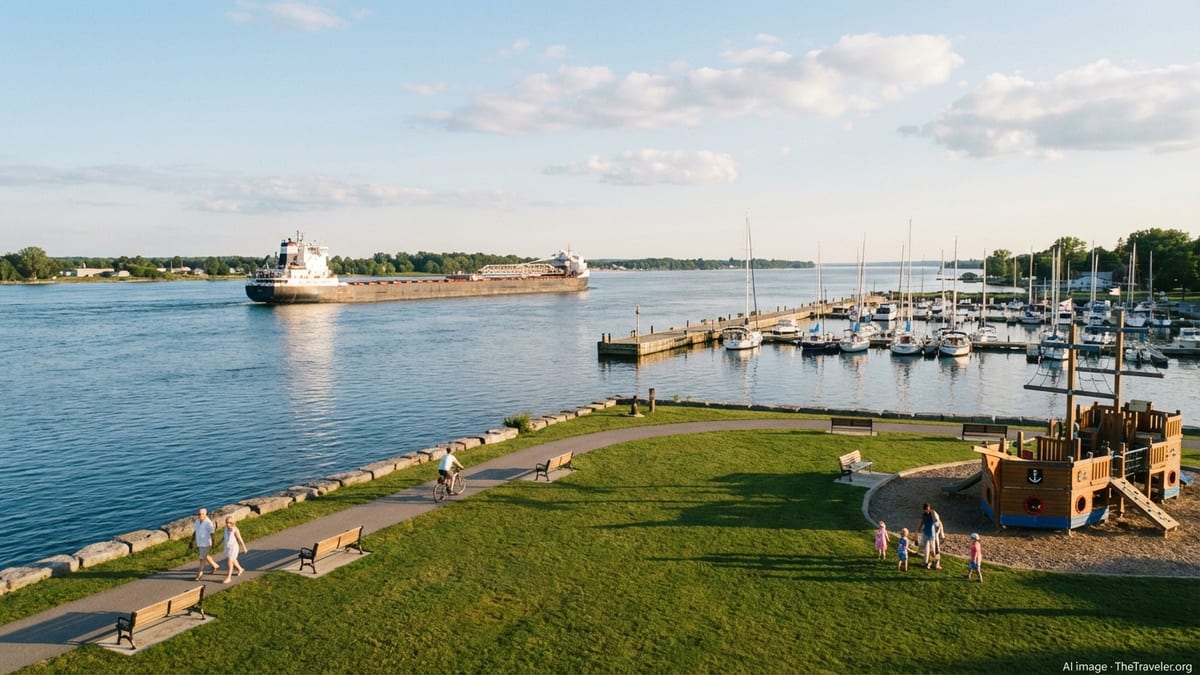
Prescott’s identity is inseparable from the St. Lawrence River. The town stretches along a broad curve of shoreline, with open views across to Ogdensburg, New York and the wide shipping channel that still carries oceangoing freighters between the Great Lakes and the Atlantic. For visitors, the river is not a distant backdrop but a constant presence, whether you are strolling along a paved promenade, lingering over coffee near the water, or watching a laker glide past at sunset. The working river lends the town a quiet sense of movement and purpose that contrasts gently with the slower pace on shore.
Modern Prescott has invested heavily in making its waterfront accessible. Public parks, a harbour, and a continuous system of walking and cycling paths allow you to experience the river from multiple vantage points without ever feeling shut out by private development. The result is a shoreline that feels welcoming and walkable, with lawns that run right to the water’s edge in places and shaded benches that invite you to pause and look out toward the islands and distant headlands.
Season by season, the waterfront takes on a different character. Summer brings boats and theatre crowds, families on the playgrounds, and cyclists following the Great Lakes Waterfront Trail. Autumn can be quieter, with cool, clear days ideal for long walks along the river as maples flare red and orange on both shores. Even in winter, when wind sweeps straight off the ice, locals use the open views as a backdrop for brisk walks and photo stops. For many, simply being near this wide, storied river is reason enough to visit.
RiverWalk Park, Marina and Waterfront Trails
At the heart of the shoreline experience is RiverWalk Park, a relatively recent addition that transformed what was once largely a paved parking area into a green community space with nautical accents and broad river views. Here, grassed terraces, pathways, and scattered heritage artifacts such as an old ship’s anchor and cannon subtly reference the town’s past as a forwarding and military hub while still feeling contemporary and open. Families gravitate to the large pirate ship themed playground, while others make use of picnic tables and seating areas oriented toward the river.
Immediately adjacent lies the Sandra S. Lawn Harbour and Marina, a 148 slip facility that welcomes both seasonal and transient boaters. For travelers arriving by water, Prescott’s harbour is an inviting gateway, with floating docks, views straight out to the shipping channel, and quick access on foot to King Street, the town’s main commercial corridor. Even if you arrive by car or bicycle, walking the docks and watching sailboats, fishing craft, and touring cruisers come and go offers a pleasant contrast to the massive freighters that pass just offshore.
RiverWalk Park also forms a key link in the Heritage River Trail and the route of the Great Lakes Waterfront Trail as it passes through Prescott. Cyclists and walkers can follow signed routes that trace the length of town, connecting parks, Shakespeare’s Gardens, small beaches, and quiet residential stretches of shoreline. To the west, the trails pass through Centennial Park, a broad greenspace with river views. To the east they lead toward Fort Wellington and onward to more rural stretches of waterfront. The continuity of these paths helps visitors experience Prescott as a single walkable riverfront rather than a set of disconnected viewpoints.
Fort Wellington and the Military Story of Prescott
Prescott’s prominent role in Canadian history becomes clear the moment you approach Fort Wellington National Historic Site at the town’s eastern edge. Built initially during the War of 1812 to guard the vital shipping route along the St. Lawrence River, the fort sits on a rise above the shoreline, its restored earthworks and wooden palisades still oriented toward the river and the American shore. The position allowed British forces and later Canadian militia to protect the head of the Gallop Rapids and the busy forwarding point that developed in Prescott as cargo was transshipped between large lake vessels and smaller craft capable of running the rapids.
The fort you see today reflects its reconstruction in the late 1830s, when fears of renewed conflict and cross border unrest prompted the British to rebuild and strengthen the position. The star attraction is the large timber blockhouse at the centre of the site, one of the best preserved examples of its type in Canada. Inside, Parks Canada has recreated period barracks, storage rooms, and domestic spaces, giving visitors a sense of how soldiers and their families lived when the fort was an active military post. Costumed interpreters, when present in season, help bring the routines and tensions of garrison life to life, from weapons drill to cooking over open hearths.
Fort Wellington also carries the layered memory of later conflicts. During the Patriot War of 1837 and 1838, the fort served as a key staging point for loyalist militia, and its presence discouraged direct attack during the attempted invasion that culminated in the nearby Battle of the Windmill. Into the late 19th century and even during the First World War, the fort remained a useful depot and training ground thanks to Prescott’s status as a transportation crossroads. Today, the atmosphere is peaceful, with grassy ramparts, views across the river to New York State, and interpretive exhibits that frame the fort not as an isolated outpost but as part of a broader story of borderland communities and evolving Canada United States relations.
Battle of the Windmill and Windmill National Historic Site
Just a short drive or bike ride east of downtown Prescott stands one of the most distinctive landmarks on this section of the St. Lawrence River. The stone tower at Windmill Point began life in the early 19th century as a grist mill serving local farmers. In November 1838, it became the focal point of the Battle of the Windmill, when a band of Hunter Patriots, largely American based militants sympathetic to the Upper Canada Rebellion, attempted to invade and spark an uprising against British rule. Turned away from Prescott by local militia and the presence of Fort Wellington, the invaders fortified themselves around the windmill and nearby buildings.
Over four days, British regulars, Canadian militia, and cooperating American forces attacked and ultimately overwhelmed the entrenched Patriots. The engagement was bloody for the small number of combatants involved, and its outcome helped quell hopes of further large scale incursions. The battle also reinforced the sense of shared interest on both sides of the border in maintaining order along this crucial waterway. For modern visitors, the site offers a tangible connection to that turbulent period, placing you within sight and sound of the same river channel that linked and divided communities nearly two centuries ago.
In the late 19th century the old mill was converted into a lighthouse, its stone walls adapted to guide shipping through this reach of the St. Lawrence. Since the 1990s, the structure has been open seasonally as Battle of the Windmill National Historic Site. When operational, visitors can climb the interior to a viewing level just below the lantern and take in elevated views of the river, Prescott, and the low shoreline of northern New York. Interpretive panels and exhibits explain the battle, the larger Patriot War, and the later transformation of the windmill into a navigation aid. Even when the tower itself is closed, the surrounding grounds, with their memorial plaques and riverside setting, make a worthwhile stop on a drive or cycling trip.
Parks, Gardens and Outdoor Recreation
Beyond RiverWalk Park, Prescott maintains a network of parks, gardens, and green spaces that encourage outdoor activity in every season. Centennial Park, at the southwestern edge of town, offers wide open lawns, play structures, and water views, making it a favourite for family gatherings and casual picnics. Smaller neighbourhood parks such as Fader’s Park and Sarah Spencer Park provide additional playgrounds and shaded corners, illustrating the town’s emphasis on walkable recreation space threaded through residential districts.
One of the more distinctive features of the waterfront is Shakespeare’s Gardens, a landscaped area near the marina that incorporates plantings and quotations inspired by the plays of William Shakespeare. Located close to the amphitheatre used by the St. Lawrence Shakespeare Festival, the gardens serve as both a contemplative riverside space and a living extension of the town’s summer theatre culture. Visitors can stroll among flowerbeds, pause on benches with river views, and read selected lines from the Bard while freighters slide past in the distance.
The broader landscape around Prescott rewards exploration as well. The town sits within the Frontenac Arch Biosphere, a zone where granite from the Canadian Shield reaches across the St. Lawrence River toward the Adirondack Mountains. For outdoor enthusiasts, this translates into a mix of gently rolling farmland, forest fragments, and shoreline rock outcrops within easy driving or cycling distance. Golfers can book a round at the Prescott Golf Club, set back from the river but still benefiting from cooling summer breezes. Cyclists following the Great Lakes Waterfront Trail or local country roads encounter a mix of heritage farmsteads, small hamlets, and occasional glimpses of the river as it bends past offshore islands.
Cultural Life, Festivals and Local Attractions
For a town of its size, Prescott has an active cultural calendar that revolves in part around its waterfront setting. The best known event is the St. Lawrence Shakespeare Festival, which stages professional outdoor productions each summer in an amphitheatre overlooking the river. Audiences sit on tiered seating as evening light softens over the water and performers bring classic plays and creative adaptations to life. The experience is as much about intimacy with the setting as it is about the drama, and it has helped establish Prescott as a small but respected destination for theatre lovers in eastern Ontario and northern New York.
In addition to Shakespeare, the town and local organizers typically host a series of free concerts and community events along the waterfront through the warmer months. A Sunday night concert series brings live music to the riverfront, while markets and seasonal celebrations give both residents and visitors reasons to linger after daylight fades. Recent initiatives have even painted simple games and activity prompts directly onto paved sections of the waterfront, inviting people of all ages to use the space more playfully.
A short stroll inland reveals more of Prescott’s character. King Street, the traditional main street, holds a mix of historic stone and brick buildings now occupied by cafes, pubs, small shops, and services. Several 19th century structures close to the waterfront evoke the era when the town thrived as a forwarding and commercial centre along the river corridor. While Prescott today is quieter than its busiest industrial decades, the pattern of compact streets, modest storefronts, and human scaled architecture remains intact, creating a streetscape that rewards unhurried exploration and a willingness to duck into side streets and laneways.
Planning Your Visit to Prescott
Prescott sits directly on Highway 401 and the older parallel Highway 2, roughly midway between Kingston and Cornwall and within reach of both Ottawa and Montreal as a day trip. This convenient location makes it an easy pause on longer journeys or a relaxed overnight destination when paired with other attractions in the Thousand Islands and Eastern Ontario region. Parking for visitors is generally straightforward, particularly along or near the waterfront, and the compact layout means you can leave the car behind once you arrive and explore most highlights on foot or by bicycle.
Summer and early autumn are the most popular times to visit. From late June through August, the combination of warm weather, theatre performances, boating traffic, and green parks creates a distinctly festive riverside atmosphere. Shoulder seasons in spring and fall offer cooler temperatures, thinner crowds, and the pleasure of watching the river in more subdued moods. Winter travel appeals mainly to those who enjoy stark river scenery, quiet streets, and a slower pace, although some attractions and services may operate on reduced hours or close entirely in the coldest months.
Visitors who prefer an active experience can plan days around walking sections of the Great Lakes Waterfront Trail, exploring Fort Wellington and the Battle of the Windmill site, and perhaps booking tee times or paddling excursions. Those inclined toward slower travel may find equal satisfaction sitting on a bench with a takeaway coffee, exploring the gardens, browsing local shops, and timing a stroll to coincide with the passage of a freighter. Whatever your pace, a little advance planning around operating seasons for historic sites and theatre performances will help you make the most of your time in Prescott.
The Takeaway
Prescott, Ontario is a study in how a small river town can make the most of its geography and history. The St. Lawrence River provides grandeur and a sense of ongoing movement, while the human scale waterfront parks and trails invite visitors right to the water’s edge. Fort Wellington and the Battle of the Windmill site anchor the town in the pivotal events of the 19th century, yet they feel accessible rather than remote, with interpretive stories that touch on everyday lives as much as on campaigns and rebellions.
Layered onto that foundation is a surprisingly rich cultural and recreational offering. From Shakespeare under the open sky to quiet strolls in themed gardens, from family friendly playgrounds to cycling routes that connect with a continent spanning trail network, Prescott offers more than a quick highway stop. Its charms are subtle rather than flashy, rewarding travelers who linger long enough to watch the light change on the river, listen to a bit of music in the park, or wander up to the old fort on the hill.
Whether you arrive by boat, by bicycle, or via a simple turn off Highway 401, Prescott invites you to slow down, step out to the waterfront, and reflect on how this stretch of river has shaped the town’s past and present. For many visitors, that quiet blend of scenery, story, and small town warmth is precisely what makes this corner of the St. Lawrence worth seeking out.
FAQ
Q1. Where is Prescott, Ontario located?
Prescott sits on the north shore of the St. Lawrence River in eastern Ontario, roughly midway between Kingston and Cornwall, with Ogdensburg, New York directly across the river.
Q2. What is special about Prescott’s waterfront?
The town’s entire shoreline is highly accessible, with RiverWalk Park, a public marina, trails, gardens, and open greenspaces that keep the riverfront largely in public hands.
Q3. Can visitors tour Fort Wellington?
Fort Wellington operates as a National Historic Site, with a restored blockhouse, earthworks, exhibits, and seasonal interpretation that allow visitors to explore key areas of the fort.
Q4. What is the Battle of the Windmill site?
The Battle of the Windmill National Historic Site preserves a stone windmill turned lighthouse east of Prescott where a major 1838 engagement of the Patriot War took place.
Q5. Are there walking and cycling routes in Prescott?
Yes. The Heritage River Trail and the Great Lakes Waterfront Trail run through town, linking parks, RiverWalk Park, the marina, and nearby historic sites along the shoreline.
Q6. When is the best time of year to visit Prescott?
Late spring through early autumn offers the widest range of activities, from outdoor theatre and concerts to boating, cycling, and relaxed riverside strolls.
Q7. Does Prescott have cultural events or festivals?
The St. Lawrence Shakespeare Festival is a highlight, presenting outdoor summer theatre by the river, complemented by concerts and community events on the waterfront.
Q8. Is Prescott suitable for families with children?
Yes. RiverWalk Park’s large playground, additional neighbourhood parks, open lawns, and easy trails provide plenty of low stress options for families with children.
Q9. How much time should I plan for a visit?
A full day allows time to walk the waterfront, tour Fort Wellington, visit the Windmill site, and explore downtown, though many travelers choose to stay overnight.
Q10. Can Prescott be combined with other nearby destinations?
Prescott pairs well with the Thousand Islands region, Brockville, and day trips to Ottawa or Kingston, making it a flexible base or stop within Eastern Ontario travel plans.