

More news on this day
Princess Cruises is sharpening its focus on the fast-growing Asia Pacific cruise market, expanding its Australian program while shifting additional capacity into key regional hubs such as Singapore, New Zealand and the wider South Pacific.
Get the latest news straight to your inbox!
Three-Ship Strategy Deepens Princess Presence in Australia
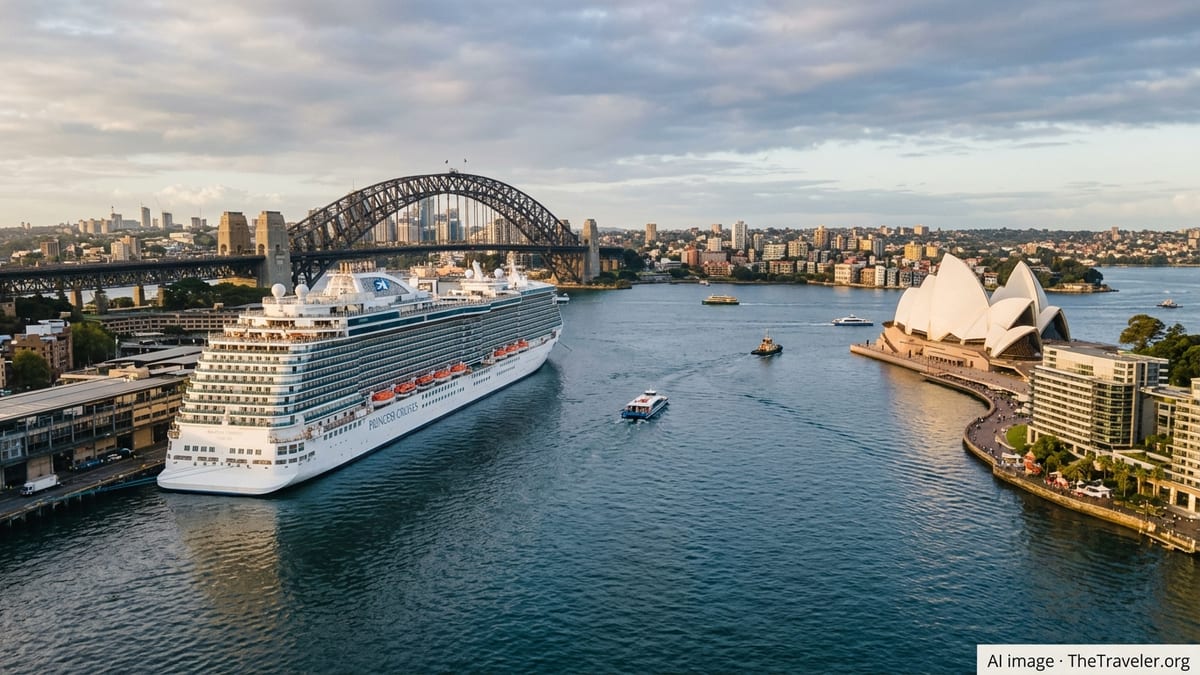
Princess Cruises is set to strengthen its footprint in Australia with a multi-ship deployment that places the country at the center of the line’s South Pacific strategy. Publicly available deployment information for the 2026 to 2028 seasons shows Princess planning to homeport multiple ships in major Australian gateways, including Sydney, Brisbane and Fremantle, with itineraries stretching across New Zealand, the South Pacific islands and Australia’s coastal regions.
Industry coverage indicates that for the 2026 to 2027 season, Princess intends to base ships such as Grand Princess and Royal Princess in Australia and New Zealand, operating a mix of short coastal breaks and longer voyages that include Fiji, Tasmania and Queensland ports. These programs add to the brand’s existing presence in the region and are designed to capture both repeat cruisers and first-time guests drawn to close-to-home holidays.
Deployment details for the 2027 to 2028 southern summer point to a further step-up, with Princess planning three ships in Australian waters and a return to Western Australia via Fremantle. The use of larger, feature-rich vessels reflects the line’s confidence in the market’s ability to absorb additional capacity despite heightened competition from sister brands within Carnival Corporation and from rival cruise operators.
Schedules released in brochures and trade announcements highlight an emphasis on flexible voyage lengths, from short sampler cruises catering to new-to-cruise Australians to extended itineraries that link Australia with Asia. This variety supports Princess Cruises’ positioning as a premium option for guests seeking both domestic and international experiences from local ports.
Singapore Emerges as a Central Hub for Asia Expansion
While reinforcing its Australian base, Princess Cruises is simultaneously pivoting toward rapid growth in Asia, with Singapore emerging as a key strategic hub. Trade press reports note that the line plans to homeport two large ships, Diamond Princess and Sapphire Princess, in Singapore for the 2026 to 2027 season. This dual deployment marks the first time in several years that Princess has committed two ships to the city-state for a full winter program.
The expanded Singapore season is expected to offer a range of itineraries across Southeast Asia, including calls in Malaysia, Thailand, Vietnam and Cambodia, along with holiday sailings over Christmas and New Year. The combination of short regional getaways and longer multi-country cruises is designed to appeal to both local travelers and international guests using Singapore as a fly-cruise gateway.
According to analysis in cruise industry publications, returning a second ship to Singapore effectively doubles Princess Cruises’ capacity in Asia for the 2026 to 2027 winter and enables near year-round regional operations when combined with deployments in Japan and other North Asian markets. This strategy aligns with broader forecasts that identify Asia, and particularly Southeast Asia, as one of the world’s fastest-growing cruise regions in terms of passenger volume and infrastructure investment.
Recent deployment brochures also show Princess scheduling repositioning voyages that link Australia and Singapore, further integrating the two regions. These cruises provide Australians with additional options to embark locally and disembark in Asia, or vice versa, supporting tourism flows in both directions and helping fill ships during shoulder seasons.
Realignment Within Carnival Portfolio Boosts Princess Role
Princess Cruises’ enhanced focus on Australia and Asia is unfolding against the backdrop of a wider portfolio realignment by parent company Carnival Corporation. Public disclosures show that P&O Cruises Australia is being absorbed into Carnival Cruise Line in 2025, with several former P&O ships rebranded under the Carnival banner and the dedicated P&O Australia brand phased out.
Industry commentators suggest that this consolidation concentrates mainstream capacity with Carnival Cruise Line while leaving Princess to solidify its role as the group’s primary premium brand for Australasian and Asia-focused itineraries. With P&O Cruises Australia withdrawing as a standalone player, Princess gains clearer differentiation at the higher end of the market, particularly for guests seeking longer voyages, world cruises and destination-intensive itineraries.
Carnival Corporation’s latest annual reporting highlights the strategic importance of the Asia Pacific region, noting that markets across Asia and the Pacific Rim remain comparatively underpenetrated compared with North America and Europe. Princess Cruises, with its established presence in Japan, Australia and the South Pacific, is positioned within the group as a key vehicle to capture this incremental demand.
The redeployment of hardware across the portfolio, including the transfer and rebranding of ships between brands over the past several years, underscores a deliberate effort to match each vessel with the market segment and geography where it can perform best. Within that framework, Princess Cruises’ upcoming Australian and Asian seasons represent a coordinated push to optimize yield and maximize occupancy in markets experiencing structural growth.
Rising Demand and Infrastructure Support Regional Growth
The decision to commit more tonnage to Australia and Asia comes as regional demand indicators remain robust. Cruise industry associations report that Asian source markets have posted strong growth over the past decade, driven by rising middle-class incomes, expanding air connectivity and significant investment in port and terminal infrastructure. Singapore, in particular, has developed into a modern cruise hub with facilities capable of accommodating some of the world’s largest ships.
Australia has similarly matured into a leading cruise market with high per-capita participation, with pre-pandemic data showing sustained double-digit growth rates over multiple years. Despite disruptions during the global health crisis, itineraries from Sydney, Brisbane and other Australian ports have again recorded strong bookings, with some sailings reported as sold out well ahead of departure.
For Princess Cruises, this environment creates an opportunity to balance its global deployment by placing more capacity where onboard spending and repeat business trends remain favorable. Longer South Pacific and Asia itineraries typically attract guests with higher vacation budgets and a willingness to purchase premium experiences such as specialty dining, shore excursions and upgraded accommodation categories.
Infrastructure upgrades across Australia, New Zealand and Southeast Asia also support the line’s plans to operate larger and newer ships in the region over time. Modern terminals, improved docking facilities and streamlined customs processes help reduce turnaround times in port, a factor that can contribute to operational efficiency and more complex multi-country itineraries.
Competitive Landscape and Outlook for Asia Pacific Cruising
Princess Cruises’ strategy unfolds within an increasingly competitive Asia Pacific cruise landscape, where global brands and regionally focused operators are racing to secure berths, itineraries and customer loyalty. Other Carnival Corporation brands, along with rivals such as Royal Caribbean Group and MSC Cruises, have signaled interest in expanding Asian and Australasian deployments, particularly around marquee ports like Singapore, Sydney and Tokyo.
Analysts note that the dual approach of maintaining a strong Australian base while scaling up in Asia gives Princess a diversified regional platform that can be adjusted in response to changing demand or economic conditions. If outbound travel from one market softens, itineraries can be rebalanced toward others, leveraging the line’s established presence across the wider Pacific basin.
Looking ahead to the late 2020s, published deployment snapshots and orderbook commentary suggest that Princess Cruises will continue to integrate its new generation Sphere-class ships into global itineraries that touch the Asia Pacific region. As more capacity enters the fleet, pressure will grow to identify profitable year-round deployments, and the combination of Australian summers and Asian winters presents a logical pairing.
For travelers, these moves translate into a broader choice of itineraries linking Australia, New Zealand, Southeast Asia and North Asia, often without the need for long-haul flights at both ends of the journey. For ports and destinations across the region, sustained investment by cruise lines such as Princess represents an ongoing vote of confidence in Asia Pacific’s long-term appeal as one of the world’s most dynamic cruise markets.