

More news on this day
Investigators in the United States and Canada have launched a formal inquiry after an Air Canada Express jet collided with a Port Authority emergency vehicle on a runway at New York’s LaGuardia Airport, killing both pilots and injuring dozens of occupants on board and on the ground.
Get the latest news straight to your inbox!
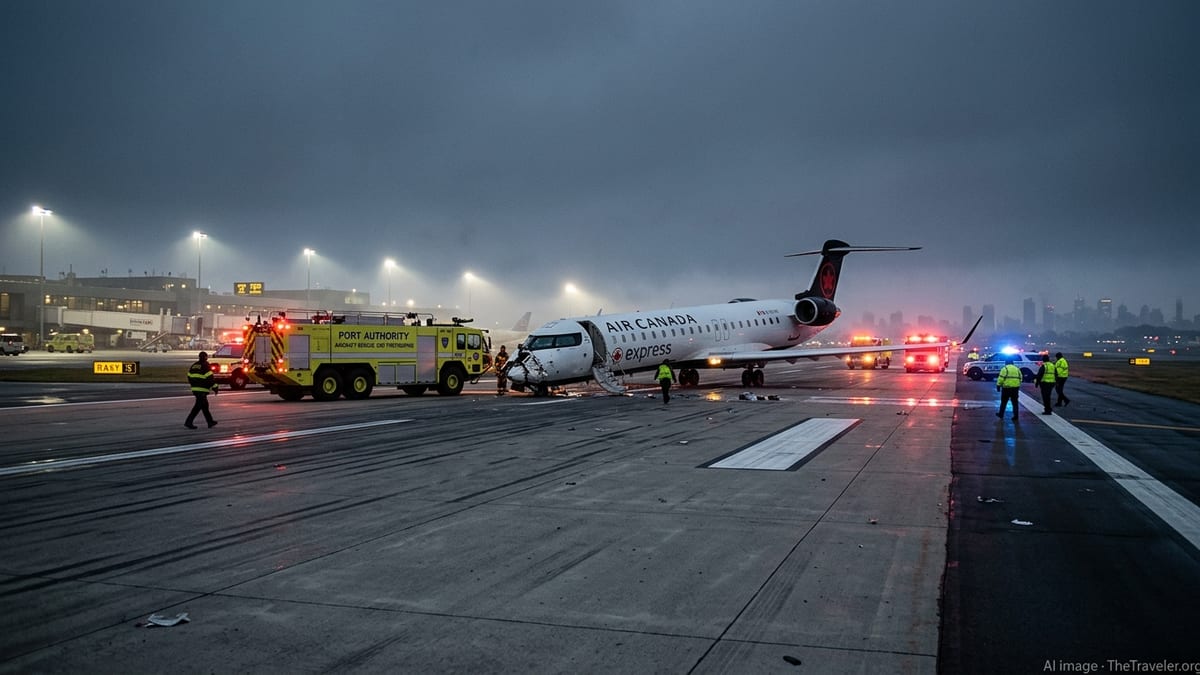
Nighttime Collision on Runway 4
Publicly available information shows that the incident occurred late on Sunday, March 22, when Air Canada Express Flight 8646 from Montreal was landing on Runway 4 at LaGuardia. The Bombardier CRJ900, operated by Jazz Aviation on behalf of Air Canada Express, struck a Port Authority Aircraft Rescue and Firefighting truck that was crossing the active runway.
Reports indicate there were 76 people on board the regional jet, including 72 passengers and four crew members. The cockpit and forward galley area absorbed the force of the impact, leading to catastrophic damage at the front of the aircraft while the rear fuselage and tail remained largely intact on the runway.
According to published coverage, the collision took place around 11:45 p.m. local time as the jet completed its landing roll. Initial accounts describe the nose of the aircraft crumpled and tilted upward, with debris scattered across the concrete and the Port Authority vehicle coming to rest near the forward section of the fuselage.
Images circulated by news outlets show emergency lighting illuminating the scene in the hours after the collision, with the damaged jet surrounded by fire crews and airport equipment. The aircraft, registered C-GNJZ, has been described in public reporting as a total loss.
Casualties and Passenger Evacuation
Published reports from multiple outlets state that both pilots in the cockpit of Flight 8646 died in the collision. Their positions at the very front of the low-slung CRJ900 left them exposed to the full force of the impact with the heavy aircraft rescue vehicle.
Dozens of passengers and crew were transported to area hospitals with varying injuries, according to publicly reported figures. Some were treated for fractures, lacerations and suspected head trauma, while others were evaluated for smoke inhalation and the effects of a rapid, high-stress evacuation.
Emergency responders on the airfield assisted in evacuating the cabin, with some passengers reportedly using over-wing exits and slides after the aircraft came to a stop. Publicly available accounts describe at least one flight attendant being found outside the aircraft still restrained in a jumpseat, a detail that underscores the violence of the collision along the forward fuselage.
Ground personnel aboard the Port Authority truck were also injured. Early numbers released through media briefings and local coverage suggest a mix of serious and minor injuries among the two occupants of the vehicle, both of whom were part of the airport’s emergency response organization.
Runway Incursion and Air Traffic Control Questions
The collision is being characterized in aviation reporting as a runway incursion accident involving both an arriving aircraft and a specialized ground vehicle. The Port Authority truck was reportedly responding to a separate incident involving another flight elsewhere on the airfield when it crossed Runway 4 as the Canadian regional jet landed.
Recordings of air traffic control communications, shared by aviation monitoring communities and covered by major news organizations, capture a controller clearing an emergency vehicle to cross the runway, followed by urgent calls instructing the truck to stop as the landing aircraft approached. At one point on the tapes, a voice can be heard expressing concern about having “messed up” while managing simultaneous situations during a busy nighttime period.
Analysts in industry publications are focusing on how the tower was configured at the time, including whether a single controller was handling both ground and tower duties and how workload and distraction may have influenced decision-making. The configuration of taxiways and intersecting runways at LaGuardia is also attracting attention, as the airport is known for tight geometry and constrained space.
While definitive causal findings remain months away, the event is already being compared in specialist commentary to earlier runway incursion cases in North America that prompted changes in signage, lighting and controller procedures intended to keep aircraft and ground vehicles separated on active runways.
Formal Investigation and Safety Focus
National transportation safety agencies in the United States and Canada have announced that a multidisciplinary team is being dispatched to LaGuardia to begin on-site work. Public statements indicate that investigators will examine flight data and cockpit voice recorders from the CRJ900, as well as recordings, transcripts and radar logs from the control tower.
Investigators are expected to reconstruct the movements of both the jet and the Port Authority truck in the minutes leading up to impact, using ground radar tracks, vehicle GPS data where available, and physical evidence on the runway surface. The performance and configuration of the aircraft’s braking system and landing rollout will also be part of the technical review.
Attention is likely to focus on how the Port Authority’s airfield driving rules, training and dispatch procedures were applied in the moments before the truck entered the runway. Publicly accessible operational manuals and airport regulations specify that active runways must remain clear of ground vehicles unless explicit coordination has taken place, and part of the investigation will evaluate how such safeguards functioned on the night of the crash.
Beyond the immediate causes, safety specialists anticipate that the inquiry will revisit broader questions about runway incursion prevention, including the use of in-cockpit alerts, enhanced ground radar, and standardized phraseology between controllers, pilots and ground crews in high-density environments like LaGuardia.
Impact on LaGuardia Operations and Travelers
In the hours after the collision, the Federal Aviation Administration imposed a ground stop and LaGuardia Airport temporarily suspended operations while emergency crews secured the scene and assessed damage to Runway 4. According to airline and airport communications reported by U.S. media, flights were diverted to other New York City area airports and to regional hubs along the East Coast.
Travelers experienced cascading disruptions as Monday morning traffic built up with one of LaGuardia’s primary runways out of service. Airlines issued waivers allowing passengers to rebook affected flights without additional fees, and departure boards across terminals displayed long lists of delays and cancellations linked to the runway closure and subsequent congestion.
For Air Canada and its regional partner Jazz Aviation, the incident has triggered immediate internal safety reviews and operational checks on similar aircraft operating into busy U.S. airports. Public information from the carriers indicates a focus on supporting affected passengers and crew members, as well as coordinating with investigators to provide technical data and maintenance records for the CRJ900 fleet.
The crash is also likely to influence how LaGuardia and other constrained urban airports manage emergency vehicle movements when multiple incidents unfold simultaneously. Travel industry observers note that the accident underscores the complex balance between rapid emergency response and the need to maintain sterile, vehicle-free runways when aircraft are landing or departing.