

More news on this day
Proflight Zambia is set to strengthen intra-African air links with the launch of a new three-times-weekly service connecting Lusaka, Livingstone and Windhoek from 3 March 2026, a route designed to boost tourism, business travel and regional integration across Southern Africa.
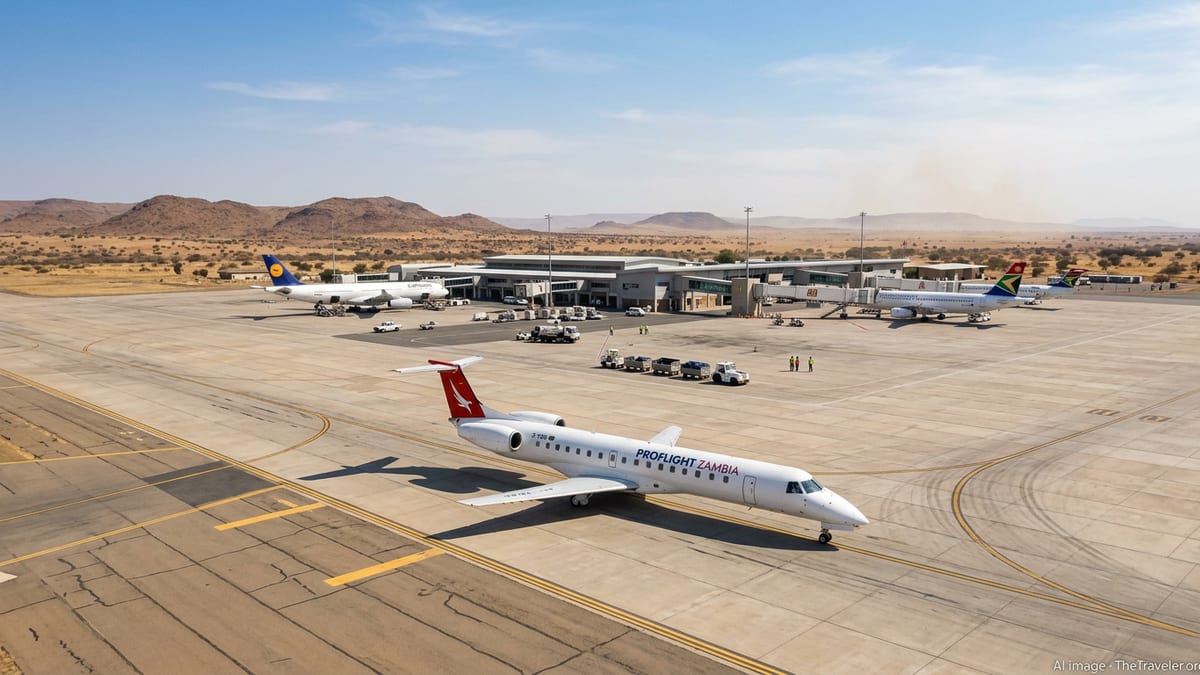
New Three-City Route Anchors Growing Regional Network
The new service will operate between Lusaka’s Kenneth Kaunda International Airport, Livingstone’s Harry Mwaanga Nkumbula International Airport and Windhoek’s Hosea Kutako International Airport, creating a direct three-city corridor across Zambia and Namibia. The flights are scheduled three times a week on Tuesdays, Fridays and Sundays, giving both leisure and corporate travellers predictable connectivity across the region.
According to schedules filed by the airline and partner airport authorities, southbound flight P0 063 will leave Lusaka at 08:30, pause briefly in Livingstone at 09:55 and continue to Windhoek for an 11:35 arrival. The northbound sector will depart Windhoek at 12:20, reaching Livingstone at 13:55 before arriving back in Lusaka at 15:20. The Livingstone stop is expected to be a short, approximately 30-minute transit, with passengers remaining on board when travelling through between Lusaka and Windhoek.
Proflight Zambia plans to operate the route with jet equipment, including its 50-seat regional jet, aligning capacity with rising demand on key regional sectors. The airline already runs a mix of domestic and regional services, and the Windhoek launch consolidates its strategy to connect secondary tourism gateways more efficiently to major Southern African hubs.
For Windhoek, the new flights provide a direct bridge into Zambia’s capital and its main tourism gateway at Livingstone, complementing existing links to South Africa and other regional markets. For Zambia, the service extends Lusaka’s role as a hub by adding Namibia’s capital to a network that already reaches Johannesburg, Cape Town and Maun, among other destinations.
Tourism Gains for Victoria Falls, Namibia’s Deserts and Safaris
Tourism stakeholders in both countries are positioning the three-city service as a catalyst for multi-destination itineraries that combine Victoria Falls, Namibia’s desert landscapes and wildlife areas in a single trip. Livingstone, on the Zambian side of Victoria Falls, is a major draw for international visitors who often connect through Lusaka or Johannesburg. Direct air links from Windhoek are expected to make it easier to package the falls with Namibian highlights such as Sossusvlei, the Skeleton Coast and Etosha National Park.
Data cited by Namibian aviation officials show that Zambia ranked among Windhoek’s largest African origin-and-destination markets in 2024, with an estimated 10,000 two-way international passengers, representing double-digit growth on the previous year. The new flights are expected to capture a larger share of this demand by eliminating the need for indirect routings via Johannesburg or Addis Ababa for many travellers.
Travel trade bodies in both countries have welcomed the move, highlighting opportunities for tour operators to design seamless regional circuits. Typical packages are expected to include Lusaka as an arrival or departure hub, two to three nights in Livingstone for Victoria Falls and activities such as rafting and helicopter flips, followed by onward travel to Windhoek and into Namibia’s interior.
The route also supports efforts by Zambia and Namibia to position themselves as year-round, higher-yield destinations. Improved air access is seen as especially important for attracting North American and European travellers who are increasingly seeking multi-country itineraries across Southern Africa and who value shorter total journey times.
Business Travel and Trade Connectivity on the Rise
Beyond tourism, the Lusaka–Livingstone–Windhoek service is expected to deepen business links between two of Southern Africa’s most dynamic mid-sized economies. Lusaka is a financial and commercial hub for Zambia’s mining, agriculture and services sectors, while Windhoek hosts key institutions serving Namibia’s mining, logistics and energy industries.
By offering daylight departures and convenient same-day return options on three weekdays, the schedule is designed to support corporate and government travellers who previously had to rely on more circuitous routings. The ability to depart Windhoek at midday and reach Lusaka mid-afternoon, or to travel in the opposite direction in a single morning, reduces time spent in transit and may cut travel costs for regional firms.
Industry analysts note that stronger air links between the two capitals could spur additional cross-border investment, particularly in sectors such as tourism infrastructure, agribusiness, logistics and renewable energy. The flight also opens new opportunities for meetings and events planners seeking to rotate conferences and trade fairs between Zambia and Namibia, with Livingstone emerging as a natural incentive and conference destination anchored by Victoria Falls.
Aviation observers point out that the new route may also help redistribute traffic flows within Southern Africa, easing reliance on traditional mega-hubs. By enabling more journeys to be completed on intra-regional services, airlines and airports are betting on a gradual shift toward a more connected, networked African aviation market.
Strategic Step in Proflight Zambia’s Expansion Plan
The three-city service is a central pillar in Proflight Zambia’s broader network expansion, which in recent seasons has included the introduction of services linking Lusaka and Livingstone with Cape Town and Maun. The airline has consistently framed these developments as part of a long-term commitment to support regional economic integration and to position Zambia as a land-linked rather than landlocked country.
By adding Windhoek to its destination list, Proflight Zambia becomes the only carrier currently offering direct service on the Lusaka–Livingstone–Windhoek triangle. This first-mover advantage could help the airline secure a strong foothold in a growing market segment of regional travellers seeking point-to-point connectivity without backtracking via larger hubs.
The route also strengthens the role of Livingstone as more than a pure leisure endpoint. With direct flights to and from Windhoek and onward connections through Lusaka to Ndola, Solwezi and Mfuwe, passengers can now more easily move between Namibia and Zambia’s mining regions or safari areas in a single itinerary, using Proflight’s network to stitch together multiple commercial and tourism centres.
Within Zambia, the airline is leveraging its domestic network to feed the new regional flights, enabling travellers from secondary cities to connect through Lusaka to Windhoek and Livingstone on a single ticket. This hub-and-spoke approach is seen as vital for making regional services commercially viable while broadening travel options for communities beyond the main gateways.
Regional Partners and Airports Back Connectivity Push
Airport operators in both countries have thrown their support behind the new service, positioning it as part of a wider strategy to expand Southern Africa’s intra-regional air network. The Namibia Airports Company has emphasised the importance of the Lusaka–Livingstone–Windhoek link as a “catalyst for regional integration and economic synergy,” reflecting a policy push to enhance air connectivity across the Southern African Development Community.
At Lusaka’s Kenneth Kaunda International Airport, recent infrastructure upgrades, including a modern international terminal, have improved the airport’s capacity to handle growing regional traffic. The addition of scheduled flights to Windhoek further diversifies Lusaka’s route map and underlines its emerging role as a connector between Southern, Central and East Africa.
Travel and tourism boards in both Zambia and Namibia are expected to collaborate on joint marketing campaigns as the launch date approaches, promoting twin-centre holidays and regional business travel. Industry insiders anticipate increased cooperation on trade fairs, cultural exchanges and sports tourism, capitalising on more convenient air links.
With Proflight Zambia’s three-city service now formally scheduled from early March 2026, stakeholders across the aviation, tourism and business communities are watching closely to see how quickly travellers embrace the new corridor. If load factors build as expected, the route could become a template for further cross-border links connecting key secondary cities across the African continent.