

More news on this day
Regional and mainline carriers including PSA Airlines, Delta Air Lines and Mesa Airlines are scrambling to recover after at least seven flight cancellations and dozens of delays at Louisville’s Muhammad Ali International Airport on Sunday, leaving travelers stranded and disrupting key routes to Charlotte, Atlanta, Washington, Denver, Detroit and other major hubs at the height of a busy spring travel weekend.
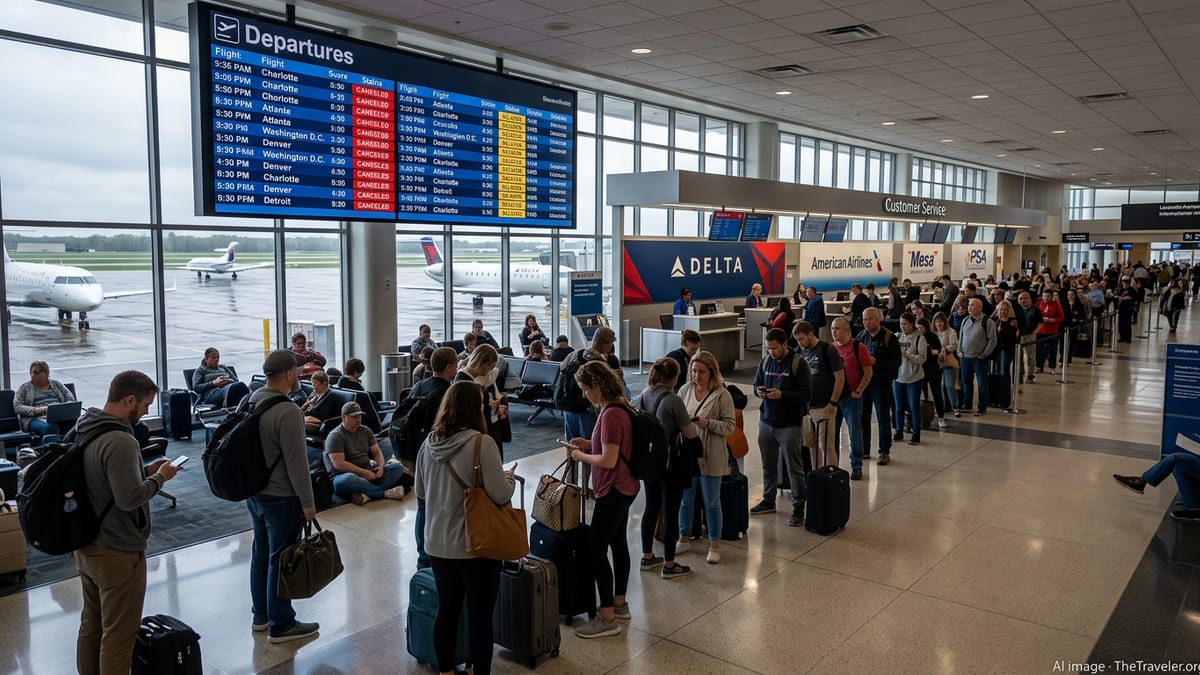
Disruptions Hit Key Hubs Across the Network
The wave of cancellations and rolling delays at Louisville is feeding directly into already strained operations at several of the country’s busiest airports. Flights linking Louisville to major hubs such as Charlotte, Atlanta and Washington are crucial for connecting passengers on to Denver, Detroit and a host of secondary cities across the Midwest and East Coast.
Delta, which has been working to stabilize its schedule after a bout of severe weather and ground delays in Atlanta over the past 48 hours, has seen its Louisville flights pulled into the wider disruption. Connections that normally move smoothly through Atlanta and Detroit have instead become choke points, with passengers describing missed onward flights, long lines at customer service counters and confusion over rebooking options.
Regional affiliate PSA Airlines, which operates flights for American Airlines, has also cut at least one Louisville flight and delayed several more. For many travelers, that has meant a broken first link in an itinerary that was supposed to carry them via Charlotte or Washington to destinations farther afield, amplifying the impact of what appears, on paper, to be a modest number of cancellations.
Mesa Airlines, a regional partner that feeds larger hubs in the Midwest and Mountain West, has likewise been forced to scrub departures and hold others at the gate. The combined effect is a day in which a relatively small airport such as Louisville is experiencing the same sort of cascading disruption more commonly associated with larger hubs.
Stranded Travelers Face Long Waits and Limited Options
Inside Muhammad Ali International’s concourses, the operational issues are translating into frayed tempers and exhausted travelers. Families returning from early spring break getaways have reported wait times of several hours just to speak to gate agents, with some being offered rebookings that would not depart until late Monday or even Tuesday.
Seats on remaining flights to major hubs are scarce, especially to Atlanta and Charlotte, where airlines are already juggling compressed schedules and out-of-position crews. Travelers with tight international connections are among the hardest hit, with some facing the prospect of losing nonrefundable long-haul tickets because a short regional leg out of Louisville never left the gate.
Airport staff have been working to distribute meal vouchers and direct passengers to hotels, but rooms near the airport and in downtown Louisville quickly filled as the day wore on. With multiple airlines affected, some travelers have resorted to renting cars and driving to larger hubs such as Atlanta or Chicago in hopes of salvaging their trips.
Business travelers, too, are feeling the effects. Several described on social media how a canceled morning departure to Washington upended same-day meetings in the capital, while a delayed evening flight to Denver risked derailing carefully planned schedules for the week ahead.
Weather, Crew Positioning and Knock-On Effects
While Sunday’s skies over Louisville were relatively calm, the disruptions are the latest reminder that air travel reliability often hinges on conditions hundreds of miles away. A series of storms, coupled with earlier ground stops and ground delay programs at major hubs such as Atlanta and Denver, has left aircraft and crews out of position across airline networks this weekend.
Delta’s operation in particular has been under strain after thunderstorms and aircraft inspections in Atlanta triggered hundreds of cancellations and delays, forcing the airline to reshuffle everything from aircraft routing to crew duty assignments. Those adjustments ripple out to smaller spokes including Louisville, where a single aircraft arriving late from a hub can upend an entire day’s schedule on a route.
Regional carriers such as PSA and Mesa are especially vulnerable to these knock-on effects. Their contracts and crew schedules are tightly calibrated to serve a fixed number of hub turns each day. When storms and congestion disrupt those turns, there is often little spare capacity to absorb additional delays, making cancellations more likely when crews bump up against legal duty time limits.
Operational experts note that the current pattern illustrates how even a handful of canceled flights can reverberate widely in a hub-and-spoke system. With aircraft zigzagging across the country from early morning to late at night, a delay or cancellation in one city can echo through several others, sometimes for days.
Advice for Passengers Traveling Through Louisville and Beyond
With airlines still working to reset their operations, travelers scheduled to pass through Louisville or its key connecting hubs are being urged to treat flight times as fluid. Industry analysts recommend checking airline apps frequently, enabling notifications and verifying departure and arrival times multiple times on the day of travel, rather than relying solely on original itineraries.
Passengers whose flights have already been canceled or significantly delayed may have more options if they act quickly. Same-day changes to alternate hubs, such as rerouting from Charlotte to Philadelphia or from Atlanta to another Southeast gateway, can sometimes preserve onward connections before those seats are taken by other disrupted travelers.
Travelers are also being advised to build in additional buffer time for connections, especially on itineraries that involve tight domestic links into transatlantic or transpacific departures. Where possible, experts suggest booking longer layovers and considering early morning departures, which tend to be less affected by the cumulative delays that build up later in the day.
For now, Louisville’s run of cancellations and delays serves as another warning sign for a spring travel season already marked by high demand, shifting weather patterns and fragile airline schedules. With more storms in the forecast for key regions, passengers across the network may need to brace for further disruptions in the days ahead.