

Public transport in Germany is extensive, integrated and heavily used by residents. For individuals and families considering relocation, understanding how fares work, what typical monthly spend looks like, and how recent reforms have changed costs is essential. This briefing explains the main public transport cost components in Germany, focusing on recurring expenses that affect everyday life rather than short tourist visits.
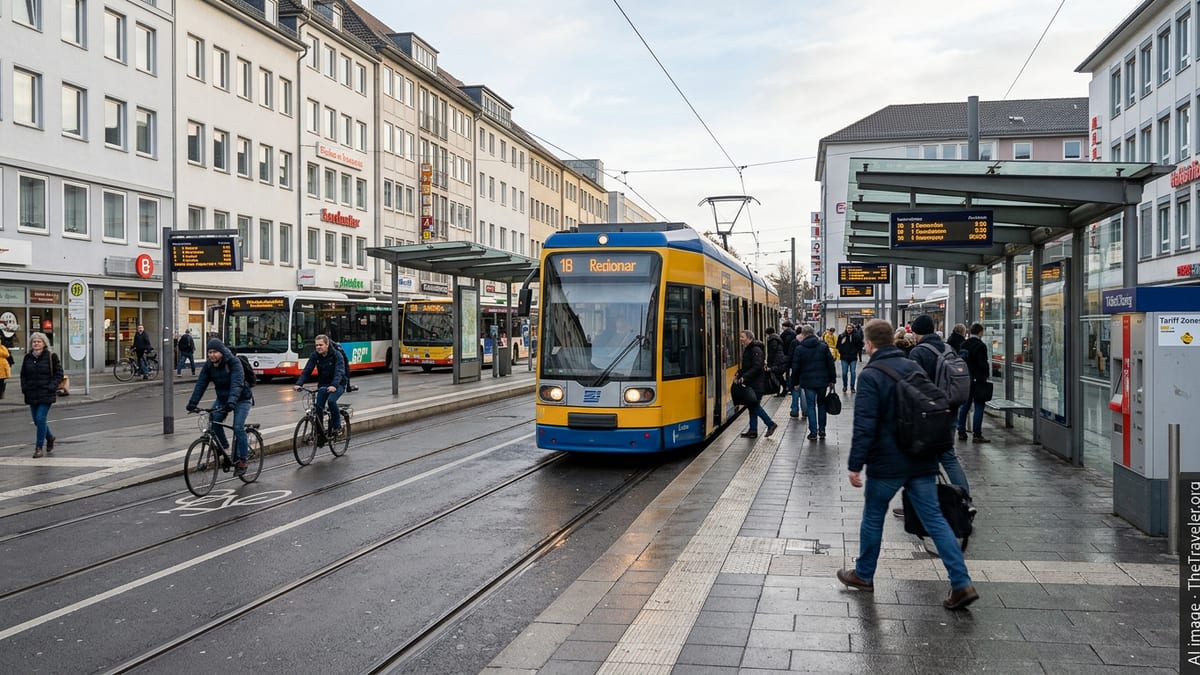
Overview of Public Transport Cost Structure in Germany
Public transport in Germany is organized regionally, with more than 60 local and regional transport associations setting detailed fares. Despite this fragmentation, the core cost structure is similar nationwide. Passengers pay for single trips, day tickets or recurring passes, with prices varying by city size, distance and included modes such as buses, trams, suburban trains and regional rail.
Most residents who rely on public transport use monthly or annual passes rather than individual tickets, as these dramatically reduce the cost per journey. Long distance and high speed intercity trains are priced separately from local and regional systems and should be treated as a different cost category. For everyday commuting and local mobility, the relevant pricing is that of urban, suburban and regional networks.
In recent years, Germany has experimented with flat rate nationwide public transport offers that significantly simplify the cost landscape for residents. These reforms aim to make costs more predictable for households and support a modal shift away from private cars. For relocation planning, understanding these national offers alongside regional pass options is key to estimating realistic monthly expenses.
Public transport spending interacts with other elements of a relocation budget, particularly housing location, as living farther from city centers usually requires longer and potentially more expensive commutes. However, due to integrated tariff systems and discounts for frequent users, cost increases with distance are less steep than in some other countries.
The Deutschlandticket: National Flat Rate Pass
The most important development in German public transport pricing is the introduction of the Deutschlandticket, a monthly flat rate pass valid across local and regional transport nationwide. The ticket is sold as a digital subscription and is priced at roughly the level of a standard city monthly pass in a major metropolitan area. It allows unlimited travel on local buses, trams, metro systems, suburban trains and most regional trains throughout Germany.
This product has effectively created a national ceiling for typical monthly public transport costs for many commuters, especially those who travel across regional boundaries or use regional trains regularly. For someone relocating, the Deutschlandticket provides cost certainty and flexibility: it can cover commuting, errands in the home city, and weekend or occasional regional travel without extra fare complexity, as long as no long distance intercity trains are required.
The Deutschlandticket does not include high speed intercity services and certain special lines, and it is generally subscription based, renewing each month until cancelled. Cancellation usually needs to be requested before the end of the current month to avoid being charged for the next one. Some transport associations and employers offer variations that include additional benefits, such as discounted local bike sharing or car sharing integration, but the core product is the same nationwide.
For relocation budgeting, the Deutschlandticket effectively sets a realistic upper bound for everyday public transport costs for many adults who do not need premium services. Families and individuals in cities with historically high monthly pass prices may even experience lower transport costs than before its introduction, while residents in smaller cities might see costs closer to previous local pass levels.
Local Single Tickets, Day Tickets and Short Trips
While many residents choose a monthly pass, understanding single journey pricing is important for light users, part time workers, or accompanying family members who travel less frequently. Local single tickets in German cities are typically structured by zones or distance. A full price standard single ticket in a major city often costs in the low to mid single digit euro range, with reduced prices for shorter distances or fewer zones.
Many networks offer a cheaper short trip fare that covers only a few stops or a limited number of stations, which can be cost effective for very short errands or occasional use. Day tickets allow unlimited travel in defined zones for one day at a cost that is usually equivalent to a few single tickets. Small group day tickets are widely available and can reduce costs for families or groups traveling together on weekends or holidays.
For occasional local use, a typical pattern might involve a handful of standard single tickets per week, leading to a modest monthly outlay. However, once usage reaches the level of at least four to five round trips per week, a monthly pass or the Deutschlandticket usually becomes cheaper on a per journey basis. This threshold is important for relocators who are unsure how often they will rely on public transport.
Digital ticketing via regional apps often offers slightly lower prices than paper tickets bought from machines, and allows more flexible products such as pay per use caps where total daily spending is automatically limited at the level of a day ticket. While not universal, these developments can further reduce costs for irregular users in some cities.
Monthly and Annual Passes in Major Cities
Beyond the nationwide Deutschlandticket, individual cities and transport associations continue to offer their own monthly and annual passes. These products can be attractive when they include extra benefits that the national ticket does not provide, such as integration with nearby regional express services beyond the formal local classification, or specific discounts for off peak travel or seniors.
In large metropolitan areas, traditional local monthly passes for an inner city zone historically cost in the similar range to the current Deutschlandticket, while broader zone coverage or first class regional travel could push the price higher. For many commuters whose trips were previously limited to a single zone, the nationwide ticket now offers a much larger valid area at no substantial additional monthly cost.
Annual passes, which require upfront payment or a binding contract for twelve months, typically offer a noticeable discount relative to buying twelve individual monthly passes. Discount levels vary by region but commonly represent savings in the low to mid double digit percentage range over a year. For relocators who expect to stay in one city and rely heavily on public transport, and whose employer does not provide a job ticket, an annual pass can still be slightly cheaper than subscribing to the Deutschlandticket if priced below the national level.
City specific student, apprentice, and training passes offer substantial discounts compared with standard adult tariffs. These special categories are tightly regulated and require proof of status. For families planning relocation with school age or university age dependants, these discounted passes can significantly reduce overall household transport spending compared with paying full adult fares for everyone.
Employer and Student Discounts, Job Tickets and Subsidies
Many employers in Germany participate in job ticket programs, under which staff receive discounted public transport passes through their workplace. With the advent of the Deutschlandticket, some job ticket schemes now offer the national flat rate ticket at a reduced monthly price, provided the employer contributes a minimum subsidy. In some arrangements, employer co funding can reduce the employee's monthly cost by a substantial margin compared with an individual subscription.
For relocators considering job offers, the availability and structure of a job ticket can materially change the effective cost of commuting and other local travel. In dense urban areas where public transport is the dominant mode of commuting, employer participation in these schemes is relatively common, though not universal. Public sector employers and large corporations are more likely to offer such benefits than very small companies.
Students at public universities frequently benefit from compulsory or semi compulsory semester tickets, paid as part of the student fee package. These passes often cover extensive regional networks and can offer very low per month effective costs compared with standard adult tariffs. Adult education, vocational training and apprenticeship schemes also typically include access to discounted transport products, either through educational institutions or regional authorities.
Some municipalities and states provide targeted subsidies or reduced fares for low income residents, people receiving certain social benefits, or older passengers. These schemes are highly regional and can include discounted monthly passes, social tickets valid in off peak periods, or vouchers. While not directly relevant for all relocating professionals, awareness of such options can be useful for households with diverse income situations.
Children, Families and Fare Reductions
Public transport for children in Germany is significantly cheaper than for adults, and in some age brackets or on specific days and products, children may travel free when accompanied by a paying adult. Age thresholds vary slightly by region, but broadly, young children below school age often travel without charge, while school age children receive reduced fares or dedicated school passes at discounted monthly rates.
In many transport associations, a child ticket is priced at a fraction of the adult single fare, and monthly passes for pupils can cost substantially less than standard adult passes. Some regional offers allow a parent's monthly ticket or Deutschlandticket to cover their own children without additional cost on evenings or weekends, effectively lowering family leisure transport expenses.
For families with multiple children, these reductions can lead to a much lower marginal cost per additional person compared with adults traveling individually. Cost planning should consider not only the price of formal school passes but also the specific rules for off peak and weekend travel, as these can influence decisions on extracurricular activities, sports clubs or language courses in other districts.
Adolescents transitioning from child to adult tariffs may face a step increase in transport costs when they cross age thresholds set by the tariff. Families planning a multi year relocation horizon may wish to consider how imminent these transitions are for their children, as the monthly budget impact can be noticeable in dense urban regions with higher base fares.
Regional Variation and Urban vs Rural Cost Patterns
Germany exhibits substantial regional variation in public transport intensity, but price levels for standardized products like the Deutschlandticket anchor costs across the country. In major metropolitan regions such as those centered on large cities, historical monthly pass prices for full networks were comparable to the current national flat rate, while in smaller cities and rural districts, locally defined monthly passes have often been somewhat cheaper.
In rural areas, single ticket prices per kilometer traveled may be similar to or slightly higher than those in cities, but the total monthly cost for a typical user can be lower simply because services run less frequently and there are fewer daily trips. However, residents with long commutes across several districts may strongly benefit from the Deutschlandticket, which eliminates the need to buy multiple regional passes or zone combinations.
Urban residents often find that a single monthly pass covers almost all of their mobility needs, including commuting, errands and leisure within the metropolitan area, resulting in a high degree of cost predictability. In contrast, rural relocators may need to combine a national or regional pass with continued car ownership, leading to a more complex cost structure. Nonetheless, the presence of a national flat rate ceiling means that public transport costs rarely escalate beyond a clear monthly range for heavy users.
Network integration also affects costs. Regions with well integrated associations allow seamless transfers between modes and operators without additional payment, improving value for money. Where integration is less complete, passengers may still face separate tickets for certain interregional bus lines or private operators, though this has become less common in core commuting corridors.
The Takeaway
For individuals and families evaluating relocation to Germany, public transport costs are relatively transparent and, compared with many countries, moderate for heavy users. The key structural feature is the availability of the Deutschlandticket, a nationwide flat rate pass priced at roughly the level of a traditional large city monthly pass, which effectively places an upper bound on typical monthly local and regional transport expenses for most adults.
Local single tickets and day tickets remain relevant for occasional users, but once travel becomes regular, monthly products almost always deliver better value. City specific annual passes, employer job tickets, and student or pupil tariffs create additional layers of discount that can bring effective monthly costs well below national flat rate levels for eligible groups.
Regional differences persist, especially between dense urban networks and sparsely populated rural areas, but these differences are now more about service frequency and reliance on supplementary car use than about extreme fare disparities. Families benefit from significant child discounts and, in some cases, family friendly rules that expand the effective coverage of a parent’s pass.
Overall, in relocation cost modeling, households that expect to rely primarily on public transport can often budget for a predictable monthly figure per adult user within a relatively narrow band, with potential reductions through employer and educational discounts. This cost stability and the broad geographic coverage of passes are important considerations when comparing Germany with alternative destination countries.
FAQ
Q1. How much should an adult budget monthly for public transport in Germany?
An adult who uses public transport regularly can generally budget for a monthly pass in the range of a typical Deutschlandticket level, with potential reductions through employer or local discounts.
Q2. Is it cheaper to buy single tickets or a monthly pass?
For light users who travel only occasionally, single or day tickets can be sufficient, but once someone makes several round trips per week, a monthly pass usually becomes more economical.
Q3. Does the Deutschlandticket cover all types of trains?
The Deutschlandticket covers local and regional transport such as buses, trams, metro systems and most regional trains, but it does not include high speed intercity or most long distance trains.
Q4. Are public transport costs very different between cities?
There is variation, but the nationwide flat rate has reduced extremes. Large city monthly passes and the Deutschlandticket are often similar in price, while smaller cities may be somewhat cheaper.
Q5. How do employer job tickets affect costs?
Employer job tickets can provide significant discounts on monthly passes, particularly when employers contribute to the cost, lowering the employee’s monthly transport expenses compared with standard tariffs.
Q6. What do families typically pay for children’s transport?
Children benefit from reduced fares, free travel at very young ages in many regions, and discounted school or pupil passes, resulting in substantially lower costs than for adults.
Q7. Are student public transport passes affordable?
University and vocational students often access semester tickets or special products with very low effective monthly costs, as these passes are partly subsidized and widely negotiated by student bodies.
Q8. Do rural residents pay more for public transport?
Per ticket prices may not be dramatically higher, but rural residents often have lower service frequency and may still need a car, so their overall mobility budget can be more complex than in cities.
Q9. Can I cancel a monthly subscription easily if I move or change jobs?
Most monthly subscriptions, including the Deutschlandticket, are designed to be cancellable on a monthly basis if notice is given before the operator’s cutoff date, but exact rules vary by provider.
Q10. How predictable are public transport costs for long term planning?
Thanks to widely used monthly and annual passes and the national flat rate ceiling, most households can forecast public transport costs with reasonable certainty over a multi year relocation horizon.