

More news on this day
Rapidly escalating military strikes involving the United States, Israel and Iran have triggered abrupt airspace closures across parts of the Middle East, forcing airlines to cancel flights from Pune, Dubai and Abu Dhabi and plunging global travel into fresh uncertainty.
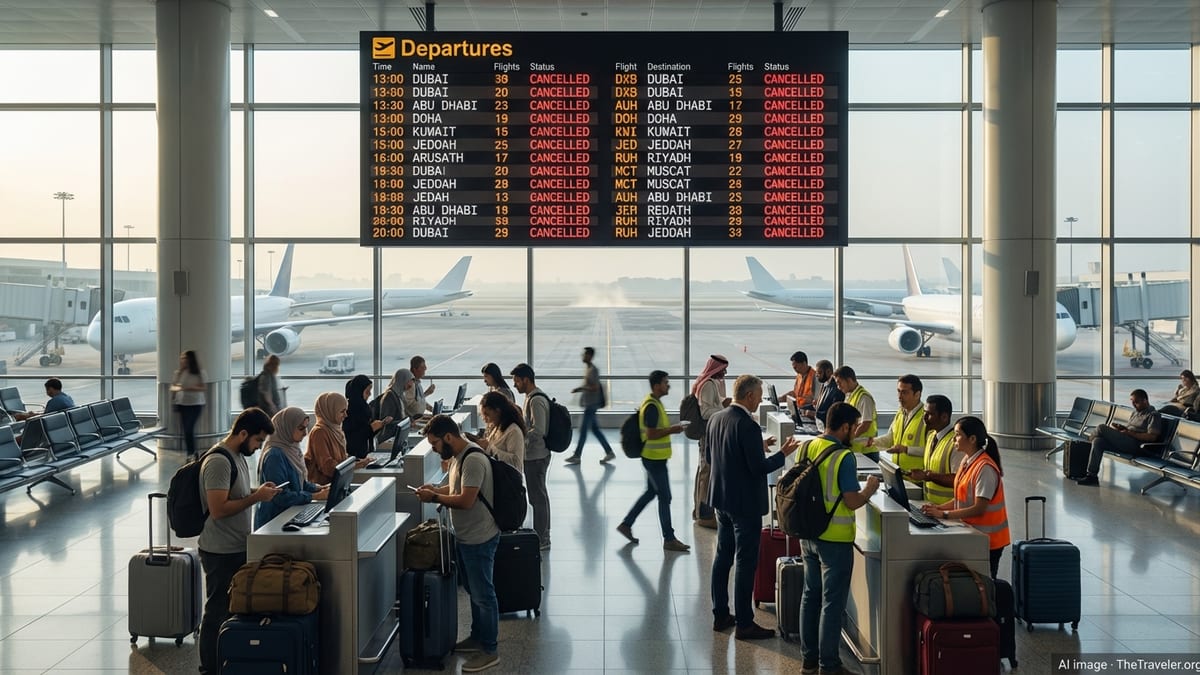
Pune–Gulf Links Severed Overnight
International connections from Pune to key Gulf hubs were among the first visible casualties for Indian travelers as the crisis deepened. Pune Airport officials confirmed that three overseas services to Dubai and Abu Dhabi were cancelled over the weekend after airspace over sections of West Asia was abruptly shut to civilian traffic.
The affected services include SpiceJet flight SG 51 from Pune to Dubai, Air India Express flight IX 283 from Pune to Abu Dhabi and IndiGo’s 6E 1484/1483 Dubai–Pune–Dubai rotation. Passengers expecting late evening and overnight departures found themselves grounded with little warning, as security assessments changed hour by hour.
Airport authorities said airlines had begun pushing updates through their own digital channels, but many travelers only learned of the cancellations on arrival at the terminal. With the suspensions tied directly to regional airspace restrictions, carriers described the situation as beyond their control, even as customer queues formed at help desks for refunds and rebooking.
The disruption comes at a particularly sensitive time for outbound travel from western India, with school breaks, corporate travel and religious journeys converging in the weeks ahead. Local agents reported a spike in calls from families and workers due to transit through Dubai and Abu Dhabi to Europe and North America, seeking clarity on whether to postpone or reroute.
Dubai and Abu Dhabi Operations Partially Frozen
In the UAE, the impact has been even more dramatic, with Dubai and Abu Dhabi temporarily losing their long-held reputation as the region’s most reliable aviation hubs. Dubai Airports suspended flights at Dubai International and Al Maktoum International for several hours after multiple regional airspace closures, urging passengers not to travel to the airport unless explicitly advised by their airline.
Emirates and flydubai announced temporary halts to all flights to and from Dubai until mid-afternoon on Sunday, as authorities evaluated the security picture and coordinated safe corridors with air traffic control. Terminal departure boards at Dubai International quickly filled with red cancellations and indefinite delays, leaving thousands of passengers stranded in terminals and nearby hotels.
In Abu Dhabi, Etihad Airways issued an urgent suspension notice, halting all departures from Zayed International Airport until at least early afternoon local time. The carrier said it was working with regulators to restore operations gradually and offered complimentary rebooking within a defined travel window, as well as refunds for those who opted not to travel.
UAE authorities reported isolated incidents of falling debris and minor damage in parts of Abu Dhabi and Dubai, underscoring the proximity of the security crisis to the country’s main urban centers. While civil defense teams quickly brought local incidents under control, the government moved to restrict non-essential aviation activity, including recreational flying, as a precautionary step.
Airspace Closures Ripple Across the Middle East
The immediate cause of the aviation chaos was a sweeping series of airspace shutdowns declared by several Middle Eastern countries after a coordinated strike by the United States and Israel on targets in Iran. In response, Iran launched retaliatory missile and drone attacks at Israeli and allied assets in the region, putting key air corridors at the center of the confrontation.
Authorities in Israel, Jordan, Iran and Iraq moved swiftly to close their skies to civilian aircraft, while Gulf states hosting major US military installations, including Qatar, Kuwait and the UAE, imposed partial restrictions. Flight-tracking data showed large no-fly zones spreading over the eastern Mediterranean, the Gulf and swathes of the Levant, forcing long-haul aircraft to divert via more southerly or westerly routes.
Industry analysts warned that the near-simultaneous closure of multiple Middle Eastern airspaces could persist beyond the initial hours of the crisis. The region has become even more critical to global aviation since airlines began avoiding Russian and Ukrainian airspace, leaving Gulf and Levantine corridors as the main bridge between Europe and Asia. Any prolonged shutdown would add hours to flight times and raise operating costs on already stretched long-haul networks.
Regulators stressed that passenger safety remained the overriding priority and that restrictions would stay in place until the risk of missile or drone activity along civil routes had been reassessed. Airlines, for their part, cautioned that schedules could change at very short notice as military developments unfolded.
Global Airlines Reroute and Ground Services
Beyond India and the Gulf, carriers across North America, Europe and Asia scrambled to adapt. American, European and Asian airlines announced varying degrees of suspensions and diversions for services to Dubai, Doha, Abu Dhabi and other Gulf hubs, citing both government advisories and internal security assessments.
Some airlines opted to halt all services touching the Middle East for at least forty eight hours, including routes merely transiting the region on the way between Europe and Asia or between North America and South Asia. Others attempted to maintain limited schedules with significant rerouting, flying farther south over the Arabian Sea or detouring via North Africa to avoid conflict zones.
Indian long-haul carriers reported particular challenges, with aircraft en route to or from Europe and the east coast of the United States forced to divert mid-flight, return to origin or land at alternative airports. Travelers on multi-leg itineraries discovered that even if their own flight was operating, a closed hub or missing onward connection could still strand them far from home.
Aviation security experts cautioned that the industry has become more exposed to geopolitical flashpoints as available airspace narrows globally. Each new closure, they noted, shrinks the number of safe, efficient routes left for airlines trying to move people and cargo between continents, magnifying the effect of every new conflict on the travel ecosystem.
What Travelers From India and Beyond Should Expect Next
For passengers in Pune and other Indian cities with strong Gulf links, immediate priorities are basic: confirming whether their flight is operating and, if not, securing an alternative plan. Airlines and airports urged customers to rely on official apps and contact centers rather than turning up at terminals without a confirmed departure, warning that on-the-spot assistance capacity is stretched.
Travel agents across India reported a rush of inquiries from students, migrant workers and families due to depart for Dubai, Abu Dhabi and Doha in the coming days. Many are weighing whether to postpone non-essential trips until there is more clarity on airspace reopenings, particularly for journeys that rely on tight connections through the Gulf to Europe or North America.
Experts recommend that travelers build longer layovers into any itinerary that still passes through the Middle East, purchase flexible tickets where possible and maintain up-to-date contact information with airlines so that automatic notifications reach them promptly. Those already overseas and scheduled to transit through affected hubs are being advised to explore rebooking via alternative gateways such as Istanbul, Cairo or key European cities, subject to availability.
In Pune, the sudden cancellation of three Middle East services has highlighted just how dependent many second tier Indian cities have become on Gulf hubs for long haul connectivity. As the conflict reshapes regional airspace, travelers and airlines alike are being forced to confront a more fragile and unpredictable map of global routes, where a distant missile strike can ground a weekend flight from a neighborhood airport with only a few hours’ notice.