

More news on this day
After more than five years of rolling border closures and tightly controlled pilot tours, Pyongyang is moving back into view for international travelers as North Korea reconnects air links, revives select tour programs and positions tourism as a tool for both economic relief and diplomatic signaling.
Get the latest news straight to your inbox!
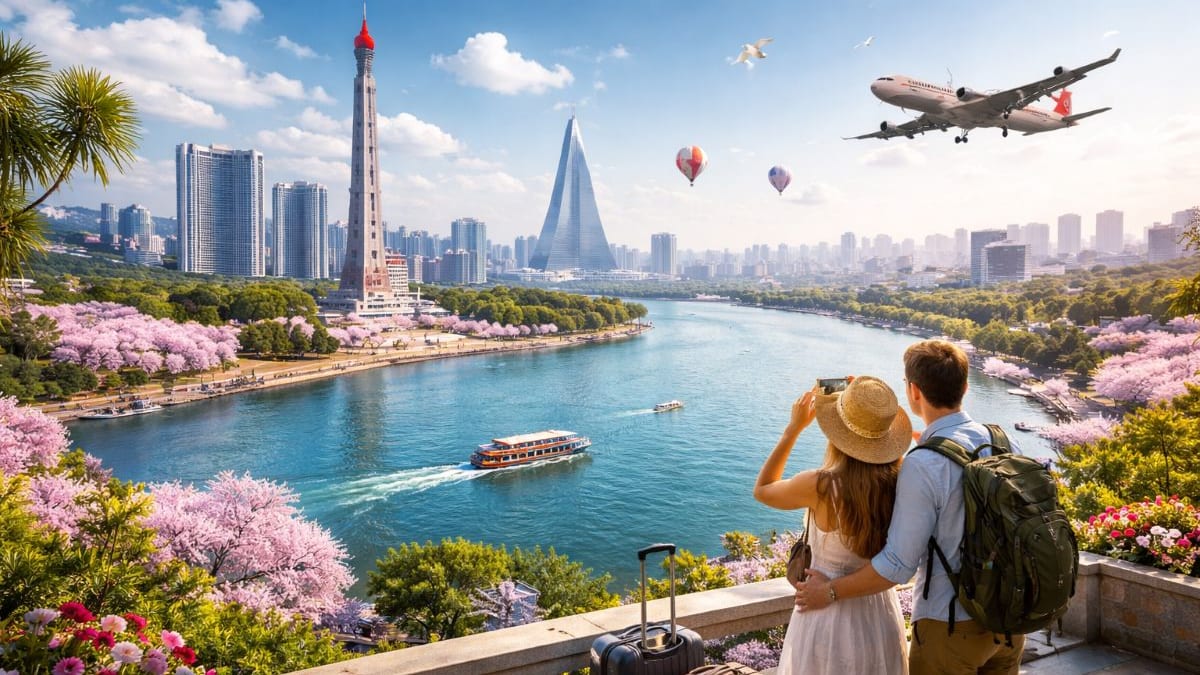
Image by Travel And Tour World
From Total Shutdown to Gradual Reopening
North Korea sealed its borders to foreign tourists in January 2020, cutting off a small but symbolically important industry that once brought in visitors from China, Russia and a handful of Western countries. Publicly available information shows that the near-total halt in cross-border movement extended well beyond the immediate health crisis, becoming one of the world’s longest pandemic-era closures.
Since early 2024, a series of cautiously managed steps has reshaped that picture. Reports indicate that Russian tourists were among the first foreign leisure visitors allowed back, with organized trips to Pyongyang and resort areas promoted from Russia’s Far East. By 2025, small groups of Western travelers were able to enter border cities such as Rason under special arrangements, suggesting that tourism authorities were testing new procedures and security protocols before opening the capital more widely.
Specialist tour operators that track developments in the country describe a pattern of brief openings followed by abrupt pauses, particularly in regional zones like Rason and the Wonsan Kalma coastal resort. Even so, these short windows have been seen by analysts as trial runs for a broader return to structured, pre-approved itineraries centered on Pyongyang and showcase destinations linked to the country’s leadership and revolutionary history.
Flights and Trains Put Pyongyang Back on the Map
One of the clearest signs that Pyongyang is again reachable for international travelers is the restoration of transport links. According to published coverage, North Korea’s flag carrier resumed limited services between Pyongyang and Beijing in 2023, a crucial air bridge for foreign visitors and diplomats alike. In 2025 and 2026, Russian and Chinese carriers added or revived their own routes, including direct flights from Moscow and the resumption of services between Beijing and the North Korean capital.
Rail connections have followed a similar trajectory. Passenger trains between Beijing and Pyongyang, suspended at the start of the pandemic, have restarted on a limited schedule, alongside renewed services on the Dandong corridor that historically carried large numbers of Chinese tourists and traders. Travel industry observers note that these links are essential for scaling up group tours, particularly from neighboring countries that once dominated visitor numbers.
Travel agencies that specialize in North Korea tours also point to the confirmation of future international events in Pyongyang, including a major marathon race in 2026, as evidence that authorities are planning for larger inflows of foreign participants. While general tourism visas are still described as restricted or granted primarily via organized groups, the renewed flow of planes and trains into the capital marks a turning point after years in which even humanitarian and diplomatic traffic was heavily curtailed.
Economic Lifeline and Diplomatic Signal
Tourism has long been viewed by analysts as one of the few sectors where North Korea can attract foreign currency without dramatically changing its economic model. Before 2020, package tours from China and, to a lesser extent, Russia and Europe brought thousands of visitors a year to landmarks in Pyongyang, the Demilitarized Zone and regional cities. With the economy under pressure from sanctions and prolonged border closures, the gradual reopening to international travelers is widely interpreted as an attempt to revive this revenue stream.
Recent tour promotions highlight itineraries that combine the capital with flagship projects such as ski slopes, hot spring resorts and beach complexes. Public information suggests that Pyongyang aims to showcase modern urban development, new public facilities and carefully curated cultural performances to visitors, reinforcing long-standing efforts to project an image of stability and controlled prosperity.
The new travel corridors also carry diplomatic weight. Expanded tour flows from Russia coincide with closer political and military cooperation between Moscow and Pyongyang, while the restoration of Chinese flights and trains underscores the enduring importance of Beijing as North Korea’s main commercial partner. Analysts note that choices about which nationalities are welcomed, and when, function as signals of the country’s external priorities as much as economic calculations.
Strict Controls Shape the Visitor Experience
Although Pyongyang is reappearing on international itineraries, the style of travel remains tightly choreographed. Tour descriptions and traveler accounts compiled by operators emphasize that visitors are confined to pre-approved routes, accompanied by local guides and subject to restrictions on movement, photography and personal electronics. Overnight stays are usually concentrated in designated hotels in the capital or at flagship resort zones.
Health-related protocols, introduced during the pandemic, continue to influence logistics. Reports from recent group trips describe health checks on arrival, controlled contact with local populations and contingency measures that can lead to last-minute itinerary changes. In several cases, access to newly opened destinations such as coastal resorts has been granted briefly, then suspended, underlining the risk that political or security concerns can override tourism plans with little warning.
Insurance providers and travel advisory services continue to classify North Korea as a high-risk destination, citing both the absence of consular assistance for some nationalities and the potential for sudden policy shifts. Governments in countries including the United States and South Korea maintain restrictions or outright bans on citizen travel to the North, which will limit the diversity of visitors even as Pyongyang increases capacity for others.
Outlook for Travelers Considering Pyongyang
For would-be visitors, the emerging picture is one of opportunity tempered by uncertainty. Pyongyang is again accessible to selected groups via organized tours departing from China and Russia, and marquee events scheduled in the capital indicate that authorities are prepared to host larger numbers of foreign guests than at any time since early 2020. At the same time, the stop-start history of post-pandemic openings suggests that any travel plans must account for the possibility of abrupt changes.
Travel companies that monitor conditions in North Korea advise potential travelers to build flexibility into itineraries, remain attentive to entry requirements and follow both their operator’s guidance and their own government’s travel advisories. They also stress the importance of understanding the limitations that define travel in the country, from restricted movement to strict rules on behavior and communication.
As flights land once more in Pyongyang and international visitors return to its broad boulevards and monumental architecture, the capital’s reopening stands out as a rare example of cross-border engagement in an otherwise highly insulated state. Whether this will evolve into a stable, long-term revival of tourism, or remain a carefully managed experiment subject to geopolitical winds, will be closely watched by the global travel industry and policy analysts alike.