

More news on this day
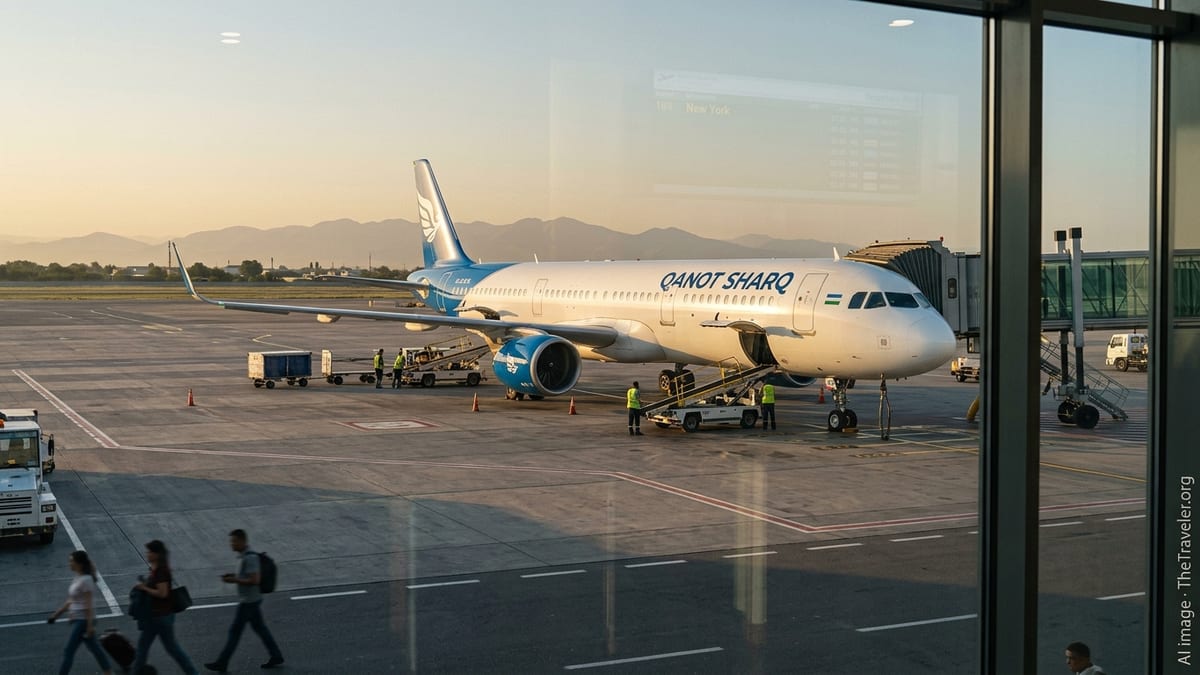
Uzbekistan’s fast-growing private carrier Qanot Sharq is moving to launch Tashkent to New York flights, a high-profile step that would place a new Central Asian brand on the transatlantic map and introduce rare competition on one of the region’s most strategically important long-haul routes.
Get the latest news straight to your inbox!
New Player Eyes Tashkent–New York Corridor
Publicly available filings and regional aviation coverage indicate that Qanot Sharq has applied to United States authorities for permission to operate services linking Tashkent with New York, positioning itself as Uzbekistan’s first private airline to attempt scheduled transatlantic passenger operations.
The proposed service would add a second Uzbek carrier on the Tashkent–New York corridor, which has for years been served by state-owned Uzbekistan Airways using Boeing 787 aircraft. Industry observers note that a new entrant on the route would be a notable shift in a market long dominated by flag carriers across post-Soviet Central Asia.
Reports suggest the initial plan centers on a twice-weekly operation connecting Tashkent and New York John F. Kennedy International Airport, aligning with Qanot Sharq’s broader strategy of building a network that links Uzbekistan more directly with Europe, the Middle East and Asia. Final schedules, launch dates and ticket sales will depend on the outcome of the US regulatory process.
The move comes as demand for travel between Central Asia and North America steadily increases, fueled by growing diaspora communities, student flows and business ties. A second carrier on the route could widen choices for travelers who today largely rely on a limited number of nonstop or one-stop options via major European and Middle Eastern hubs.
Budapest Stopover and Route Design
Details emerging from international aviation analysis point to a proposed routing that would see Qanot Sharq operate Tashkent–Budapest–New York services, using traffic rights on the intermediate sector to support overall route economics. Such a structure could enable the airline to draw passengers not only from Uzbekistan but also from Central and Eastern Europe.
The Budapest stopover would position the flight within a region already familiar with east–west transfer traffic and could offer additional itinerary options for travelers moving between North America, Central Asia and surrounding markets. For leisure passengers, a short European stopover may also enhance the appeal of the journey by adding a secondary city break.
Analysts say that a one-stop operation via Budapest allows Qanot Sharq to match aircraft range with market demand while managing risk on a new long-haul venture. It provides the flexibility to adjust capacity on each leg as the airline gauges passenger response from both Uzbekistan and connecting markets.
While a final timetable has not yet been published, industry scheduling data and commentary suggest that flights would likely be timed to facilitate onward domestic and regional connections at Tashkent, as well as evening or overnight departures that align with transatlantic bank structures at New York.
Fleet Investments Enable Longer-Haul Ambitions
Qanot Sharq’s transatlantic ambitions are closely tied to its evolving fleet strategy. The airline has signed leasing agreements for a mix of Airbus A321neo LR and XLR aircraft, long-range single-aisle jets designed to open thinner intercontinental routes that do not justify traditional widebody capacity.
According to information from aircraft lessors and aviation news outlets, the carrier is due to receive several A321neo variants with additional fuel capacity, allowing flights of up to roughly eight hours or more, depending on configuration and operating conditions. These jets are expected to form the backbone of Qanot Sharq’s medium and long-haul network, including deeper European markets and potential transcontinental links.
The airline has already taken delivery of its first A321XLR in a livery that prominently highlights Uzbekistan’s national branding, underlining its role as a privately owned complement to the country’s flag carrier. The new-generation aircraft are seen as a way to combine lower fuel burn with the range needed to contest routes traditionally served by larger widebodies.
In parallel, public information on previous deals shows that Qanot Sharq has experience operating widebody Airbus A330 aircraft under arrangements with Uzbekistan Airways, giving the airline operational exposure to long-haul flying and high-capacity missions. This background could prove useful as it steps into more complex intercontinental scheduling and crew planning.
Competition and Connectivity in Central Asia
The potential launch of Qanot Sharq services to New York would arrive at a time when Central Asia’s aviation sector is undergoing rapid change, with new private carriers entering the market and established airlines expanding fleets to tap growing travel demand. Tashkent in particular is being positioned by national strategies as a hub that can link Europe, Asia and North America.
Uzbekistan Airways already offers nonstop flights between Tashkent and New York, and has recently outlined widebody fleet expansion plans that include additional Boeing 787 aircraft. The presence of a second Uzbek operator on US-bound routes would add an extra layer of competition, which analysts say can lead to more diverse fare structures, cabin products and transfer options.
For travelers across the wider region, from Kazakhstan and Kyrgyzstan to Tajikistan and Turkmenistan, additional capacity via Tashkent could provide an alternative to connecting through larger hubs in Istanbul, Doha, Dubai or major European capitals. Publicly available commentary notes that Uzbekistan’s geography allows for efficient routings between parts of South and Central Asia and the eastern United States.
Regional tourism officials and business groups have long pointed to air connectivity as a bottleneck for inbound investment and visitation. New long-haul services, even at modest initial frequencies, are often seen as catalysts for hotel development, conference activity and trade missions, particularly when they plug emerging destinations directly into global financial centers such as New York.
Regulatory Path and What Travelers Can Expect
Before any tickets go on sale or aircraft depart, Qanot Sharq’s plan must clear the regulatory process in the United States, where agencies assess foreign air carrier applications for safety, ownership structure and competitive impact. Available filings show that the airline is seeking the necessary permissions to operate regular passenger services and to market its flights under its own code.
Industry analysts emphasize that such applications can take time to move through review, with potential requests for additional documentation or clarifications. Only once approvals are granted can the airline lock in start dates, formally load schedules into reservation systems and begin coordinated marketing efforts in both Uzbekistan and North America.
If the route proceeds as outlined, travelers can expect narrowbody long-range aircraft configured with a mix of economy and premium seating, onboard service tailored to both Uzbek and international passengers, and schedule patterns that seek to capture both visiting friends and relatives traffic and business travelers. Pricing will likely be influenced by competition from existing nonstop services and one-stop itineraries via foreign hubs.
For now, the prospect of Qanot Sharq flights between Tashkent and New York is being closely watched by aviation enthusiasts and market observers, who view it as part of a broader story of private-sector growth in Central Asian aviation. The outcome of the approval process and the route’s eventual performance will offer a revealing test of how far a relatively small carrier from the region can go in reshaping long-haul travel patterns.