

More news on this day
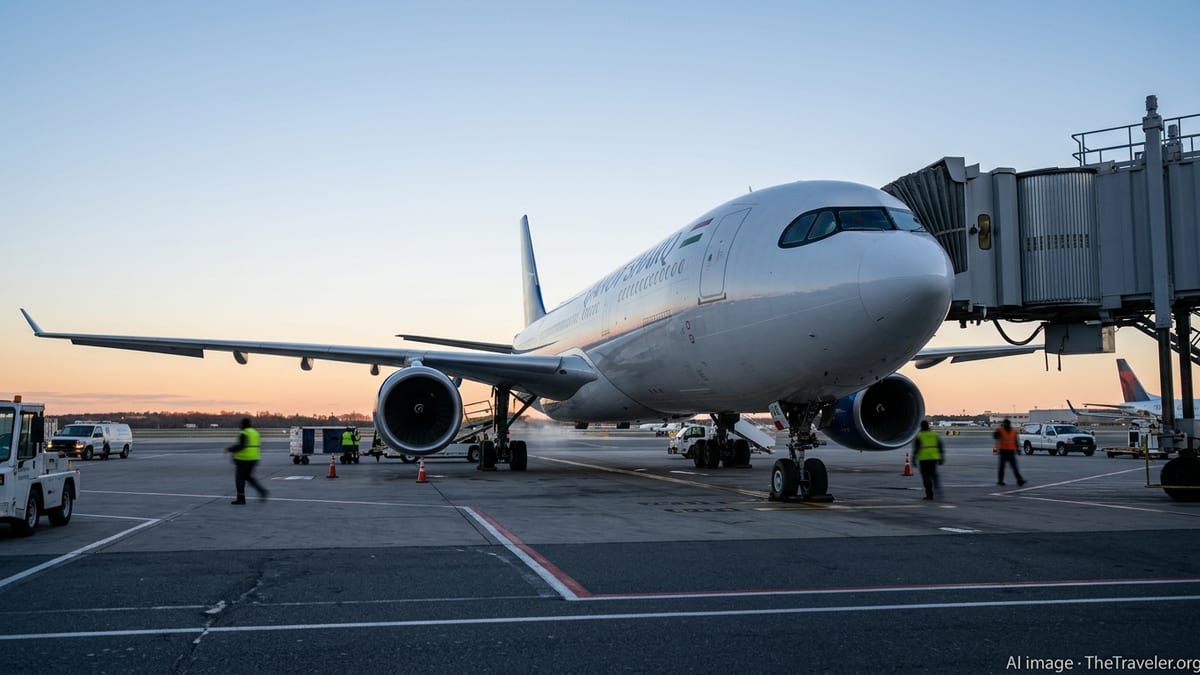
Uzbekistan’s private airline Qanot Sharq is moving to launch direct services between Tashkent and New York, a step that would break state carrier Uzbekistan Airways’ longstanding monopoly on nonstop flights linking Central Asia and the United States.
Get the latest news straight to your inbox!
Private Challenger Enters a Strategic Long Haul Market
Publicly available filings and media coverage show that Qanot Sharq has applied to the United States Department of Transportation for permission to operate regular charter flights on the Tashkent–New York route. The proposed service would run twice weekly between Islam Karimov Tashkent International Airport and New York’s John F. Kennedy International Airport, using widebody aircraft suitable for the more than 10-hour transcontinental sector.
Industry reports indicate that Qanot Sharq is seeking a foreign air carrier permit, a regulatory step required before a non-US airline can conduct commercial services to the country. The move follows Uzbekistan’s attainment and retention of a Category 1 safety rating from the US Federal Aviation Administration, which allows Uzbek carriers to operate and expand direct services to American destinations.
While Uzbekistan Airways has served New York for years as the national flag carrier, no private Uzbek airline has previously connected the country directly with the United States. If approved, Qanot Sharq’s entry would represent a significant milestone in the liberalization of Uzbekistan’s aviation sector and a visible marker of growing competition on long haul routes.
Breaking a Longstanding Monopoly on the Tashkent–New York Route
Since the mid-1990s, Uzbekistan Airways has been the sole operator of direct passenger flights between Tashkent and New York, initially with one or two services per week and today with a regular schedule using modern widebody aircraft. Schedules and aviation databases currently list the state-owned carrier as the only airline offering nonstop flights on the TAS–JFK pairing, effectively giving it a monopoly on direct air links between Central Asia and the United States.
Commentary from aviation analysts and regional observers notes that Qanot Sharq’s planned service would break that monopoly once operational. The new entrant would introduce a second Uzbek carrier on the route, providing travelers with an alternative to the national airline and potentially putting downward pressure on fares between Central Asia and the US East Coast.
The development is notable beyond Uzbekistan’s borders. Reports highlight that Uzbekistan Airways is currently the only airline based in the post-Soviet Central Asian republics operating nonstop flights to the United States. A Qanot Sharq service from Tashkent to New York would therefore not only reshape competition at home but also broaden the region’s still limited set of direct transatlantic options.
What the New Service Could Mean for Travelers
Travel industry data and regional coverage suggest that the Tashkent–New York route serves a mix of passengers, including Uzbek citizens, diaspora communities, business travelers, and tourists from neighboring Kazakhstan, Kyrgyzstan, Tajikistan, and Turkmenistan. Many of these travelers currently rely on Uzbekistan Airways or connect through hubs in Istanbul, Doha, Dubai, or major European cities to reach the United States.
If Qanot Sharq’s application is approved, additional capacity on the nonstop route could alter booking patterns. More seats and a second brand on the market often translate into more competitive pricing, varied onboard products, and greater schedule flexibility. For travelers using New York as a gateway, the presence of two Uzbek carriers could also encourage stronger interline and codeshare arrangements with US and third-country airlines.
Uzbekistan has actively promoted tourism and business travel in recent years, easing visa procedures for many nationalities and investing in airport infrastructure. A more competitive transatlantic offering may support these efforts by making it easier for visitors to access popular destinations such as Samarkand, Bukhara, and Khiva with fewer connections and shorter total journey times.
Qanot Sharq’s Growing International Footprint
Qanot Sharq, headquartered in Tashkent, has been steadily expanding its network beyond regional routes to include long haul and high-profile international destinations. Public reports point to the airline’s growth on routes such as Tashkent–Shanghai and Tashkent–London, where it has obtained the necessary regulatory approvals from foreign authorities and launched regular scheduled services alongside existing operations by Uzbekistan Airways.
The carrier has also been modernizing its fleet, including the introduction of new-generation Airbus aircraft tailored for medium and long haul missions. Aviation industry coverage notes deliveries of longer-range models that enable nonstop services to more distant markets while maintaining fuel efficiency, a factor that can be critical for the economics of thinner long haul routes like Tashkent–New York.
This gradual build-up of experience in complex international markets appears to underpin Qanot Sharq’s confidence in tackling a demanding transatlantic corridor. Its progression from regional flights to major global cities positions the airline to leverage brand recognition, operational know-how, and fleet capabilities as it seeks access to the United States.
Regulatory Timeline and Wider Market Implications
The timing of Qanot Sharq’s New York plans will depend on approvals from US authorities and coordination with Uzbekistan’s own civil aviation regulators. Reports on the application process suggest that, if granted, permission could pave the way for operations to begin in 2025 or 2026, though the exact launch date will hinge on regulatory, commercial, and fleet deployment decisions.
For Uzbekistan’s aviation market, the prospect of a second airline serving New York fits into a broader pattern of diversification. Other private and startup carriers in the country have been opening new routes within Central Asia, the Middle East, and Europe, gradually reducing the dominance that the national airline once held on many international city pairs.
On a regional level, Qanot Sharq’s bid underscores shifting dynamics in Central Asian connectivity. As countries in the region seek closer trade and tourism ties with North America and Europe, direct long haul flights are viewed as strategic assets that raise visibility and shorten travel times. The planned Tashkent–New York service, if realized, would stand as one of the highest-profile examples of this trend, signaling that competition and choice are beginning to reach even the most established routes.