

More news on this day
Qantas’ long-awaited “Project Sunrise” is moving closer to reality, with the airline targeting early 2027 to launch nonstop ultra-long-haul flights between Sydney and London Heathrow that are expected to become the world’s longest regular commercial services and a potential game-changer for Australia–UK tourism.
Get the latest news straight to your inbox!
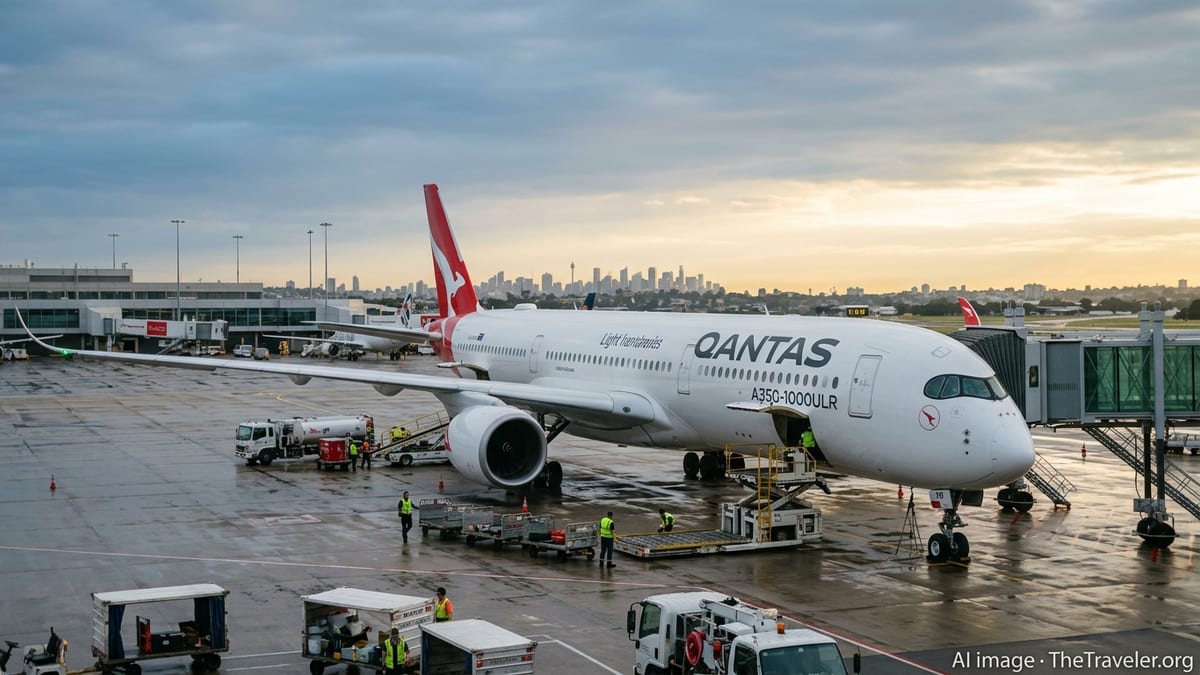
Project Sunrise: A New Chapter for the Kangaroo Route
The Sydney to London journey, long known as the Kangaroo Route, has traditionally required at least one stop, often in Asia or the Middle East. Project Sunrise aims to compress that multistage itinerary into a single flight of around 20 hours, using a specially modified Airbus A350-1000 configured for extreme range and passenger comfort. Publicly available information from the airline and aircraft manufacturer indicates that the first of these ultra-long-range A350-1000ULR jets is due to arrive in late 2026, with commercial operations from Sydney following after several months of testing and crew training.
Industry coverage indicates that Qantas is targeting early 2027 for the start of nonstop Sydney–London Heathrow and Sydney–New York services, with London expected to be among the flagship routes. The airline has described these flights as the “final frontier” of long-haul travel, extending well beyond today’s longest commercial sectors. For travelers used to breaking the journey in hubs such as Singapore, Dubai or Singapore, the direct service represents a significant shift in how and where they move between Australia and the United Kingdom.
While schedules and exact start dates have not yet appeared in reservation systems, recent reporting from aviation and travel outlets highlights that Qantas will need at least three A350-1000ULR aircraft in service to maintain a daily nonstop between Sydney and London Heathrow. That fleet build-up is expected to occur through 2027, suggesting an initial ramp-up period before the route settles into a regular pattern of operation.
The Aircraft: Inside Qantas’ Ultra-Long-Range A350
At the heart of the new route is the Airbus A350-1000ULR, tailored specifically to fly more than 10,000 nautical miles without refuelling. Aviation analysts note that regulators approved additional fuel capacity for this variant, extending the aircraft’s range to around 18,000 kilometres. This makes it technically possible to fly the approximately 16,900-kilometre great-circle distance between Sydney and London non-stop, factoring in typical routing and weather conditions.
Qantas has opted for a relatively low-density cabin layout of about 238 seats across four classes, significantly fewer than many standard A350-1000 configurations. Publicly released cabin information indicates six first-class suites, 52 business-class suites, 40 premium economy seats and 140 economy seats. The design focuses on generous personal space, with larger seat pitches than typical long-haul aircraft, and aims to mitigate the physical demands of 20-plus hours in the air.
One of the most discussed features is a dedicated “wellbeing zone” located between cabins. Renderings and descriptions shared in recent coverage show an open area where passengers will be able to stand, stretch and access hydration and light snacks away from their seats. The zone is intended to encourage movement, support circulation and combat fatigue on a flight that is expected to cross multiple time zones and two calendar days.
Crew rest facilities will also be expanded, with separate bunk areas allowing multiple rest shifts over the course of the flight. For passengers in the premium cabins, fully flat beds, upgraded bedding and refined lighting programs are being positioned as key tools in helping travelers arrive in London or Sydney more rested and better aligned with local time.
Timings, Flight Experience and Heathrow Operations
Exact schedules for the Sydney–Heathrow nonstop have not yet been filed, but expert analysis points to a likely pattern that balances Sydney’s curfew, Heathrow’s capacity constraints and the need to optimise arrival times for connections at both ends. Some aviation commentators suggest a morning or early afternoon departure from Sydney, timed to arrive in London early in the evening, with a return flight leaving Heathrow late in the evening to reach Sydney in the early morning.
These timings would seek to protect onward connection windows at Heathrow while avoiding the most heavily congested daytime arrival banks. The challenge is compounded by Heathrow’s slot restrictions and night-flight limitations, which mean Qantas will have to integrate the ultra-long-haul into one of the world’s most tightly managed airfields. Industry observers note that this may influence not only departure times but also which terminal and gate facilities are used for the Project Sunrise flights.
On board, the carrier is expected to lean heavily on sleep science, tailored inflight dining and lighting sequences to help passengers manage jet lag. Reports indicate that Qantas has already trialled experimental ultra-long-haul flights with volunteer passengers and crew to study sleep, activity and mood. The findings from those test flights are being used to inform meal timing, menu composition, cabin temperature and light intensity throughout the journey.
Connectivity is also expected to play a central role. While detailed specifications are still emerging, industry coverage points to upgraded onboard Wi-Fi, expanded inflight entertainment and more accessible power outlets in all cabins. Together, these elements are designed to support both leisure and business travelers who may wish to work, sleep and relax at different stages of the 20-hour sector.
Tourism and Business Travel: What It Means for Australia–UK Flows
The 2027 launch of nonstop Sydney–Heathrow services is likely to carry implications well beyond aircraft technology. Tourism analysts argue that shortening total journey time and eliminating connections could stimulate new demand, particularly among travelers who previously viewed the multiple-stop trip as too arduous. For UK visitors, the promise of boarding in London and stepping off directly in Sydney may encourage more frequent long-haul holidays, extended stays and multi-city itineraries within Australia.
For Australian travelers, especially those in New South Wales and surrounding regions, the nonstop option could shift booking patterns away from traditional one-stop hubs. Some industry commentary suggests that Middle Eastern and Asian carriers may see a modest impact on their Australia–UK traffic, particularly in premium cabins, although connecting options will likely remain important for price-sensitive travelers and those preferring breaks along the way.
Business travel stands to benefit from time savings that can amount to several hours each way compared with typical one-stop journeys. Corporate travel managers may consider the nonstop service particularly attractive for time-critical trips, with the ability to work and sleep in a consistent cabin environment from origin to destination. However, fare levels and corporate contracts will play a key role in how quickly business travelers adopt the new route.
There may also be knock-on effects for regional tourism within Australia. With Sydney positioned as the Project Sunrise gateway, tourism boards are expected to highlight easy onward connections to destinations such as the Great Barrier Reef, the Red Centre and Tasmania. If the route proves successful, future nonstop services from Melbourne to London, also discussed in public planning documents, could further broaden access for UK visitors.
What Travelers Should Watch Before Booking 2027 Flights
Although anticipation is high, travelers looking to plan around the Sydney–Heathrow nonstop should note that several details remain subject to change. Fleet delivery schedules for the A350-1000ULR have already shifted from original timelines, and aviation media continues to flag ongoing supply chain and manufacturing pressures in the widebody sector. Any further delays could push back the start of Project Sunrise services or affect their initial frequency.
Potential passengers will also want to monitor how the new flights are priced relative to one-stop alternatives. Industry analysts expect a premium for nonstop ultra-long-haul seats, particularly in the early years of operation and in business and first class. Over time, competitive responses from other airlines and evolving demand patterns may influence fare levels.
Another key factor is personal tolerance for very long flights. While the nonstop route removes the inconvenience of connecting, some travelers may prefer a break on the ground for rest and movement. Travel advisers suggest that passengers consider their own comfort preferences, seating choices and health considerations when deciding between a direct 20-hour sector and a one-stop itinerary.
As 2027 approaches, travelers can expect a gradual rollout of more detailed information, including confirmed schedules, cabin walkthroughs and fare structures. For now, the planned Sydney–London Heathrow nonstop stands as one of the most closely watched developments in global aviation, promising to redefine how tourists and business travelers move between Australia and the United Kingdom.