

More news on this day
Qantas is doubling down on premium cabins, using superjumbos and ultra-long-range jets to chase high-yield corporate and affluent leisure travelers on some of the world’s most important business corridors.
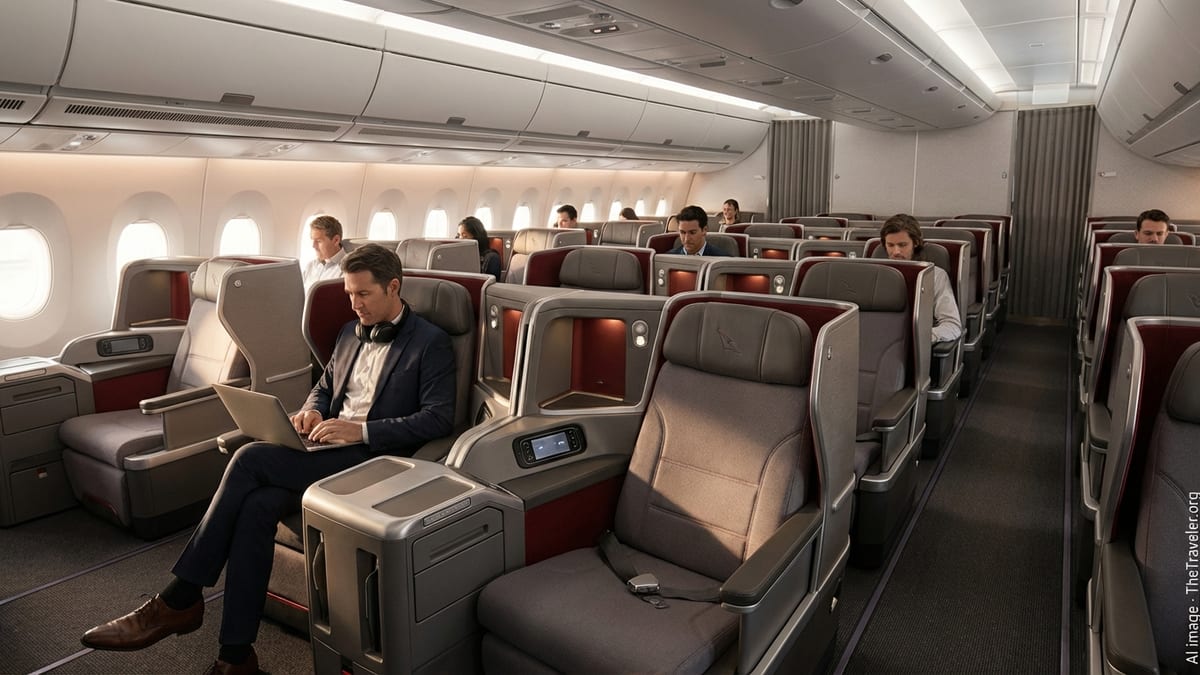
Premium Demand Drives a New Long-Haul Strategy
From Asia to Europe and North America, Qantas is reshaping its long-haul network around passengers willing to pay more for space, privacy and productivity in the air. Rather than maximizing overall seat numbers, the airline is steadily tilting its fleet and schedules toward business, first and premium economy, aligning capacity with a structural shift in demand that has emerged since the pandemic.
Corporate travel to and from Australia has recovered more slowly in pure volume, but airlines and travel managers report that when executives do fly, they are trading up. Qantas executives have repeatedly highlighted that premium cabins are outperforming economy on key long-haul routes, and that customers are proving willing to pay a fare premium for non-stop or near-non-stop itineraries that save hours of travel and reduce disruption.
This has set the stage for a strategy in which Qantas increasingly uses aircraft and schedules as precision tools, directing its most premium-heavy jets onto trunk business markets such as Sydney to Singapore, London and New York. The result is a network designed less around sheer capacity and more around yield, loyalty and the needs of high-spending travelers.
A380 Superjumbos Return as Premium Workhorses
Central to Qantas’s premium pivot is the redeployment of its refurbished Airbus A380 fleet on long-haul business routes. The carrier has progressively brought the double-decker jets back into service with upgraded first and business cabins, a larger premium economy section and an expanded upper-deck lounge aimed squarely at frequent flyers looking to work, meet and relax in flight.
The impact is particularly visible on the busy Sydney–Singapore corridor, a vital link for finance, resources and tech traffic between Australia and Southeast Asia. From late 2026, Qantas will almost double A380 frequencies on the route, replacing smaller Airbus A330s on additional rotations and lifting weekly A380 services from seven to thirteen. That change increases overall capacity while disproportionately boosting higher-yield seats.
On each A380, business class jumps to around 70 suites in a 1-2-1 configuration, up from 28 business seats on the A330s previously used, while first class expands to 14 suites and premium economy rises to 60 seats. The move delivers a 37 percent rise in business class capacity and an 86 percent lift in first class on Singapore–Sydney, a clear signal that Qantas sees enduring demand for premium cabins on regional long-haul routes feeding its global network.
The A380 upgrades go beyond seat counts. New business suites marketed by frequent flyers as “mini first” feature direct aisle access, greater privacy and enhanced storage, while the upper-deck lounge now offers curated snacks, cocktails and a social workspace. These refinements are designed to keep Qantas competitive against Asian and Middle Eastern carriers that have long marketed their own premium-heavy flagships on Australia services.
Project Sunrise: Ultra-Long-Haul Built Around Premium Cabins
While the A380 strengthens existing long-haul flows, the centerpiece of Qantas’s premium strategy is Project Sunrise, the ambitious plan to launch non-stop flights from Sydney to London and New York in 2027. To operate these routes, Airbus is assembling a bespoke A350-1000ULR fleet for Qantas with an unusually low-density, premium-heavy layout.
Unlike typical A350-1000s, which carry 300 to 350 passengers, Qantas’s version will seat only about 238 people, with more than 40 percent of the cabin area devoted to first, business and premium economy. First class will comprise enclosed suites with separate recliners and beds, while business class will feature next-generation suites with doors and ample workspace. Premium economy will offer generous legroom and enhanced recline, while even economy benefits from extra pitch compared with many competing long-haul configurations.
This reduction in seats, combined with an additional 20,000-litre fuel tank, allows the aircraft to fly up to 22 hours, covering the 10,000-mile Sydney–London sector non-stop. Qantas has flagged that fares on these routes will carry around a 20 percent premium over traditional one-stop itineraries, reflecting both the cost of operating ultra-long sectors and the time savings for travelers. Early plans indicate Sydney–New York is likely to launch first, followed by Sydney–London once further aircraft arrive and regulatory approvals are in place.
Cabin design on the Sunrise A350s is also tailored to the physical demands of 19 to 22-hour flights. A dedicated wellbeing zone between premium economy and economy will provide standing space, stretch areas and hydration stations, informed by Qantas-backed research into jet lag and circadian rhythms. For business travelers expected to land and go straight into meetings, these wellness elements are being positioned as part of the value proposition alongside privacy, connectivity and direct routings.
Rewiring Corporate Travel Between Australia and the World
For global corporates with hubs in Sydney, Melbourne, Singapore, London and New York, Qantas’s premium-heavy strategy stands to materially change how long-haul trips are planned. The near doubling of A380 services on the Singapore–Sydney route gives companies more flexibility in scheduling same-day connections to Europe and North America, while expanding the pool of business and first seats at peak times.
The arrival of non-stop Sunrise services will go further, creating new patterns of travel that bypass traditional stopover hubs altogether. A Sydney-based executive heading to London, for example, could depart in a lie-flat business suite, sleep through much of a 20-hour sector and arrive without the disruption of a transit stop. For multinational firms paying for premium cabins, the calculus will increasingly weigh crew and employee productivity against the fare premium.
Qantas is also positioning these developments as a competitive lever in the corporate contracting and loyalty market. High-value travelers on Sunrise routes will be folded deeper into the airline’s frequent flyer ecosystem, which already generates substantial profit through partner airlines, banks and retailers. By offering distinctive ultra-long-haul products and more premium seats on key regional links, Qantas aims to anchor corporate accounts that might otherwise be tempted by rival carriers via Singapore, Dubai or Hong Kong.
At the same time, the shift carries risk. A premium-heavy fleet leaves Qantas more exposed if corporate demand softens or if economic conditions prompt businesses to trim travel budgets. But for now, early booking trends and the willingness of travelers to pay more for time-saving, non-stop options are reinforcing the airline’s conviction that the future of long-haul business travel lies in fewer seats, more space and ever-longer flights.