

More news on this day
Australia’s Qantas is deepening its commitment to Singapore, unveiling plans for a new cabin crew base in the city-state alongside a major increase in Airbus A380 services on the busy Sydney–Singapore route.
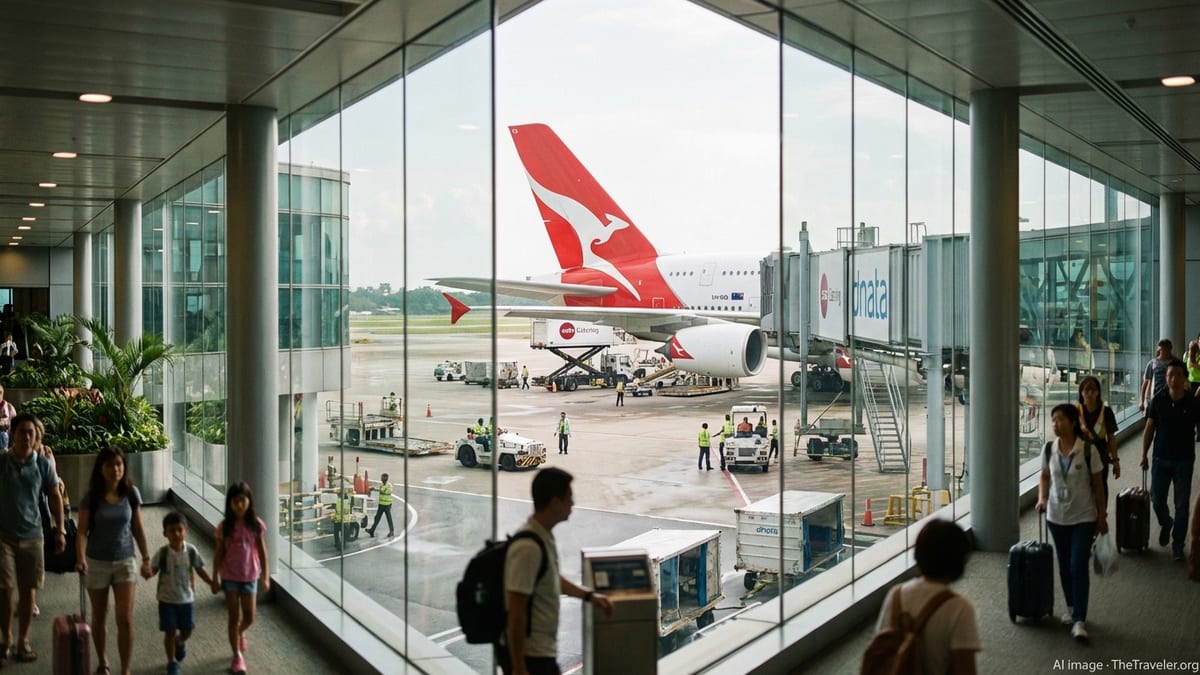
New Singapore Crew Base Marks Strategic Shift
Qantas will establish its first dedicated cabin crew base in Singapore from September 2026, a move that solidifies the carrier’s reliance on Changi Airport as its principal hub in Southeast Asia. The airline plans to recruit around 120 cabin crew in the first year, with headcount slated to grow to as many as 650 over the next five years as schedules expand.
The Singapore base will become Qantas’s fourth overseas crew outpost, joining London, Auckland and Wellington. It reflects the city-state’s position as Qantas’s largest international hub outside Australia, and its third-largest overall after Sydney and Melbourne, with flights linking Singapore to Sydney, Melbourne, Brisbane, Perth, Darwin and onward to London.
Executives say stationing crew in Singapore will allow the airline to run its international network more efficiently and respond faster to disruptions. With aircraft and crew already positioned in the region, Qantas expects to improve recovery times after weather events, air traffic congestion or technical delays on some of its most heavily trafficked long-haul services.
The decision is also closely aligned with Qantas’s broader fleet and network renewal. As more long-range and high-capacity aircraft are brought into service over the next several years, the airline is seeking to concentrate its resources in a handful of major hubs where it sees sustained premium and connecting demand.
Transition for Jetstar Crew and Regional Workforce
The new base in Singapore will also act as a bridge for affected staff within the Qantas Group following recent changes to low-cost operations in the city. Qantas has indicated it expects to offer new roles to roughly 50 Singapore-based cabin crew currently flying with Jetstar Airways, its Australia-headquartered budget subsidiary, which is closing its crew base in the city-state as part of a streamlined low-cost model.
Former staff from Jetstar Asia, which ceased operations in 2025, will also be eligible to apply for positions in the new Qantas operation. The airline says this will help it retain experienced, locally based aviation professionals while consolidating flying under the mainline brand on key regional and long-haul routes.
Industry analysts note that Singapore’s deep pool of multilingual crew and its status as an aviation employment hub make it an attractive location for Qantas to expand. The move is expected to offer more stable long-term opportunities for crew previously attached to short-haul low-cost operations, while giving Qantas access to a labour market familiar with the specific demands of high-density regional and intercontinental flying.
For Singapore, the decision reinforces Changi’s role as a base for high-quality airline jobs at a time when regional carriers are rebuilding networks and staffing levels after earlier retrenchments. It also strengthens the competitive position of the Australia–Singapore corridor, which is served by a mix of full-service and low-cost airlines out of both countries.
A380 Presence on Sydney–Singapore Nearly Doubles
Alongside the crew base announcement, Qantas is significantly upping capacity on its flagship Sydney–Singapore route by assigning its 485-seat Airbus A380 to nearly all services between the two cities. From early December 2026, 13 of the airline’s 14 weekly Sydney–Singapore and Singapore–Sydney flights will be operated by the double-deck superjumbo, with just one weekly rotation remaining on the smaller Airbus A330.
The change effectively almost doubles the number of A380 frequencies on the city pair and represents the highest volume of Qantas superjumbo departures ever scheduled from Singapore. The airline’s A380s offer four cabin classes including First, Business, Premium Economy and Economy, in contrast with the two-class A330, and will substantially increase premium seat availability on what is one of Qantas’s busiest international routes.
Capacity modelling indicates overall seats on Sydney–Singapore will rise by more than 20 percent from December, while First and Business Class capacity will see even steeper growth as the A380s replace A330s on the secondary daily QF81 and QF82 services. For travellers, the adjustment means more chances to secure First suites and lie-flat Business seats, particularly on peak days and during northern winter holiday periods.
The uplift on Sydney–Singapore follows earlier seasonal A380 deployments on the route in mid-2025 and northern summer 2026. By making the superjumbo a near-permanent fixture on both daily services from December, Qantas is signalling strong confidence in sustained premium and leisure demand between Australia and Southeast Asia.
Strengthening Australia–Singapore Travel and Trade Links
The expanded A380 operation and new crew base arrive at a time when flows between Australia and Singapore are rebounding strongly, driven by tourism, corporate travel and education. Singapore serves as a key gateway for Australian passengers heading to Europe, South Asia and parts of Southeast Asia, while also channelling inbound visitor traffic and investment into Australian cities.
For Sydney in particular, more A380 services mean additional inbound capacity for visitors and students, as well as expanded bellyhold cargo space for high-value freight. Aviation and tourism officials in New South Wales are likely to welcome the increased lift, which supports local hotels, hospitality and export sectors linked to the bilateral relationship.
Travel agents expect the extra premium seats to be especially attractive to corporate travellers and high-spend leisure passengers who value nonstop flying and the convenience of connecting through Singapore rather than more congested hubs further afield. With partner carriers in the same alliance also operating on the corridor, the enhanced Qantas schedule broadens connection options across Asia and Europe.
The move also fits into a broader trend of airlines redeploying A380s back onto trunk routes where slot constraints and dense demand patterns justify high-capacity aircraft. For Qantas, concentrating its superjumbos on marquee sectors such as Sydney–Singapore and onward to London allows it to maximise utilisation of the type while newer long-range jets are introduced elsewhere in the network.
Network Flexibility and Competitive Pressures
Qantas has been gradually returning all 10 of its A380s to service after long-term storage, and has repeatedly flagged Singapore as a core focus of its post-renewal network. The carrier is currently retuning its wide-body deployment in response to evolving demand patterns, shifting the A380 to routes where both premium and economy cabins can be filled consistently while using modern twinjets on thinner long-haul sectors.
In that context, the decision to anchor more capacity in Singapore serves a dual purpose. It enhances schedule resilience and connectivity across Asia, while also shoring up Qantas’s competitive stance against rival full-service carriers based in Southeast Asia and the Middle East, many of which have already restored or expanded high-capacity aircraft on Australian routes.
With the combination of a new crew base and near all-A380 operation between Sydney and Singapore, Australia’s flag carrier is effectively betting that the corridor will remain one of its most valuable international markets well into the second half of the decade. For travellers, the changes translate into more seats, more choice of cabin and a consistently upgraded onboard product on one of the region’s busiest air bridges.