

More news on this day
Hundreds of passengers across Australia have been left stranded or severely delayed after Qantas and its regional arm QantasLink grounded 21 flights and delayed a further 52 services today, causing rolling disruption at major airports in Canberra, Melbourne, Sydney, Brisbane and several regional gateways.
Major Airports Grapple With Sudden Wave of Cancellations
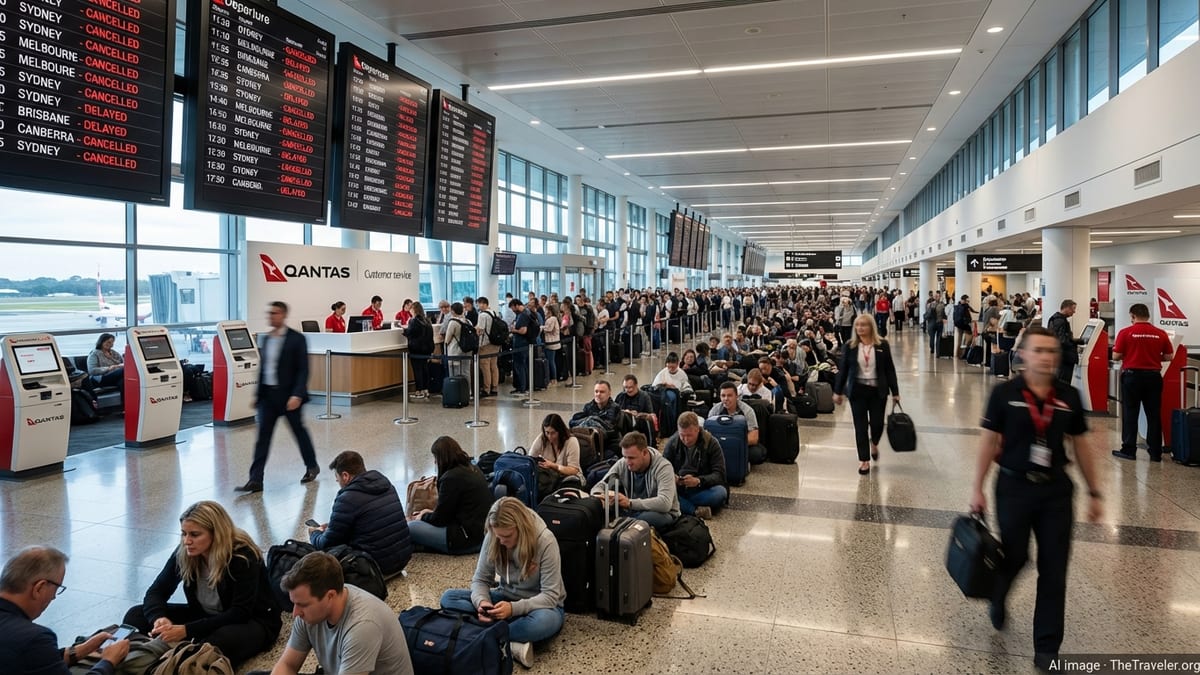
The latest wave of disruption hit at peak travel periods, with early morning and mid-afternoon departures among the worst affected as Qantas and QantasLink pulled multiple services from schedules with limited notice. Airport departure boards in Melbourne, Sydney, Brisbane and Canberra showed clusters of Qantas-branded services marked as cancelled or significantly delayed, triggering long queues at customer service desks and self-service kiosks.
Operational data reviewed by aviation analysts indicated that the combined tally for Qantas and QantasLink reached 21 grounded flights and 52 delayed services over the course of the day. While some of the delays were contained to under an hour, others stretched to well beyond two hours, disrupting onward connections and evening plans for domestic and regional travellers.
Melbourne and Sydney, the airline’s two largest hubs, bore the brunt of the disruption by sheer volume, but the impact was also sharply felt in Canberra and Brisbane, where Qantas and QantasLink account for a significant share of domestic movements. Regional links feeding into these hubs saw knock-on effects, with aircraft and crews out of position and schedules quickly backing up.
Airport staff reported a visible build-up of passengers in terminal seating areas as travellers waited for updates, while those on cancelled flights raced to secure scarce alternative seats on later departures or via different cities. Many were told that some rebookings would have to be pushed into the next day because of limited spare capacity.
Canberra and Regional Routes Hit Hard by QantasLink Disruptions
In Canberra, where QantasLink plays a crucial role connecting the national capital with regional centres and larger hubs, the grounding of multiple regional services created particular headaches for business travellers and public sector workers. Morning and late-afternoon flights from smaller cities into Canberra are heavily relied upon for same-day meetings, parliamentary business and medical visits, leaving many itineraries in tatters.
Passengers on affected QantasLink flights described being notified of cancellations via text messages and app alerts only after arriving at the airport, or learning of delays at security checkpoints. With regional frequencies already relatively low compared with trunk routes, the loss of even one or two rotations can mean no viable alternative until the following day.
Travel industry observers noted that the timing of the latest disruption is especially sensitive for QantasLink, coming amid political scrutiny of the carrier’s decision to close several regional crew bases. That move, intended to consolidate staff in major cities to improve reliability, has been criticised by unions and a parliamentary inquiry, and today’s cancellations have renewed questions about whether those structural changes are improving or undermining operational resilience.
Beyond Canberra, regional links to and from cities such as Hobart, Launceston and inland New South Wales communities experienced scattered delays as aircraft were reassigned to protect higher-volume trunk routes. Travel agents in smaller centres reported a spike in urgent calls from customers trying to salvage day trips and time-sensitive journeys.
Long Queues, Frayed Tempers and Scramble for Alternatives
Inside terminals, the human impact of the disrupted operation unfolded in familiar scenes of long queues and anxious conversations at departure gates. In Melbourne and Sydney, passengers stranded by cancelled services formed lines that snaked well beyond the rebooking counters as staff attempted to juggle hotel vouchers, meal allowances and seat availability on later flights.
Families heading off on school-holiday breaks and weekend getaways found themselves especially vulnerable, as fully booked services left limited flexibility to accommodate groups together. Some opted to accept separate seats on different flights or routings via other cities, while others abandoned their plans entirely after being offered departures a full day later than scheduled.
At Brisbane Airport, taxi ranks and rideshare pick-up areas saw a surge of travellers choosing to leave and return home rather than wait in the terminal for rolling estimates of new departure times. Others resorted to hiring rental cars for long overnight drives between east-coast cities, reporting that one-way vehicle availability tightened quickly as word of the disruption spread.
Airline staff on the ground were praised by many passengers for their efforts under pressure, but there was also frustration over perceived gaps in communication, particularly around the reasons for cancellations and realistic timelines for getting operations back on track. Several travellers reported receiving conflicting information from digital channels and gate announcements, deepening confusion.
Operational Strain Raises Questions Over Capacity and Resilience
The latest disruption has reignited debate over the robustness of Qantas’s domestic operation and, in particular, the resilience of the QantasLink regional network. Industry experts point to a convergence of factors that can trigger cascading delays, including tight aircraft utilisation, constrained crew availability and ongoing maintenance cycles for aging regional fleets.
When multiple issues occur simultaneously, carriers often face a choice between running a highly compromised schedule rife with extended delays or pre-emptively cancelling flights to restore some predictability. In this instance, the decision to ground 21 services suggests the airline sought to prioritise stabilising its network, though the immediate impact on passengers was severe.
Aviation analysts note that Australia’s geography leaves few quick alternatives when domestic air services falter. Distances between major cities are too great for rail to serve as a realistic backup in most cases, and long-distance coaches are often booked out during periods of flight disruption. This structural dependence on air travel magnifies the effect of even a relatively modest number of cancellations at a single carrier.
Observers say today’s events will likely feed into ongoing scrutiny from regulators and policymakers over the reliability of major airlines, especially on routes where competition is limited. Consumer groups have already called for clearer minimum standards around delay management, compensation and rebooking obligations to ensure travellers are not left bearing the brunt of systemic weaknesses.
Wave of Disruptions Follows a Season of Airline Turbulence
Today’s turmoil for Qantas and QantasLink passengers slots into a broader pattern of irregular operations across Australia and New Zealand in recent weeks. Data from aviation tracking services and travel industry monitors shows that major hubs including Sydney, Melbourne and Brisbane have repeatedly recorded high levels of delays and cancellations affecting a mix of domestic and international carriers.
In early February, hundreds of travellers across Australia and New Zealand faced widespread delays and cancellations across multiple airlines, highlighting how quickly operations can unravel when weather, crew rotations and technical issues coincide. Qantas and its regional arm have featured prominently in several of these disruption clusters, reflecting their market share and central role in domestic aviation.
While no single cause has been pinpointed for the latest Qantas-specific disruption, analysts suggest it reflects cumulative pressure on fleets and crews during a busy travel period, with little slack in the system to absorb unexpected issues. Travel insurers and corporate travel managers have responded by urging clients to build extra buffer time into itineraries and to avoid tight same-day connections wherever possible.
For leisure travellers, the trend has helped fuel a shift toward earlier departures on the first legs of multi-sector journeys, with many preferring to overnight at hub cities rather than risk misconnecting to international flights. Today’s events are likely to reinforce that caution, particularly among travellers connecting through Sydney and Melbourne on Qantas-operated feeder services.
Passenger Rights, Refunds and Rebooking: What Travellers Can Expect
As queues built up at service counters today, many Qantas and QantasLink passengers voiced uncertainty about what they were entitled to in the event of a cancellation or long delay. Australia does not have a unified, EU-style compensation regime for air passengers, leaving travellers dependent on a mix of airline policies, consumer law and travel insurance coverage.
In practice, when flights are cancelled for reasons within an airline’s control, carriers commonly offer rebooking on the next available service, credits or refunds, and in some cases hotel accommodation and meal vouchers for those stranded overnight away from home. The level of support can vary depending on factors such as the cause of the disruption, the length of delay and whether the affected passenger is travelling domestically or on an international ticket.
Consumer advocates recommend that travellers retain boarding passes, receipts and written communications from airlines when disruptions occur, as these records can be crucial in later disputes over reimbursements or insurance claims. They also advise checking the fine print of fare rules and insurance policies, which may differentiate between cancellations initiated by airlines and those caused by weather, air traffic control restrictions or security incidents.
Today’s disruption is likely to generate a fresh wave of complaints and claims in the days ahead, particularly from passengers who missed important events or non-refundable onward travel arrangements. Some travel agents reported advising clients to proactively document their losses and lodge requests in writing, anticipating that call centres and online chat channels would be stretched for several days.
Calls Mount for Stronger Oversight and Clearer Communication
The latest Qantas disruption has prompted renewed calls from traveller advocacy groups and some political figures for stronger oversight of airline performance and clearer, more timely communication with affected passengers. While airlines regularly publish on-time performance data, critics argue that headline statistics mask the human and economic impact when clusters of flights are disrupted on a single day.
Advocates are urging carriers to provide more transparent explanations when large numbers of flights are grounded at once, including whether issues relate to staffing, maintenance, scheduling or external constraints. Improved communication, they argue, could help passengers make better-informed decisions about whether to wait at the airport, seek alternative routes or delay travel altogether.
There are also mounting calls for the aviation sector to work more closely with airports, regulators and consumer bodies on contingency planning for days of extreme disruption. Ideas floated include standardised protocols for rebooking across carriers during major events, clearer signage and assistance in terminals, and enhanced data sharing to give travellers real-time insight into their options.
For now, though, the immediate focus for Qantas, QantasLink and airport operators is the practical task of clearing the backlog created by today’s grounded and delayed services. As aircraft and crews gradually return to position and late-night departures attempt to recover lost ground, many passengers will still be piecing together disrupted journeys long after departure boards return to normal.