

More news on this day
Qantas’ ambitious Airbus A321XLR rollout, central to its growth strategy across Australia and Southeast Asia, is facing a legal storm as aircraft engineers take the airline to the Federal Court over claims that key duties on the new jets were unlawfully outsourced, reviving a bitter industrial battle just as the carrier ramps up its regional expansion.
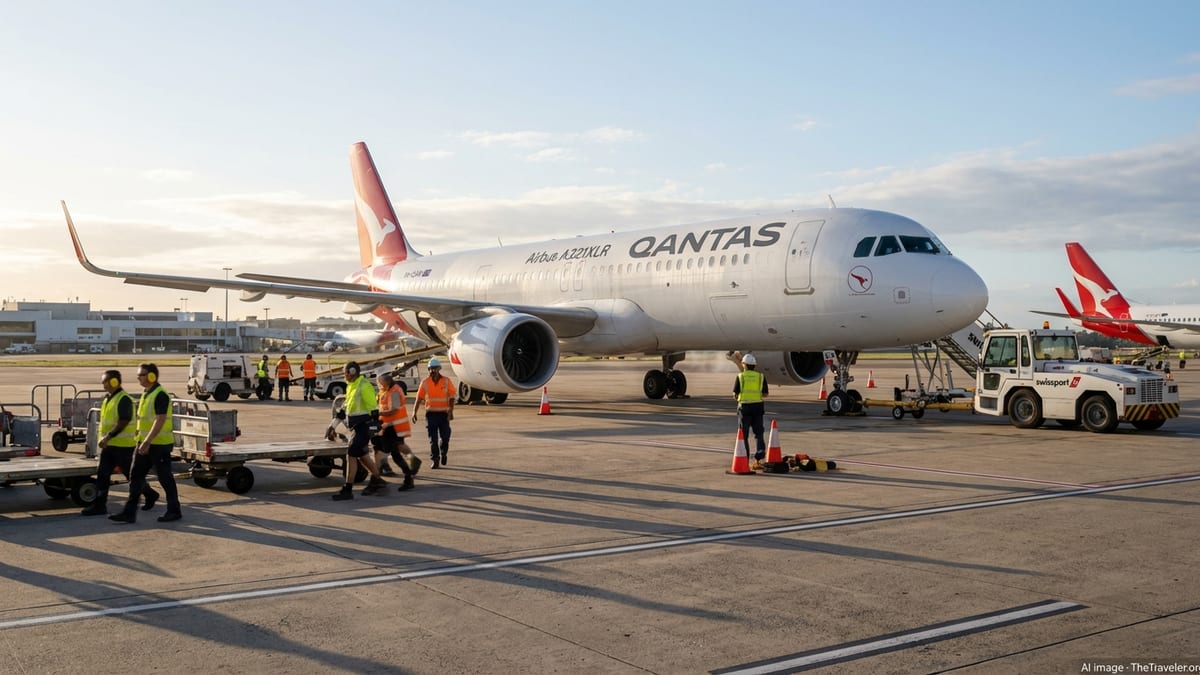
Fresh Legal Challenge Over A321XLR Duties
The Australian Licensed Aircraft Engineers Association has launched proceedings in the Federal Circuit and Family Court, alleging Qantas breached workplace agreements by shifting core receive and dispatch tasks and aircraft towing on its new A321XLR fleet to external ground-handling providers Swissport and Menzies. The work, traditionally performed on the tarmac by licensed aircraft maintenance engineers, accounts for a large share of day-to-day line maintenance activity and is seen by the union as critical to both safety and job security.
The case will test whether the airline’s latest changes amount to an unlawful outsourcing of engineering work, coming on the heels of a separate, high-profile outsourcing scandal that has already cost Qantas hundreds of millions of dollars in penalties and compensation. Engineers argue that by moving these responsibilities to third parties, Qantas is not only undermining the intent of existing enterprise agreements but also eroding skilled roles that underpin safe operations of its newest narrowbody jets.
Qantas rejects the characterisation of its strategy as outsourcing, insisting that no licensed engineering jobs will be lost as a result of the changes. The airline argues that reallocating receive, dispatch and towing duties to airport services companies is designed to free its engineers to focus on more complex maintenance and troubleshooting on the A321XLRs, which incorporate new technologies and longer-range capabilities compared with the Boeing 737s they are replacing.
Legacy of Earlier Outsourcing Fight Looms Large
The latest dispute lands at a sensitive moment for Qantas, whose corporate reputation has already been bruised by a series of legal setbacks related to its pandemic-era restructuring. In August 2025, the Federal Court imposed a record 90 million Australian dollar penalty on the airline for illegally outsourcing more than 1,800 ground-handling workers in 2020, a ruling hailed by the Transport Workers’ Union as a landmark for aviation labour rights and a damning assessment of management’s decision-making.
That judgment followed earlier findings that Qantas had breached the Fair Work Act when it moved baggage, ramp and cleaning jobs to external contractors at airports around the country. It forced the airline to establish a compensation fund of around 120 million dollars for affected workers, many of whom testified to suffering deep financial and personal hardship as they challenged the decision in court.
Unions say the new A321XLR case shows Qantas has not fully absorbed the lessons of those rulings. They argue that, while the scale of the latest changes is smaller, the principle is similar: pushing duties traditionally performed by in-house staff to external providers in pursuit of cost savings and operational flexibility, with insufficient consultation and disregard for existing agreements. For many workers, the Federal Court hearing will be seen as a test of whether recent penalties are enough to deter further encroachment on directly employed roles.
A321XLR at the Heart of Qantas’ Growth Strategy
At stake is not just a technical dispute over job classifications, but a core pillar of Qantas’ fleet and network strategy. The A321XLR is the centrepiece of the group’s largest narrowbody renewal program, with the airline holding orders and options for dozens of the long-range jets. The first aircraft, delivered mid-2025, have begun operating on key domestic routes such as Sydney to Melbourne and Sydney to Perth, gradually displacing older Boeing 737-800s.
The A321XLR’s extended range of up to around 8,700 kilometres gives Qantas far greater reach than the aircraft it replaces, while promising fuel-burn reductions of roughly 30 percent compared with older narrowbodies. The type is configured with 20 business seats and around 177 to 180 economy seats in its initial layout, offering more premium capacity, larger overhead bins and upgraded cabin technology. Qantas plans to introduce lie-flat business class on a subset of the fleet from 2028, a first for its single-aisle aircraft and a signal of its intention to compete more aggressively for high-yield corporate traffic.
For travellers, the new jets have been framed as a step-change in comfort and efficiency, even as some design decisions, such as high passenger-to-toilet ratios on early aircraft, have drawn criticism from consumer advocates. For Qantas, however, the aircraft are primarily a tool to deepen its domestic dominance and unlock new short and medium-haul routes into Asia and the Pacific that were previously marginal or out of reach with twin-aisle aircraft or 737s.
Expanding Footprint Across Southeast Asia
The A321XLR is central to Qantas’ stated ambition to expand flying into Southeast Asia, leveraging the jet’s range and economics to connect Australian cities to secondary Asian markets. Group chief executive Vanessa Hudson has flagged routes such as Adelaide to Singapore and new links from Perth into India as potential beneficiaries of the aircraft, alongside increased frequencies on existing services into Southeast Asia.
Industry analysts note that the aircraft allows Qantas to deploy narrowbodies on thinner city pairs that would not sustain a larger widebody jet, while still offering the onboard experience and schedule frequency demanded by business and premium leisure passengers. As more A321XLRs enter service through 2026 and beyond, the airline is expected to progressively shift some flying on routes currently served by Boeing 737s or Airbus A330s across to the new type, particularly in markets where demand is growing but remains volatile.
For Southeast Asian tourism markets, the strategy could mean more direct links to Australian cities beyond Sydney and Melbourne, bringing high-spending visitors to destinations such as Vietnam, Thailand and Indonesia as well as increased capacity to Singapore and other key hubs. The aircraft’s ability to operate long stages with lower fuel burn also dovetails with Qantas’ sustainability messaging, as it seeks to cut emissions intensity while tapping strong regional demand.
Reshaping the Network After Jetstar Asia Closure
The A321XLR rollout is occurring in parallel with a major reshaping of the group’s low-cost footprint in the region. In June 2025, Qantas announced it would wind down Jetstar Asia, its Singapore-based subsidiary, after more than two decades of operations. The carrier cited steep rises in supplier costs, higher airport fees and intense competition from local and regional rivals as reasons for the move, which will eliminate more than 500 jobs and remove 13 Airbus A320s from the Singapore market.
While the closure marks a retreat from owning a dedicated low-cost base in Southeast Asia, Qantas argues the capital unlocked will be reinvested into fleet renewal and strengthening its core operations in Australia and New Zealand. The group has said Jetstar-branded services from Australia and Japan into Asian destinations will continue, and that many of Jetstar Asia’s aircraft will be redeployed to support growth on leisure routes closer to home.
In that context, the A321XLR gives Qantas and Jetstar a more flexible tool to serve regional demand without the fixed overheads associated with a separate Singapore-based airline. Jetstar is set to begin receiving its own A321XLRs from 2027, configured for international operations, further blurring the lines between what has traditionally been the mainline network and low-cost leisure flying into Asia.
Unions Warn of Safety and Service Implications
As the Federal Court action moves forward, unions representing engineers, ground handlers, cabin crew and pilots are using the A321XLR dispute to raise broader concerns about the direction of Qantas’ employment practices. They argue that outsourcing core tarmac duties on the new aircraft not only undermines job security for licensed engineers but may also have knock-on effects on safety culture, training standards and on-time performance during the busy ramp-up of new routes.
Union officials point to previous findings against Qantas, including a conviction over the illegal stand-down of a health and safety representative during the pandemic, as evidence of what they describe as an entrenched culture of sidelining worker voices. They say that, particularly with a technologically advanced aircraft like the A321XLR, there is a strong case for keeping closely integrated teams of engineers and ground staff under direct company control to ensure accountability and rapid problem-solving when issues arise.
Qantas counters that its contracted providers operate under strict regulatory oversight and that safety is non-negotiable, regardless of who performs specific ramp tasks. The airline says it will work with staff and unions through established consultation processes, but has stopped short of committing to reverse the outsourcing of receive and dispatch duties, arguing that the change is consistent with how many global carriers structure their ground operations.
Balancing Cost Pressures With Service Promises
The clash over the A321XLR also reflects the broader cost pressures facing Qantas and its competitors as they invest heavily in new aircraft while contending with volatile fuel prices, contested labour markets and intensifying competition across the Asia Pacific. Fleet renewal programs spanning A321XLRs, A220s and long-haul A350s represent a multibillion-dollar commitment that the airline expects to fund through ongoing profitability and efficiency gains.
Management maintains that reallocating certain tasks to third-party providers is part of a wider strategy to streamline operations and ensure specialist staff focus on high-value work. Yet passengers, regulators and politicians will be watching closely to see whether promised improvements in reliability, comfort and sustainability materialise as the new aircraft enter service in larger numbers, particularly given lingering resentment from customers over pandemic disruptions and fare levels.
For Qantas, the challenge is to convince stakeholders that its push for efficiency will not come at the expense of service quality or employment standards. How it navigates this latest legal confrontation over the A321XLR will be an important signal of whether it can reconcile those objectives as it pursues ambitious growth across Australia and Southeast Asia.