

More news on this day
Australia is preparing to redraw the global aviation map as Qantas moves closer to launching a non-stop London to Sydney service, a Project Sunrise milestone that promises to redefine what is possible in ultra-long-haul air travel and cement the country’s status as a laboratory for the future of flying.
From Experimental Marathon to Scheduled Mega-Route
When a Qantas Boeing 787-9 touched down in Sydney on November 15, 2019, after 19 hours and 19 minutes in the air from London, it proved that the longest commercial routes on earth were no longer a theoretical exercise. The near-empty research flight QF7879 covered around 17,800 kilometres, thrilling aviation analysts and reigniting a debate about how far passengers are willing to fly without stopping.
The London–Sydney marathon was the second in a trio of experimental ultra-long-haul flights under the airline’s Project Sunrise research program, which also included a non-stop New York–Sydney sector. On board were scientists tracking everything from pilot fatigue and crew workload to passenger sleep cycles, movement patterns and response to lighting and meal timing. The data captured on those flights now underpins cabin design and service concepts that Qantas plans to deploy on commercial services later this decade.
While the 2019 flights were one-off demonstrations rather than revenue services, they marked the first time a modern passenger jet had flown the London–Sydney route without refuelling. For Qantas, they were proof-of-concept trials for an ambition first publicly articulated in 2017: to connect Australia’s east coast directly with Europe and North America and claim what former chief executive Alan Joyce once called the “final frontier” of long-haul aviation.
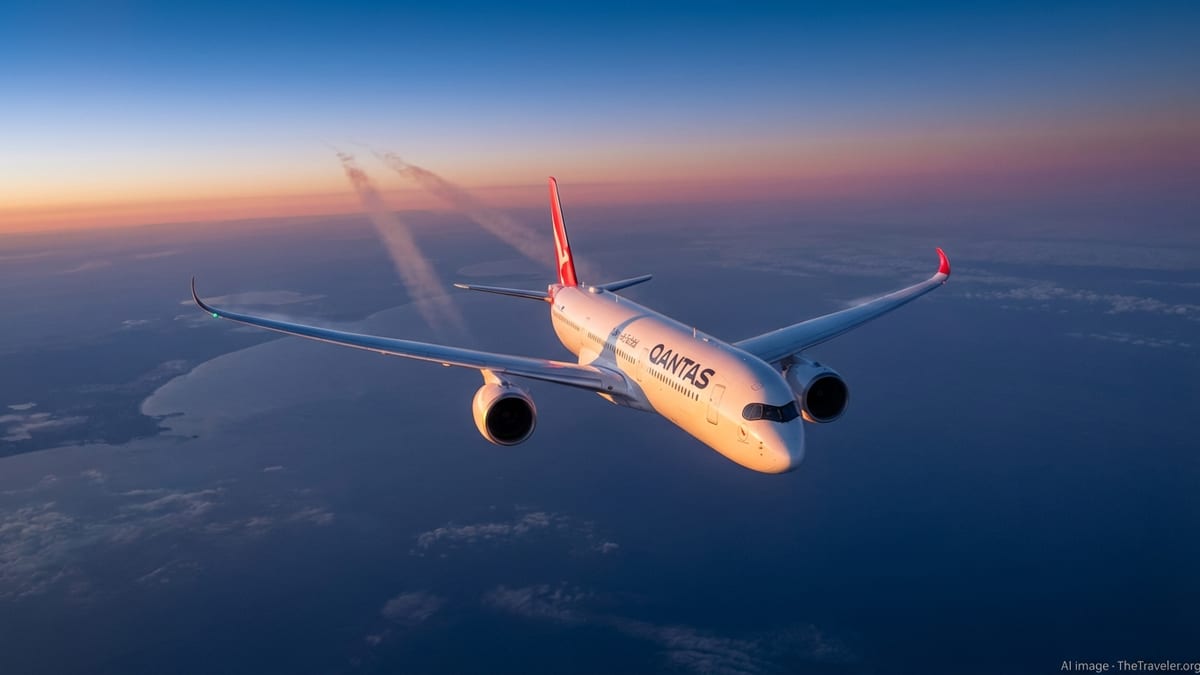
Today, that ambition is moving from testbed to timetable. With dedicated ultra-long-range Airbus A350-1000 aircraft now in advanced stages of assembly, Qantas is preparing to turn its record-breaking London–Sydney flight into a scheduled service, reshaping global route maps and travel expectations in the process.
Project Sunrise: Australia’s Bid to Shrink the World
Project Sunrise, named in tribute to Qantas’s World War II-era “Double Sunrise” endurance flights, has evolved into one of the most closely watched initiatives in global aviation. Launched formally in 2017, the program challenged Boeing and Airbus to produce an aircraft capable of flying up to 22 hours non-stop, with enough payload to make such flights commercially viable rather than mere stunts.
After years of evaluation, Qantas selected the Airbus A350-1000 as the backbone of its Sunrise fleet, ordering 12 specially configured ultra-long-range variants. These aircraft will be able to fly from Sydney to London or New York without refuelling, and from eastern Australia to almost any major city on earth with a meaningful load of passengers and cargo.
The stakes for Australia are high. Direct flights from Sydney to London are not only a prestige project; they have strategic implications for tourism, business travel and trade. By positioning Sydney as a true non-stop hub connecting Europe, North America and the Asia-Pacific, Project Sunrise could help Australia capture a larger share of premium long-haul traffic that currently funnels through rival hubs in the Middle East and Asia.
It is also a statement about Australia’s broader role in aviation innovation. From early long-distance experiments in the mid-20th century to the launch of the non-stop Perth–London commercial service in 2018, the country has used its geographic isolation as a catalyst for pushing the boundaries of aircraft range and operational endurance.
The Aircraft Built for a 20-Hour Day
At the heart of the London–Sydney vision is a new breed of Airbus A350-1000, custom-built for Qantas and tailored to flights that can run close to 20 hours. The first Project Sunrise A350-1000ULR has now moved through major assembly milestones at Airbus’s facility in Toulouse, with the fuselage, wings, tail and landing gear joined and engine installation to follow ahead of extensive test flying.
The aircraft’s enhanced range will come from a combination of aerodynamic efficiency, latest-generation Rolls-Royce engines and a 20,000-litre rear centre fuel tank that pushes endurance beyond 20 hours. These A350s are being engineered to operate up to around 22 hours non-stop, giving Qantas the operational buffer needed to cope with headwinds, diversions and other in-flight contingencies on some of the world’s longest routes.
The cabin will deviate sharply from the high-density layouts typically seen on the A350-1000. Qantas has opted for just 238 seats across four cabins, sacrificing seat count in favour of space and comfort as a hedge against the physical and psychological demands of ultra-long-haul flying. First and business class will feature enclosed suites with lie-flat beds, large entertainment screens and expansive work and dining surfaces, while premium economy and economy will offer more generous seat pitch and personal space than the airline’s existing long-haul fleet.
A signature feature will be a central Wellbeing Zone between premium economy and economy, incorporating space for stretching and guided movement, along with hydration stations and healthy refreshments. It is a concept drawn directly from the 2019 research flights, where scientists monitored blood flow, joint stiffness and passengers’ propensity to move about the cabin. For flights as long as London–Sydney, where travellers will experience multiple mealtimes and time zones in one continuous sitting, these spaces may prove as critical to customer satisfaction as lie-flat beds at the front of the aircraft.
Timelines, Delays and a Pivotal Test Flight
The commercial launch of non-stop London–Sydney services has not followed a straight line. Qantas originally targeted a mid-decade start, but a combination of the pandemic, supply chain disruptions and certification requirements for the modified fuel system pushed the schedule back. Delivery of the first A350-1000ULR is now expected towards the end of 2026, with a carefully sequenced program of crew training, short-haul familiarisation flights and long-range testing to follow.
Industry briefings suggest that a record-chasing round-the-world test flight, expected to last more than 23 hours, is being planned for 2026 as part of that proving campaign. Such a mission would echo the high-profile demonstration flights of 2019, but this time using the production-spec Airbus rather than a Boeing 787 research platform. Data gathered on fuel burn, systems performance and cabin environment during that flight will help refine operating procedures on the London–Sydney and New York–Sydney routes.
The airline has signalled that commercial Project Sunrise services are now targeted for early to mid-2027. Three A350-1000ULRs will be required to sustain daily rotations on a route as long as Sydney–London, once allowances are made for maintenance, crew rest requirements and schedule resilience. That fleet build-up, plus regulatory approvals from authorities including Australia’s Civil Aviation Safety Authority, will determine whether Sydney–London or Sydney–New York is first to launch.
Despite the slippage in timelines, Qantas executives insist that demand for point-to-point ultra-long-haul services remains strong. Corporate travellers, in particular, have demonstrated a willingness to pay a fare premium for flights that avoid connections and reduce door-to-door travel time by several hours. For leisure passengers, the drawcard is as much about convenience as novelty, especially for travellers at the back of the plane who might otherwise face extended layovers at foreign hubs.
Rethinking Passenger Wellbeing on Ultra-Long-Haul Journeys
As airlines contemplate 20-hour services, passenger health and comfort have moved from marketing slogans to engineering and operational imperatives. Qantas has partnered with the University of Sydney’s Charles Perkins Centre and other experts to rethink everything from cabin lighting patterns and meal composition to exercise guidance on board.
On the 2019 research flights, volunteers wore monitoring devices tracking sleep, cognitive function and physical responses. Researchers experimented with shifting meal timing toward destination time zones, adjusting carbohydrate and protein content, and synchronising cabin lighting with circadian rhythms. The findings reinforced the importance of early time-zone adjustment and movement breaks and have already influenced service design on Qantas’s existing long-haul flights.
On the future A350 London–Sydney run, passengers can expect choreographed lighting sequences, explicitly timed meal services and inflight content aimed at helping them adapt more quickly to time-zone shifts. The Wellbeing Zone will provide space and prompts for stretching, with built-in handles, screens displaying guided routines and easy access to water and light snacks. These initiatives reflect a broader trend in which ultra-long-haul airlines seek to differentiate not only on seat width or entertainment choice but on scientifically informed wellbeing strategies.
The focus on health also extends to crew, whose workload and rest patterns must comply with stringent fatigue-management rules. The A350’s design, including crew rest compartments and galley layouts, has been influenced by feedback from pilots and cabin staff involved in the research flights. Regulators will scrutinise the resulting operating procedures closely before green-lighting regular flights of nearly 20 hours.
Economic Stakes for Australia and Global Aviation
The non-stop London–Sydney route carries weight far beyond airline marketing campaigns. For Australia, the ability to offer direct ultra-long-haul links to London and major North American cities is both an economic and diplomatic asset, supporting business ties, high-yield tourism and high-value cargo flows. Cutting up to four hours off total travel time to Europe could make Sydney and other east-coast gateways more competitive as entry points into the Asia-Pacific region.
Qantas has flagged that fares on Project Sunrise routes will attract a premium, potentially around 20 percent above comparable one-stop itineraries. The higher prices reflect not only the operational demands of ultra-long-haul flying but also the investment in low-density cabins and wellbeing-focused features that reduce seat count. Analysts say that sustained corporate demand will be crucial to the route’s profitability, alongside strong interest from affluent leisure travellers and expatriate communities willing to pay more for the convenience of a single, uninterrupted sector.
The competitive implications are being watched closely in global aviation circles. Singapore Airlines currently operates the world’s longest regular commercial flights between Singapore and New York, while Middle Eastern and Asian carriers dominate many of the one-stop itineraries between Australia and Europe. A successful Qantas London–Sydney non-stop could pressure rivals to consider their own ultra-long-haul offerings, or to double down on hub-and-spoke strategies built around frequency and connection options rather than sheer distance.
For aircraft and engine manufacturers, Project Sunrise serves as a high-profile showcase of what the latest widebody technology can achieve in terms of fuel efficiency, range and noise reduction. Airbus’s willingness to engineer a bespoke A350 variant for a relatively small initial order reflects a belief that more airlines will eventually follow Qantas into the ultra-long-haul segment.
A Sustainability Challenge at the Edge of Range
The very flights that capture headlines for their technical audacity also raise difficult questions about aviation’s environmental footprint. Ultra-long-haul sectors burn large quantities of fuel and operate for extended periods at high cruise altitudes, where emissions have complex climate impacts. Critics argue that celebrating 20-hour flights risks sending the wrong signal at a time when aviation is under pressure to decarbonise.
Qantas has sought to address these concerns by committing to offset emissions from its ultra-long-haul test flights and highlighting the relative efficiency of modern aircraft such as the A350 compared with older widebodies. The airline is also part of broader industry efforts to scale up the use of sustainable aviation fuel and improve operational efficiency through optimised flight planning and weight reduction measures.
Supporters of Project Sunrise argue that a non-stop London–Sydney flight can, in some circumstances, be more carbon-efficient per passenger than a two-leg journey on older aircraft with lengthy ground times. Nonetheless, the optics of very long flights remain challenging in an era of climate awareness. How Qantas communicates the environmental trade-offs of its new routes, and the extent to which it can integrate lower-carbon technologies as they emerge, will influence public and regulatory acceptance.
For Australia, which has set its own emissions-reduction goals while maintaining a strong reliance on air connectivity, the success of Project Sunrise will be measured not only in block times and passenger loads but also in how convincingly it can be framed as part of a transition to cleaner aviation rather than a step away from it.
Redefining What Long-Haul Travel Feels Like
Beyond the statistics and timelines, Qantas’s planned London–Sydney non-stop flight represents a shift in how travellers conceive of distance. A journey that once required multiple stops and an almost expedition-like mindset is being compressed into a single, tightly choreographed experience. For some passengers, the draw will be the simple removal of a connection and the chance to board in London and step off in Sydney without enduring the limbo of a transit terminal.
For others, it is the chance to experience an entirely new category of flight, one built from the ground up around the demands of a 20-hour day in the sky. Suites that more closely resemble compact hotel rooms, inflight wellness spaces, tailored lighting and nutrition plans and continuous high-speed connectivity are all elements of that vision. The aircraft itself becomes less a mode of transport and more a carefully managed environment designed to carry the human body and mind across vast distances with minimal disruption.
As Qantas moves toward turning its groundbreaking 2019 London–Sydney research flight into a scheduled reality later this decade, Australia once again finds itself at the frontier of global aviation. If the airline can translate technical ambition into reliable, commercially sustainable service, the non-stop link between London and Sydney will stand as a symbol of how far long-haul travel has come and a hint of how much further it may yet go.