

More news on this day
Qantas is preparing to rewrite the rulebook on long-haul aviation, confirming that from 2027 it plans to operate record-breaking nonstop flights between London and Sydney using specially adapted Airbus A350-1000ULR aircraft, in what the airline hails as a transformative leap for global travel.
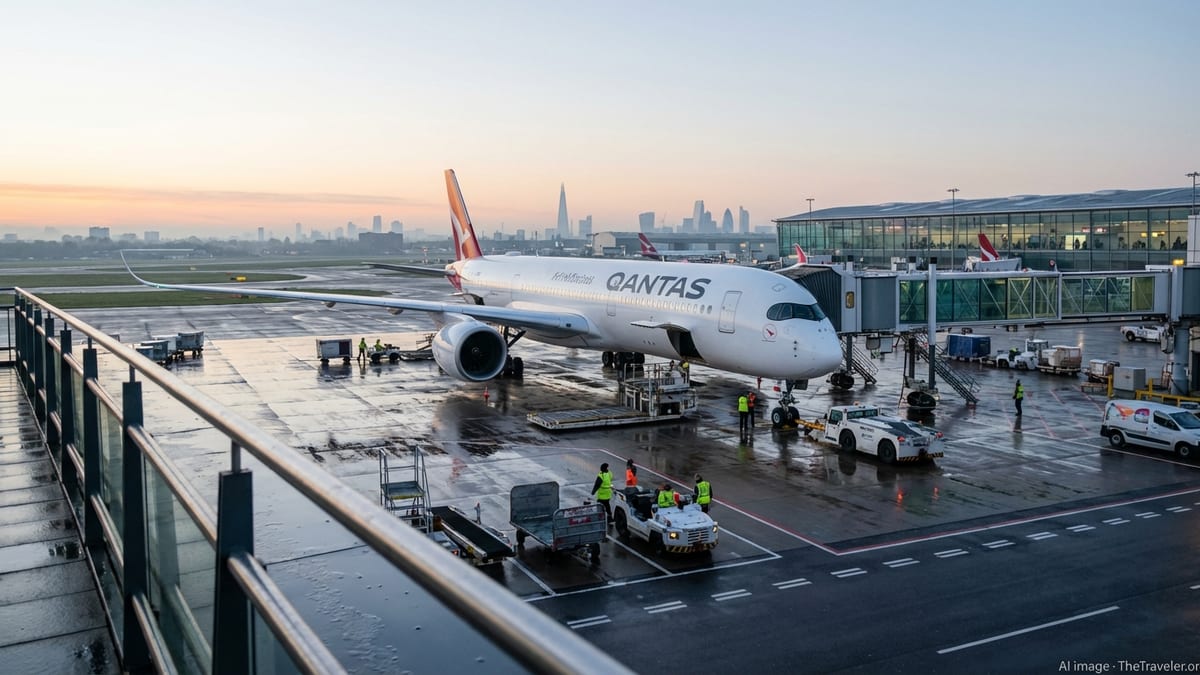
A New Chapter in the Longest Flight Race
The planned nonstop route between London and Sydney will rank among the longest commercial flights ever operated, with flying time expected to reach around 22 hours. It forms a central pillar of Qantas’ Project Sunrise program, the carrier’s multi-year effort to link Australia’s east coast directly with key global cities such as London and New York without refuelling stops.
The new services will build on Qantas’ experience running research flights on ultra-long sectors, including experimental nonstop journeys between New York, London and Sydney using Boeing 787 aircraft. Data from those test flights on crew performance, passenger sleep and jet lag has fed directly into the design of the aircraft and onboard experience for Project Sunrise.
Qantas has positioned the 2027 launch window as the point at which the first A350-1000ULR aircraft will have completed testing and certification, and when operational preparations including crew training, network planning and regulatory approvals are expected to be in place for regular nonstop operations between London and Sydney.
While exact timetables have yet to be published, the airline has made clear that London and New York will be the launch destinations for the Sunrise fleet, with additional ultra-long-haul city pairs likely to follow once the initial aircraft are in service.
Inside Project Sunrise and the A350-1000ULR
Project Sunrise is Qantas’ codename for its ultra-long-haul strategy, first unveiled in 2017 as a challenge to aircraft manufacturers to build an airliner capable of flying east-coast Australia to Europe and North America in a single hop. Airbus ultimately secured the deal, with Qantas ordering a customized version of the A350-1000 known as the A350-1000ULR, equipped for flights of up to about 22 hours.
The A350-1000ULR is being fitted with an additional rear centre fuel tank of roughly 20,000 litres and enhanced systems to extend its range well beyond that of standard A350 variants. The aircraft is designed to cover more than 9,700 nautical miles nonstop, enough to comfortably span the 9,180-nautical-mile distance between Sydney and London while preserving fuel reserves for diversions and holding patterns.
Production of the first Qantas A350-1000ULR reached a milestone in late 2025, when Airbus confirmed that all major structures, including fuselage sections, wings and landing gear, had been joined on the final assembly line in Toulouse. From there, the aircraft will move into an intensive program of engine installation, testing and certification flights in 2026 before being handed over to Qantas ahead of the 2027 service launch.
Qantas has 12 A350-1000ULR aircraft on order for Project Sunrise, a fleet size the airline says will be sufficient to serve key nonstop markets while building in resilience for maintenance and operational disruptions. Additional A350-1000s configured for long range rather than ultra-long range are due later in the decade to support broader network growth.
Reimagined Cabins for 22-Hour Journeys
Central to Qantas’ plan to make nonstop London–Sydney flights viable is a radical cabin layout that sacrifices seat density for comfort. Instead of the more than 300 seats typically found on an A350-1000, the Sunrise jets will carry just 238 passengers across four cabins: First, Business, Premium Economy and Economy.
At the front of the aircraft, six First Suites are designed to evoke boutique hotel rooms. Each suite will feature a separate reclining armchair and a two-metre-long fully flat bed, a dining table for two, large 4K in-flight entertainment screen and generous personal storage. High privacy walls and sliding doors are intended to create an enclosed, apartment-style feel even in the open cabin environment.
Behind First, 52 Business Suites will offer direct aisle access, sliding doors and lie-flat beds measuring roughly two metres in length. Wider seats, enhanced storage, wireless charging and large 4K screens are set to position the product at the sharp end of the global business-class market, reflecting Qantas’ expectation that a significant share of demand on these ultra-long sectors will come from corporate travellers willing to pay a premium for nonstop convenience.
Premium Economy and Economy cabins are being designed with unusually generous seat pitches, larger entertainment screens and multiple charging points. Qantas has highlighted a 33-inch pitch in Economy, greater legroom than many long-haul rivals, alongside ergonomic cushions and adjustable headrests intended to make extended time in the seat more tolerable.
Wellbeing Zone and Jet Lag Science
Perhaps the most distinctive feature of the Sunrise A350s is the dedicated Wellbeing Zone, a communal area between Premium Economy and Economy that gives passengers space to move, stretch and hydrate during the marathon flights. The zone will incorporate sculpted walls with integrated stretch handles, a large screen showing guided exercises, and a self-service station with drinks and healthy snacks.
Qantas has worked with industrial designer David Caon and specialists from the University of Sydney’s Charles Perkins Centre to shape the cabin and service around combating jet lag and the physical strain of ultra-long travel. The partnership has focused on factors such as light exposure, movement, hydration, nutrition and timing of meals and rest.
Cabin lighting on the A350-1000ULR will employ a suite of programmed scenarios, including “sunrise” and “sunset” sequences tailored to the destination time zone. These lighting plays, aligned with carefully timed meal services and rest periods, are designed to nudge passengers’ body clocks toward local time before arrival, reducing the shock of landing after more than 20 hours in the air.
Alongside lighting and movement, connectivity and entertainment are being treated as part of the wellbeing equation. All passengers will have access to free in-flight Wi-Fi, Bluetooth audio for personal devices and large-format screens to help pass the time. The airline argues that high-quality distraction, combined with more space and the option to move regularly, can significantly improve the perceived length and comfort of the journey.
Shaving Hours off the Kangaroo Route
The London–Sydney nonstop service is poised to redefine what travellers know as the Kangaroo Route, the historic air corridor linking Europe and Australia that has traditionally required one or more stops. Today’s typical one-stop itineraries through hubs in Asia or the Middle East can take well over 24 hours door-to-door, factoring in ground time, transfers and potential delays.
By flying nonstop, Qantas expects to cut total travel time by up to four hours compared with the fastest one-stop services. For business travellers on tight schedules and leisure passengers eager to maximise time at their destination, the value proposition lies in eliminating the uncertainty and fatigue of intermediate stops, security checks and layovers.
The move will also be a symbolic milestone in the decades-long evolution of air links between Australia and Europe. Qantas has previously pushed the boundaries of range with its nonstop Perth–London service using Boeing 787s, but taking the nonstop option all the way to Sydney extends that connectivity deeper into Australia’s population and financial centre.
Industry analysts expect the London–Sydney nonstop to command a fare premium, particularly in the front cabins, compared with traditional one-stop options. However, Qantas is betting that time savings, convenience and the novelty of flying one of the world’s longest routes in a bespoke ultra-long-haul cabin will be compelling enough to sustain demand.
Operational and Environmental Challenges
Operating a roughly 22-hour commercial flight places unique demands on aircraft, crew and scheduling. Flight and cabin crew will require extended rest facilities, and rosters will need to be structured around duty time limits that reflect the extraordinary length of each sector. The A350-1000ULR’s design incorporates enlarged crew rest areas and optimised environmental controls to support staff working in shifts throughout the flight.
From an operational perspective, Qantas will need to carefully manage payload and weather-related performance to maintain reliable nonstop services on such a long route. Headwinds, air traffic constraints and diversion requirements can all affect flight planning, potentially forcing occasional technical stops if conditions are unfavourable.
Environmental scrutiny is also likely to be intense. Ultra-long flights consume large quantities of fuel, even when operated by newer, more efficient aircraft. Qantas points to the A350’s advanced aerodynamics, lightweight composite structure and latest-generation engines as factors that reduce emissions per passenger-kilometre compared with older aircraft on multi-stop itineraries.
The airline is also highlighting its broader sustainability strategy, including investment in sustainable aviation fuels, fleet modernisation and carbon reduction initiatives, as it seeks to position Project Sunrise as consistent with its long-term climate commitments. Critics, however, argue that the concept of very long nonstop flights sits uncomfortably with global efforts to curb aviation emissions and may sharpen debates about the future of long-haul travel.
Competitive and Passenger Impact
The introduction of nonstop London–Sydney flights is set to reshape competitive dynamics on routes linking Europe and Australia. For years, Gulf and Asian hub carriers have captured significant market share by offering one-stop connections via their home hubs. A nonstop option gives Qantas a distinctive product that no rival currently matches on this specific city pair.
Industry observers note that while not all travellers will prioritise a nonstop flight, those who do may be drawn away from connecting itineraries on other airlines, particularly in premium cabins. For passengers who value stopovers to break up the journey, hub carriers will continue to offer an alternative rooted in choice of timing, routing and price.
For Qantas, Project Sunrise also functions as a powerful brand statement, signalling technological ambition and reinforcing its identity as Australia’s long-haul flag carrier. The airline believes the halo effect of operating the world’s longest or among the longest flights, with highly publicised first-class and business suites, will spill over into customer perception of its wider network.
For passengers, the impact will be more tangible. Travellers flying between London and Sydney from 2027 will, for the first time, have the option to board a single aircraft, settle into a purpose-built ultra-long-haul cabin, and step off more than 20 hours later on the other side of the world without ever passing through a transit terminal.
Timeline to Takeoff
Qantas currently expects to receive its first Project Sunrise A350-1000ULR in late 2026, ahead of a planned commercial launch of nonstop services in the first half of 2027. Additional airframes will follow soon after, giving the airline enough capacity to operate both London and New York routes while maintaining resilience for maintenance schedules.
Before passengers can book seats, the aircraft must complete a rigorous test regime, including proving flights and regulatory certification for the unique ultra-long missions envisaged under Project Sunrise. Qantas will also conduct further trials on sleep, nutrition and inflight routines, using both simulators and real-world flights, to fine-tune service elements.
As the first Sunrise aircraft progresses through final assembly and testing in Europe, Qantas is expected to ramp up its marketing message around the record-breaking route, positioning the London–Sydney nonstop as a flagship symbol of post-pandemic renewal and long-haul innovation.
If the airline meets its current schedule, 2027 will mark the year when one of aviation’s enduring ambitions, a direct regular link between London and Sydney, moves from concept and test flights to a booked seat on a daily timetable, reshaping expectations of how far and how comfortably a commercial jet can fly nonstop.