

More news on this day
Australia, the United Kingdom and Singapore are racing to steady key travel corridors as Qantas reroutes its flagship nonstop Perth–London service via Singapore in response to sweeping Middle East airspace closures tied to the escalating Iran crisis.
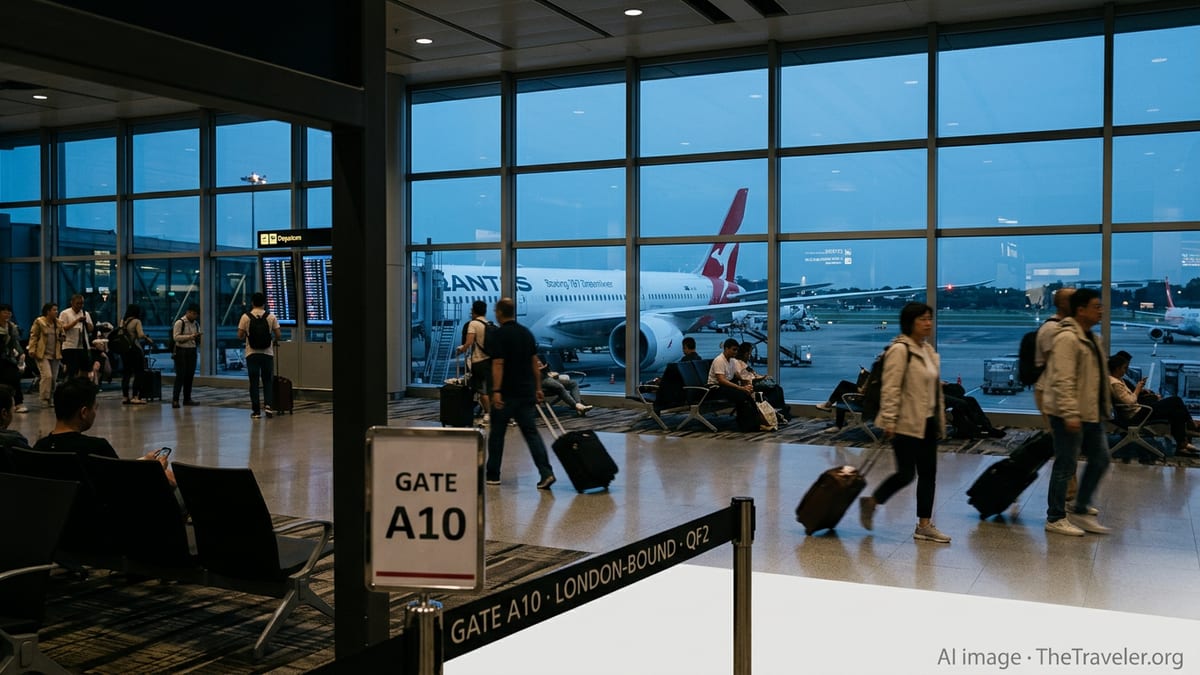
Flagship Perth–London Route Forced Into Singapore Detour
Qantas confirmed this week that flight QF9, its high-profile nonstop link between Perth and London Heathrow, has been suspended from 4 March 2026, with the service now operating via Singapore for a refuelling and crew stop. The adjustment follows the rapid closure of multiple Middle Eastern flight corridors after US and Israeli strikes on Iran and subsequent Iranian missile activity prompted at least eight regional states to shut their skies.
The change effectively ends, for now, what had been marketed as a symbol of ultra-long-haul ambition: a direct, roughly 17-hour hop between Western Australia and the UK capital. Detours to avoid Iranian, Iraqi, Israeli, Qatari, Bahraini, Kuwaiti and Emirati airspace mean the original great-circle routing is no longer viable within normal fuel and crew duty limits.
Passengers booked on QF9 are being advised that the new Singapore stop is expected to add at least three hours to overall journey times. Qantas has paired the move with a limited window of fee-free rebooking or refunds for customers traveling to, from or via several affected Middle Eastern countries, while stressing that safety and regulatory compliance remain the primary drivers of the reroute.
The carrier has precedent for the shift. A similar temporary Singapore stopover was introduced on Perth–London services during a spike in regional tensions in 2024, though the current situation is broader in geographic scope and is already generating a far larger wave of global schedule changes.
Australia Faces Capacity Crunch on the Kangaroo Route
The Australian government and aviation sector are bracing for weeks of reduced capacity on the storied Australia–UK and Australia–Europe “Kangaroo Route” as Gulf hubs that normally shoulder up to 40 percent of the traffic remain constrained. Analysts estimate that, within days of the latest strikes, overall seat capacity between Australia and Europe fell by nearly two thirds as flights via Doha, Dubai and Abu Dhabi were cancelled or heavily curtailed.
With Emirates and Qatar Airways forced to ground or reroute many services, Qantas’s own long-haul network is under pressure. The airline has quietly adjusted some Europe-bound itineraries to route via Singapore and Bangkok, while a one-off additional Sydney–Singapore–London A380 rotation scheduled for 7 March is expected to help clear some of the backlog of Australians and Britons stranded on both ends of the route.
Australia’s Department of Foreign Affairs and Trade has updated travel advisories to classify parts of the Gulf, including Qatar, the United Arab Emirates and Israel, as do-not-travel zones, while urging citizens to avoid non-essential transits through the wider region. The country’s aviation regulator has also echoed warnings from US and UK authorities advising operators to steer clear of airspace where GPS interference, missile activity and rapidly shifting restrictions make safe planning difficult.
Travel agents report that fares on remaining one-stop options to Europe, particularly those connecting via Singapore and East Asian hubs, have climbed sharply on the back of surging demand and higher fuel costs from longer routings. Many Australians with imminent departures are being advised to wait for airline-initiated changes rather than cancel pre-emptively, in order to preserve refund and rebooking rights.
UK Prioritises Repatriation and Alternative Links
In the United Kingdom, the abrupt loss of several key Gulf transit points has complicated efforts to bring home nationals caught mid-journey when airspace closures took effect. The British government has chartered and supported a series of rescue operations, with at least one early flight reportedly delayed in Oman as air corridors were reassessed in real time.
The UK Civil Aviation Authority has issued emergency guidance urging airlines to avoid overflying Iran and several neighboring states, aligning with similar notices from US regulators. Carriers operating between Britain and Australia are being pushed toward more northerly or southerly tracks that thread through the Caucasus, Turkey or the Arabian Sea, or bypass the Middle East entirely via Southeast Asian hubs such as Singapore.
The rerouting of Qantas’s Perth–London service is seen in London as a strategic adjustment that helps keep a vital long-haul artery open at a time when many traditional one-stop itineraries via the Gulf are unavailable. British Airways and Qantas, long-standing partners on the Kangaroo Route, are leaning more heavily on Singapore as a shared transfer point, while European carriers explore additional frequencies on routes that skirt the affected region.
Consumer advocates in the UK are reminding passengers that, for flights departing from British or European airports, compensation and refund rights under local aviation regulations still apply, even in cases of geopolitical disruption. However, they caution that rebooking options may be limited in the near term as airlines juggle constrained aircraft availability and longer flight times.
Singapore Emerges as a Critical Asia–Europe Bridge
Singapore is rapidly reasserting its role as a pivotal node in global aviation, with the Changi hub absorbing a growing share of traffic that would normally flow through the Gulf. Qantas’s decision to route QF9 through the city-state aligns it with a broader industry trend that is redirecting Europe–Australia and Europe–Asia flows through Southeast Asia and, to a lesser extent, East Asia.
Singapore Airlines, which already operates an extensive network to both Australia and Europe, has increased capacity on certain routes and is coordinating closely with partner carriers to handle disrupted passengers. Travel data providers report a surge in bookings on itineraries that combine Qantas or British Airways services into Singapore with onward connections on Singapore Airlines or other alliance partners to European cities.
Singapore’s aviation regulators have not issued any new public safety warnings related to overflights in their immediate region, but operators are required to file revised flight plans that avoid restricted West Asian airspace. Industry observers note that the city-state’s strict enforcement of customs and import rules, including an outright ban on e-cigarettes that applies even to transfer passengers, is catching out some newly rerouted travelers who had not planned to transit via Changi.
Beyond passenger traffic, cargo flows are also being reshaped. Freight specialists say diversions away from Gulf hubs are pushing more high-value and time-sensitive shipments onto routes that consolidate in Singapore and other Asia-Pacific gateways, with cost implications that may ripple into consumer prices if disruption persists.
Uncertain Timeline Keeps Airlines in Crisis-Management Mode
While some aviation experts believe the current airspace shutdowns could begin to ease within weeks if the Iran crisis cools, the lack of a clear diplomatic path is forcing airlines and regulators in Australia, the UK and Singapore to plan for a longer disruption. Contingency schedules now assume extended flight times between Europe and Australasia, higher fuel burn and continued bottlenecks at a handful of unconstrained hubs.
Operationally, sustained detours place strain on crews, aircraft maintenance cycles and airport ground handling. Carriers like Qantas must carefully balance the need to preserve connectivity with the risk of schedule knock-on effects if just one long-haul sector is significantly delayed. Additional widebody aircraft, such as the extra A380 rotation out of Sydney, are being deployed tactically to relieve pressure points on the network.
For governments, the episode underscores how quickly geopolitical flashpoints can sever what had come to be seen as routine global travel corridors. Australia and the UK, both heavily reliant on long-haul aviation, are expected to feed lessons from the current crisis into future route planning, bilateral air service negotiations and risk assessments, including scenarios that further diversify traffic away from any single region.
In the meantime, travelers between Australia, the UK and Europe are being told to expect longer journeys, busier alternative hubs and rapidly changing itineraries. With Singapore now central to the improvised network that has emerged in place of the Gulf, the rerouting of Qantas’s Perth–London flight stands as a visible example of how quickly the global map of commercial aviation can be redrawn.