

More news on this day
Qantas is set to make aviation history at the end of 2026, launching the first-ever nonstop commercial flights between Sydney and Las Vegas in a move that cements the United States alongside Canada, Mexico, the United Kingdom and other key markets in the Australian flag carrier’s fast-expanding long-haul network.
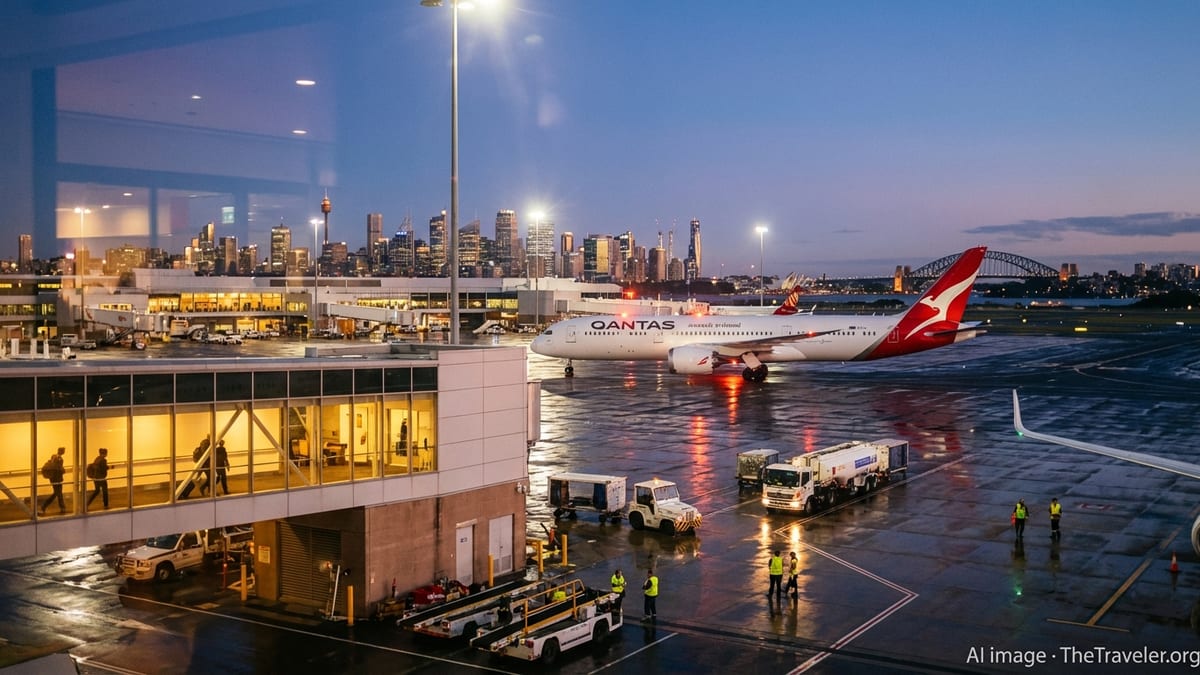
Seasonal Route Links Australia Directly with the Entertainment Capital
From December 29, 2026, Qantas will begin operating a nonstop seasonal service between Sydney Kingsford Smith Airport and Las Vegas’ Harry Reid International Airport, creating the first direct air bridge between Australia and Nevada. The program is scheduled to run through March 12, 2027, timed to coincide with the peak northern winter and Australia’s summer travel seasons.
The new flights will operate three times weekly under flight numbers QF55 from Sydney and QF56 from Las Vegas, subject to final government and regulatory approvals. The schedule is structured around evening departures from both cities, allowing travelers to maximize time on the ground while reducing the fatigue associated with multiple connections and overnight airport transits.
Las Vegas becomes the 101st destination on Qantas’ international network and the airline’s eighth city across the Americas, joining Los Angeles, San Francisco, Honolulu, Dallas, New York, Vancouver and Santiago. For U.S. travelers, it marks a rare opportunity to fly directly from the American Southwest to Australia without first backtracking to a coastal hub.
Qantas estimates that the nonstop service will save passengers up to five hours each way compared with typical one-stop itineraries via other U.S. gateways. By eliminating domestic layovers and tight connections, the airline is positioning the route as a faster, more reliable and more comfortable option for both Australian and North American travelers.
Boeing 787 Dreamliner to Power Long-Haul “Party Plane” Experience
The Sydney to Las Vegas route will be flown by Qantas’ Boeing 787-9 Dreamliner, a long-range twin-aisle aircraft already central to the carrier’s international expansion strategy. Configured with 42 lie-flat business class seats, 28 premium economy seats and 166 economy seats, the aircraft is designed for comfort on ultra-long sectors, with improved cabin pressure, higher humidity and quieter engines.
Flight QF55 is scheduled to depart Sydney at 9:00 p.m., arriving in Las Vegas at 3:55 p.m. local time after just under 14 hours in the air. The return service, QF56, is slated to leave Las Vegas at 8:20 p.m. and arrive in Sydney at 6:35 a.m. two days later, giving travelers a full overnight flight into Australia’s largest city and smoothing the transition across multiple time zones.
Qantas executives have hinted that the service will lean into Las Vegas’ reputation for entertainment and nightlife, with media describing the flights as “party planes” tailored to leisure travelers and event-goers heading to and from the Strip. While full onboard programming details are yet to be announced, the airline is expected to highlight its upgraded inflight entertainment, Australian food and wine, and a product pitched to groups, sports fans and incentive travelers.
The choice of the fuel-efficient Dreamliner reflects Qantas’ broader push to modernize its long-haul fleet and prepare for even longer point-to-point routes. The airline’s upcoming Airbus A350-1000 aircraft, part of its Project Sunrise initiative, will later allow nonstop flights from Australia’s east coast to destinations like New York and London, further expanding direct links with the United States and the United Kingdom.
United States Joins a Growing Roster of High-Profile Long-Haul Markets
The new Sydney–Las Vegas nonstop further strengthens the role of the United States within Qantas’ global network, adding a dedicated leisure and events gateway to an already dense schedule of flights into major hubs such as Los Angeles, San Francisco, Dallas and New York. It also underscores a wider strategy that has recently seen Qantas expand or restore services to Canada, Mexico and the United Kingdom as international travel demand rebounds.
In North America, Qantas already serves Vancouver as a seasonal gateway to Canada’s Pacific Northwest and connects Australian travelers with Mexico through partnerships and one-stop itineraries. The addition of Las Vegas as a nonstop destination gives U.S. and Canadian travelers a new one-plane option into Australia’s largest city, while also improving onward connectivity to New Zealand and the wider South Pacific.
Across the Atlantic, London remains Qantas’ flagship European destination, and the airline is preparing to launch nonstop A350 services from Sydney to the United Kingdom’s capital at the end of 2026. Together with the new Las Vegas route, these developments mark a significant acceleration in point-to-point flying, reducing reliance on traditional Asian and Middle Eastern hubs for long-haul connections.
Industry analysts note that by targeting globally recognized leisure destinations such as Rome, Sapporo and now Las Vegas with seasonal, event-driven schedules, Qantas is fine-tuning a model that blends tourism demand with fleet flexibility. The approach allows the airline to pivot capacity to markets where it sees strong yields and brand visibility, often in partnership with major events and tourism organizations.
Boost for Tourism, Events and Transpacific Trade
Tourism officials in both Australia and Nevada are anticipating a significant economic uplift from the nonstop route, which is expected to carry strong volumes of leisure travelers, conference delegates and sports fans in both directions. Las Vegas will gain direct access to high-spending Australian visitors, while Sydney and its surrounding regions will become more accessible to residents of the American West and Southwest seeking long-haul holidays.
The timing of the flights is closely aligned with some of Las Vegas’ most high-profile events, including the annual CES technology show and the Rugby League Las Vegas Festival, which has quickly become a magnet for Australian sports fans. Direct flights are expected to simplify logistics for teams, sponsors and media, while also making it easier for casual fans to combine sport, entertainment and sightseeing in a single trip.
For the broader travel industry, the route signals confidence in the resilience of transpacific demand and the willingness of travelers to commit to long-haul journeys when they are made more efficient and appealing. Tour operators are already beginning to package the new flights into multi-stop itineraries that combine Las Vegas with other North American hotspots and iconic Australian destinations such as the Great Barrier Reef and Uluru.
Business travel and trade links are also likely to benefit, with the nonstop service shortening journey times for executives, investors and conference delegates moving between the two countries. While the route is clearly leisure-focused, the added capacity and flexibility will support a wider ecosystem of economic activity stretching from tourism and entertainment to technology and professional services.
Competitive Response and the Future of Long-Haul Travel
The launch of nonstop Sydney–Las Vegas flights places pressure on rival carriers that have traditionally funneled Australia–U.S. traffic through West Coast hubs like Los Angeles and San Francisco. Qantas’ ability to offer a direct service into the heart of the American entertainment industry differentiates its product and could prompt competitors to reassess their own long-haul strategies.
At the same time, the move fits neatly into a global trend toward ultra-long-haul point-to-point flying, in which airlines seek to bypass congested transfer airports in favor of direct connections between city pairs with strong demand. Qantas has been one of the highest-profile proponents of this model, using aircraft such as the Dreamliner and soon the A350 to test and commercialize flights that would once have required at least one stop.
The addition of Las Vegas to its map, alongside deepening ties with key markets such as Canada, Mexico and the United Kingdom, suggests that the airline sees sustained potential in reshaping how travelers move between hemispheres. By December 2026, with new aircraft arriving and multiple long-haul initiatives converging, Qantas aims to position itself not just as Australia’s flag carrier, but as a leading architect of the next era of global air travel.
For travelers on both sides of the Pacific, the most tangible change will be felt in the boarding gate: stepping onto a Qantas aircraft in Sydney or Las Vegas and stepping off less than a day later in a different hemisphere, without a single connection in between.