

More news on this day
Qantas is set to withdraw its flagship Airbus A380 from the Melbourne to Los Angeles route from late October 2026, consolidating services on smaller but more fuel efficient Boeing 787-9 aircraft in a move that reshapes long haul travel links between Australia, the United States and Singapore.
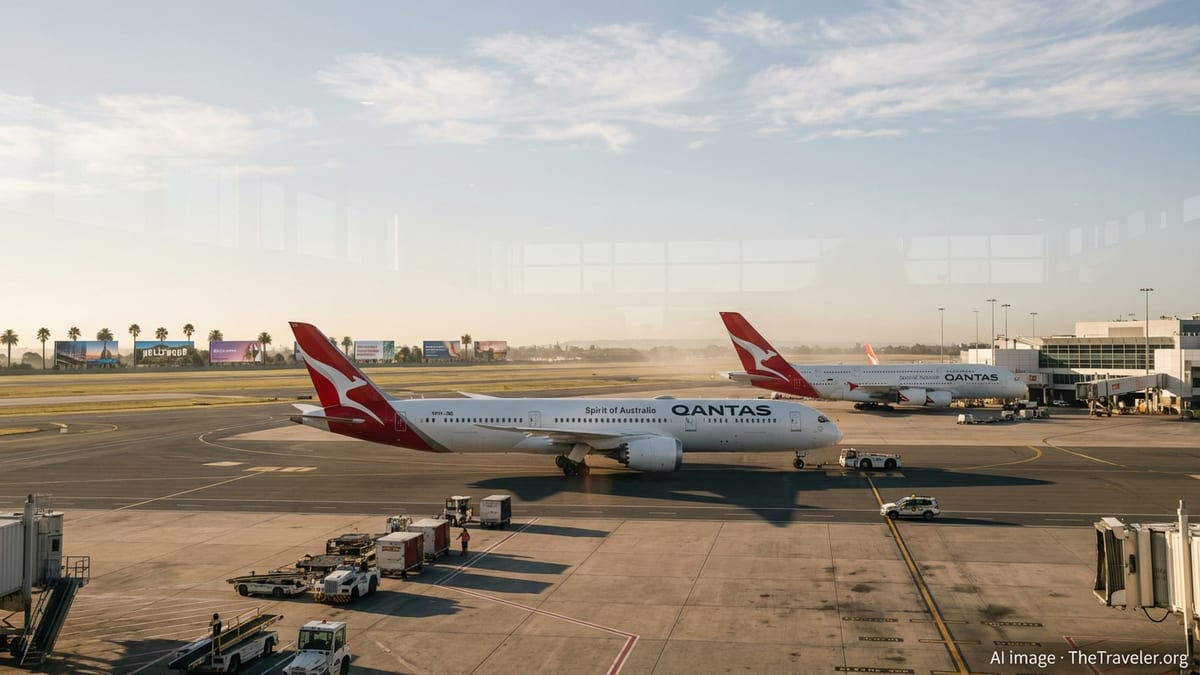
Daily Melbourne–Los Angeles Flights Move to Boeing 787-9
The Australian flag carrier will end A380 operations between Melbourne and Los Angeles after 24 October 2026, according to schedule filings and industry timetable data. From 25 October, Qantas will standardise the corridor on a daily Boeing 787-9 service, replacing the current mix of two weekly A380 flights and five weekly Dreamliner rotations.
The change means passengers on Qantas flight QF93 and its return service QF94 will see a consistent product year round, rather than alternating between the 485 seat superjumbo and the 236 seat 787-9. The airline already operates a predominantly Dreamliner schedule on the route, and the transition to an all 787-9 operation completes a gradual shift that began with the type’s introduction on Melbourne–Los Angeles in the late 2010s.
While the 787-9 offers fewer seats overall, Qantas is emphasising the aircraft’s lower fuel burn, improved range and modern cabin design. The three class Dreamliner configuration includes Business, Premium Economy and Economy cabins, with features such as larger windows, a quieter cabin and pressurisation designed to reduce jet lag compared with older widebody types.
Industry analysts say the move aligns capacity more closely with underlying demand on the Victoria to Southern California market. By deploying a smaller, more efficient aircraft daily, Qantas can maintain nonstop connectivity for both business and leisure travellers while freeing its high density A380s for routes where demand for premium seating is strongest.
Superjumbos Redeployed to Asia and the Middle East
The withdrawal of the A380 from Melbourne–Los Angeles coincides with Qantas boosting superjumbo flying on key Asian sectors. The airline is planning a major increase in A380 frequencies between Sydney and Singapore over the Northern winter 2026 to 2027 season, as it continues bringing refurbished double deck aircraft back into service.
From December 2026, A380 operations on Sydney–Singapore are scheduled to rise sharply, with additional weekly services supplementing an existing daily A380 flight that continues onward to London Heathrow. The uplift will see more First and Business Class capacity deployed on one of Qantas’s most important Asian gateways, connecting Australian cities with onward traffic to Europe and Southeast Asia.
The redeployment comes as Qantas completes a multi year refurbishment of its A380 fleet. Each aircraft now features a refreshed First suite, redesigned upper deck lounge and increased numbers of premium seats in Business and Premium Economy. The airline has also flagged enhanced onboard service for First customers, including updated dining and amenity offerings tailored to the superjumbo.
Beyond Singapore, Qantas has already used the return of its final refurbished A380 to restore daily flying on the Sydney–Dallas route, reinforcing its transpacific joint venture with American Airlines and expanding one stop access to more than 200 destinations across the United States. The additional capacity into North America from Sydney balances the reduction of A380 flying from Melbourne to Los Angeles.
Strategic Realignment Across Australia, the United States and Singapore
The aircraft swap on Melbourne–Los Angeles is part of a broader network and fleet optimisation as Qantas prepares for a wave of new deliveries and shifting demand patterns. In a recent international network update, the airline outlined plans to add hundreds of thousands of seats across Asia Pacific and US markets, supported by additional A380s returning from storage and the arrival of new generation narrowbody and regional jets.
On US routes, the carrier is concentrating its largest aircraft on trunk services from Sydney, where demand for premium cabins and connectivity into American partners is strongest. Sydney–Los Angeles and Sydney–Dallas have seen sustained A380 deployment or announced increases in superjumbo flying, while secondary US gateways such as Melbourne–Los Angeles and Brisbane–Los Angeles lean more heavily on the 787-9.
In Asia, Singapore remains central to Qantas’s two hub strategy. The increase in A380 flying on Sydney–Singapore, coupled with strong capacity growth from partner airlines based in the city state, reinforces the Changi hub as a key connecting point between Australia, Southeast Asia and Europe. Travellers from the United States can reach Singapore with a single stop via Sydney, Melbourne or Brisbane, then continue onward on Qantas or partner carriers to destinations across the region.
For Melbourne based customers, the shift to all Dreamliner service on Los Angeles is partly offset by expanded long haul options elsewhere. Qantas has already announced more capacity from Melbourne to Dallas and additional services to Asia, while low cost subsidiary Jetstar is refurbishing its own fleet of Boeing 787s to enable longer routes that could include new destinations in North America over the medium term.
What the Change Means for Passengers
For travellers used to the scale and amenities of the A380 on Melbourne–Los Angeles, the transition to the 787-9 will bring a noticeably different onboard experience. The superjumbo’s First Class suites and larger upper deck Business cabin will disappear from this particular route, replaced by the Dreamliner’s more compact but modern premium cabins.
The 787-9’s cabin has been configured to emphasise privacy and direct aisle access in Business, alongside a dedicated Premium Economy cabin that offers wider seats and greater pitch than standard Economy. Although overall seat numbers fall, the smaller aircraft can provide a more intimate cabin feel, and its advanced environmental controls are designed to ease the effects of the nearly 14 hour transpacific crossing.
Economy passengers will experience a slightly narrower cabin than on the A380, but benefit from improved lighting, larger dimmable windows and updated inflight entertainment systems. Qantas also continues to refresh soft products, including menus and bedding, as part of a broader investment programme aimed at lifting the long haul travel experience across its international network.
Schedule data indicates that Qantas will maintain at least daily service between Melbourne and Los Angeles throughout the transition period, with changes phased in progressively across 2026. Travellers with existing A380 bookings beyond late October 2026 are expected to be re-accommodated on Dreamliner services, with the airline typically offering rebooking or credit options when aircraft type changes affect specific cabin products.
Competitive Pressures and Sustainability Goals
The latest aircraft reshuffle also reflects intensifying competition on transpacific and Asia routes and the need to lower unit costs while meeting sustainability targets. Rival carriers from the Middle East, North Asia and North America continue to add capacity into both Australia and Singapore, placing pressure on yields and driving a focus on efficient fleet deployment.
Boeing’s 787-9, built largely from composite materials, offers significantly lower fuel consumption per seat than older widebody models, particularly when operated at high utilisation on long haul sectors. By concentrating A380s on routes where the additional capacity can be filled, and moving Melbourne–Los Angeles fully to the Dreamliner, Qantas can reduce emissions intensity while preserving network breadth.
The airline has publicly committed to ambitious decarbonisation goals, including the use of sustainable aviation fuel and the introduction of next generation aircraft types such as the Airbus A350 for future ultra long haul services. Optimising where and how the largest jets fly is a near term lever that supports those targets while responding to evolving passenger demand between Australia, the United States and key Asian hubs like Singapore.
For travellers planning transpacific or Asia journeys from late 2026, the changes highlight the importance of checking aircraft type and cabin layout when booking. As Qantas and its competitors adjust fleets to balance profitability, sustainability and customer expectations, the choice between a superjumbo and a new generation twin jet is increasingly part of the decision making process for long haul flyers.