

More news on this day
Qantas is rapidly reshaping its long-haul network to funnel Australians directly into Europe via Rome and Paris, as conflict in the Middle East chokes traditional hub corridors, pushes airfares higher and leaves hotels across key transit destinations facing a sharp drop in bookings.
Get the latest news straight to your inbox!
Conflict Closes a Corridor and Rewrites Flight Maps
The escalation of conflict involving Iran since late February 2026 has triggered widespread airspace closures across parts of the Middle East, disrupting what has long been one of the world’s busiest aviation corridors between Europe, Asia and Australia. Publicly available briefings on regional security and aviation operations indicate that air defence systems remain active across several Gulf states, forcing airlines to suspend or reroute services that once relied on hubs such as Dubai and Doha.
Economic assessments of the 2026 Iran war describe a severe shock to aviation and tourism, with carriers in the Gulf experiencing a near-total halt in commercial operations as airspace restrictions took effect. Where wide-body jets once stitched together Europe and Australasia via a single stop, many of those links are now broken or circuitous, adding time, fuel burn and complexity to flight planning.
Analysts tracking the fallout say the disruption is particularly acute on so-called east–west trunk routes, where a high proportion of traffic is connecting rather than origin-and-destination. With a major segment of that network effectively severed, demand has spilled onto alternative routings via Asia, North America and the handful of carriers able to offer nonstop or near-nonstop links between Australia and Europe.
Operational bulletins reviewed by TheTraveler.org show that Qantas has joined a growing list of airlines that have redrawn flight paths to avoid conflict-affected skies, adding distance over alternative waypoints while trying to keep schedules broadly intact. The extra flying time feeds directly into higher costs and, ultimately, higher fares.
Qantas Leans on Nonstop Perth Gateways to Rome and Paris
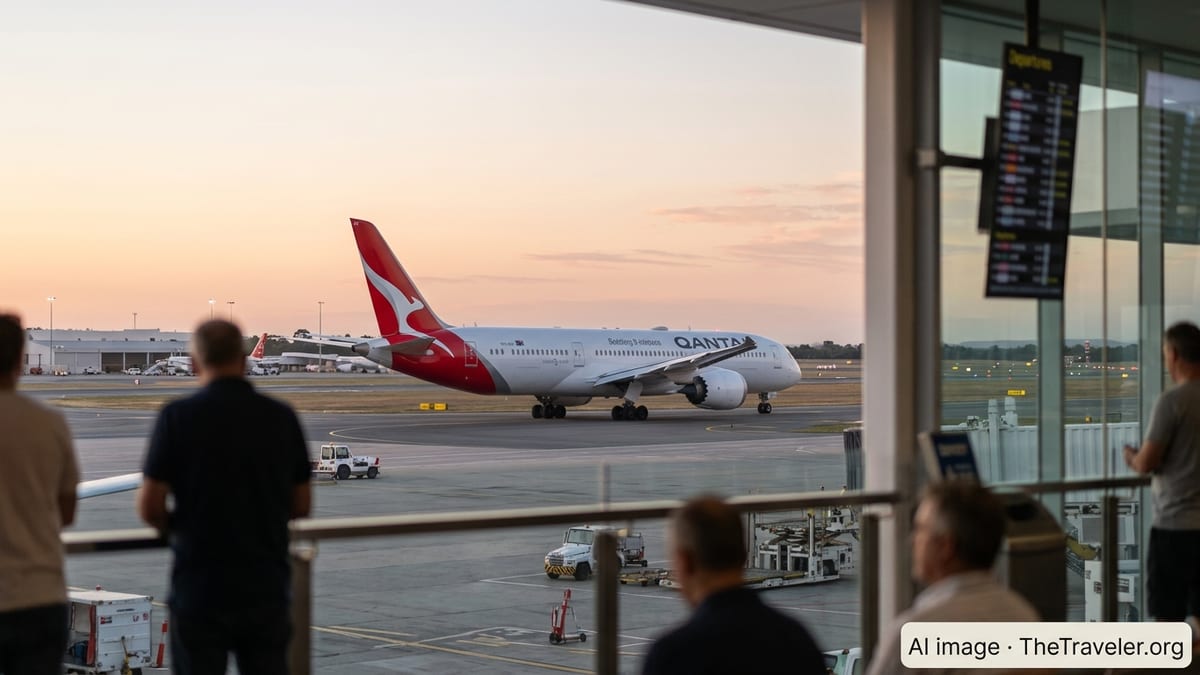
Against this backdrop, Australia’s national airline is leaning heavily on its nonstop services from Perth to Europe. Qantas’ own network information shows that in 2026 it is operating direct flights from Perth to London, Paris and Rome, positioning Western Australia’s capital as the carrier’s primary springboard into the continent.
Rome, originally launched as a seasonal experiment in 2022 and renewed due to strong demand, has been significantly expanded. Announcements over recent months indicate that Qantas will nearly double capacity on Perth–Rome for the 2026 northern summer, extending the operating window into late October and increasing weekly frequencies. Industry coverage suggests the airline is planning around 300,000 seats across its three European routes from Perth during the March to October 2026 season, underscoring the strategic weight now placed on this corridor.
Paris, reintroduced as a nonstop destination after a two-decade absence, has quickly become central to this strategy. The service, operated via Perth, gives Qantas a third European gateway alongside London and Rome, allowing Australians to bypass disrupted Middle Eastern hubs altogether. Route maps published by the airline confirm that Paris Charles de Gaulle now sits alongside Heathrow and Fiumicino as part of a tightly focused European network.
While some of these network decisions pre-date the latest crisis, reports from aviation analysts and traveler forums indicate that surging demand for Europe-bound seats since late February has accelerated the shift. With many Gulf carriers operating on a reduced or suspended basis, Qantas’ ability to fly nonstop to continental Europe has become a key competitive advantage.
Airfares Spike as Capacity Tightens and Detours Add Cost
Travelers are seeing the impact of this upheaval in their wallets. Australian media and aviation-focused outlets report that Qantas has raised international fares in response to sustained increases in jet fuel prices and the operational complexity of rerouting. One recent report noted that flights on Qantas’ European routes, including Perth–London, Perth–Paris and services via Singapore, were more than 90 percent full in March, roughly 15 percentage points higher than typical for this time of year.
That load factor pressure, combined with longer flight times around closed airspace, has translated into higher average ticket prices. Economic commentary on the airline sector following the Iran conflict highlights airlines’ limited ability to absorb fuel and routing shocks without passing on at least part of the cost to passengers, particularly on long-haul international routes where margins were already thin.
At the same time, capacity constraints are emerging in unexpected places. Feedback from travelers shared in public forums describes itineraries being rebooked at short notice, with some long-haul aircraft redeployed from trans-Pacific services to Europe-bound routes via Asia. In several cases, passengers report being nudged toward multi-stop routings through Singapore, Seoul, Helsinki or U.S. gateways as airlines scramble to assemble viable alternatives to traditional Gulf transits.
For consumers, the result is a bifurcated market: those able to secure seats on nonstop or one-stop itineraries via Perth or select Asian hubs often pay a premium, while others face complex journeys involving two or more stops and limited flexibility to change plans without significant fees.
Hotel Bookings Slump in Disrupted Transit Hubs
While airfares are climbing on many Europe-bound routes, hotels in parts of the Middle East are seeing the opposite effect. The sudden collapse in transfer traffic following airspace closures and operational suspensions at key Gulf hubs has stripped out a lucrative stream of short-stay demand from transit passengers.
Tourism impact assessments tied to the broader 2026 Iran conflict describe a rapid cooling in regional visitor numbers, particularly in destinations that rely heavily on through-traffic and stopover stays. With long-haul feeders cut and uncertainty around flight schedules, many travelers have shifted itineraries away from the Gulf altogether, opting instead for direct services to Europe or connections via relatively unaffected hubs in Asia and North America.
This shift has left some airport hotels and city properties grappling with lower occupancy and weaker forward bookings, even as daily room rates in Europe’s most popular summer destinations begin to edge higher on the back of resilient leisure demand. Travel trade commentary suggests that booking patterns for 2026 are increasingly polarized: beach resorts and cultural capitals in southern and western Europe are benefiting from travelers re-routing around the Middle East, while properties in traditional stopover cities register shortfalls.
Industry observers note that if airspace restrictions and traveler caution persist into the northern summer, hotels in secondary Gulf cities may struggle to replace lost transfer business, particularly from markets such as Australia where nonstop and Asia-linked alternatives are now firmly established.
Australian Travelers Reroute via Asia, North America and New Nonstops
For Australians, the practical consequences of the crisis are evident in how itineraries are being built. Public discussions among frequent flyers show increasing numbers of passengers intentionally avoiding Middle Eastern transits, even at the cost of extra flying time or points. Travelers describe piecing together complex multi-city journeys via Singapore, Tokyo, Seoul and major U.S. hubs to access Europe, often combining Qantas flights with partner airlines.
In this environment, Qantas’ strengthened footprint in Rome and Paris has become a cornerstone of alternative routing. Some travelers are using Perth–Rome or Perth–Paris as their primary gateway and then connecting onwards within Europe by rail or low-cost carriers, trading the convenience of a single airline ticket for the perceived safety and predictability of avoiding conflict-adjacent airspace.
Travel advisers and consumer advocates, drawing on publicly available fare and schedule data, are encouraging passengers to book early for peak-season departures, flagging that capacity on nonstop links from Australia to Europe is limited and already heavily subscribed. With uncertainty hanging over the pace at which Gulf carriers can restore full operations, the squeeze on these alternative routes is likely to continue.
For now, Qantas’ surge into Rome and Paris illustrates how quickly airline networks can pivot in response to geopolitical shocks. As Middle Eastern hubs grapple with reduced traffic and hotels in transit cities face leaner times, the skies between Australia and Europe are being redrawn, one rerouted flight at a time.