

More news on this day
The normally quiet Brisbane–Honiara corridor has become the focus of a high-stakes aviation tussle, as Qantas seeks to expand its presence on the Solomon Islands’ most important international route and Solomon Airlines warns that the move could undermine the nation’s economic lifeline and domestic connectivity.
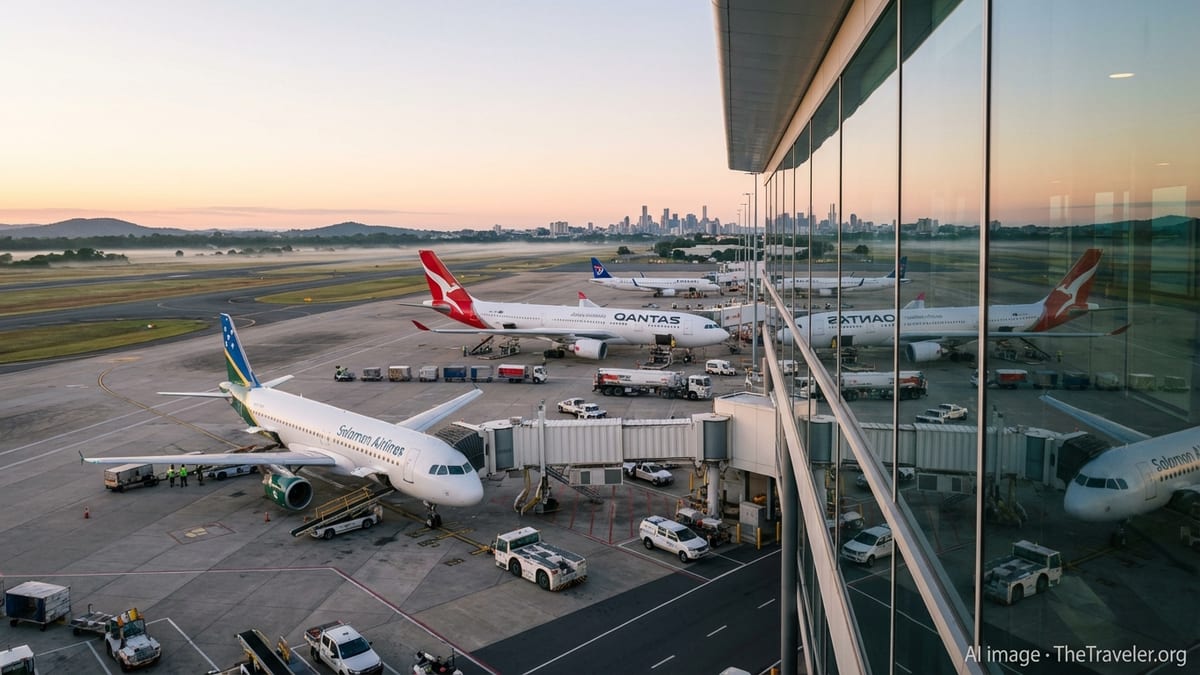
Qantas Expansion Bid Sparks Fierce Regional Standoff
Australia’s International Air Services Commission is now at the centre of an intensifying contest between Qantas and Solomon Airlines over the Brisbane–Honiara route, a market that carries modest passenger numbers but outsized strategic importance. In an application lodged on 23 January 2026, Qantas requested an additional allocation of 97 seats per week in each direction to the Solomon Islands, proposing a new weekly service between Brisbane and Honiara from 29 March 2026 using a 97-seat Embraer E190 wet leased from Alliance Airlines.
If approved, the move would lift Qantas’s services on the route from four to five weekly flights, reinforcing an already strong position supported by its powerful frequent flyer program and access to Australian government and corporate travel contracts. Qantas argues that the extra frequency would increase choice and flexibility for travellers, as well as support the broader recovery and growth of Pacific tourism.
The application has triggered an immediate and strongly worded response from Solomon Airlines, which has asked the Commission to reject the bid in the national interest. The state-owned carrier says that while the route is small by global standards and demand remains below pre pandemic levels, it is the Solomon Islands’ largest international market and a critical pillar of the country’s aviation and tourism economies.
With the case now formally before the Commission and submissions received from both sides, the decision is shaping up as a test of how Australia balances commercial competition with the economic and strategic needs of a close Pacific neighbour.
Solomon Airlines Warns of Existential Threat
In its submission to the Commission, Solomon Airlines has framed the Qantas expansion bid not as routine competition, but as a threat to the viability of the national carrier and, by extension, to air services across the archipelago. The airline’s chief executive, Paul Abbot, describes the Brisbane–Honiara sector as the largest international route for the Solomon Islands and a significant contributor to national development, even as overall passenger numbers remain modest and have failed to return to pre COVID levels.
Solomon Airlines argues that in what it calls a stagnant and declining market, adding a fifth Qantas service would not stimulate new demand but instead cannibalise existing traffic. With both carriers currently operating on many of the same days and similar timings, the airline contends that the additional Qantas capacity would skew yields further in favour of the Australian carrier, which already captures a disproportionately high share of the higher value corporate and government segments.
The domestic implications are central to Solomon Airlines’ case. The carrier serves 23 ports across the islands and says that domestic air travel numbers are extremely low, with fewer than 50,000 travellers per year spread over long distances and challenging geography. The airline states that the scale does not exist to sustain a viable domestic operation on its own, and that domestic connectivity is effectively subsidised by international revenue and direct government support.
According to its submission, any erosion of the Brisbane–Honiara route’s profitability could force cutbacks or even a collapse of domestic services, leaving many communities with no alternative to dangerous and time consuming sea journeys in small craft. That, the airline warns, would be catastrophic for internal mobility, medical evacuations, education access and basic economic activity across the nation.
Qantas Positions Move as Choice and Connectivity
Qantas, for its part, has presented its expansion plans on the Solomon Islands route as measured and market driven. The airline is not seeking to flood the market with capacity, but to add a single weekly flight using a relatively small regional jet. That flight would be operated under a wet lease with Alliance Airlines, a model Qantas has increasingly used on thinner international and regional routes to improve fleet flexibility and manage costs.
The Australian flag carrier’s broader strategy in the Pacific has focused on deepening links with neighbouring island states, anchored by strong demand from leisure travellers, visiting friends and relatives, and contract workers, alongside official and corporate travel. Brisbane is a natural hub for this activity, with Qantas marketing through its loyalty program and promoting the Solomon Islands alongside other Pacific destinations such as Vanuatu and Fiji as part of package sales and periodic fare campaigns.
Industry observers note that while passenger numbers between Brisbane and Honiara are small compared with larger international markets, the route sits squarely within Qantas’s renewed emphasis on short to medium haul international flying and its efforts to strengthen network depth around existing hubs. From a commercial perspective, gaining an extra frequency at a time when Solomon Airlines is still rebuilding its wider regional schedule offers Qantas the chance to consolidate loyalty and capture a greater share of premium and time sensitive travellers.
The airline has so far framed its application in technical and consumer terms rather than geopolitical ones, but in practice the decision will inevitably be read in a wider context that includes Australia’s evolving relationship with Pacific states and Canberra’s stated ambition to be a partner of choice in the region.
A Small Route With Outsized Strategic Weight
Measured purely by seats and revenue, Brisbane–Honiara is a niche route. Flight data shows that it is typically served by a single daily frequency in each direction shared between Solomon Airlines and Qantas, with a block time of around three hours and twenty minutes. By global standards, this is a thin market, and both airlines acknowledge that traffic has been slow to recover from pandemic disruptions.
Yet the route’s strategic weight belies its size. For the Solomon Islands, it is the primary air bridge to its largest neighbour and key development partner, and an essential link for aid, technical support, trade, health and education. For Australia, it is part of a broader aviation and security footprint in the Pacific that includes airspace management, defence cooperation and economic engagement, with Brisbane acting as a central staging point.
The flight corridor also underpins tourism, a sector that the Solomon Islands government sees as a promising engine of future growth, diversification and job creation. Although visitor numbers lag behind more established Pacific destinations, the country has been working to position itself as an eco and culture oriented alternative for travellers seeking less commercialised experiences. Reliable and competitively priced air access from Brisbane is fundamental to that ambition.
In that context, who controls capacity and pricing power on Brisbane–Honiara takes on national significance. A stronger Qantas presence could mean sharper fares and better connectivity for Australian travellers in the short term, but it could also weaken the very national carrier that underpins the domestic network feeding those visitors into outer islands and emerging tourism hubs.
Tourism, Workers and the Solomon Islands’ Economic Future
The outcome of the capacity dispute will ripple well beyond airline balance sheets. Tourism, labour mobility and trade are all tied closely to the availability and affordability of flights between Brisbane and Honiara, and any shift in market structure is likely to have tangible consequences for businesses and communities.
Inbound tourism to the Solomon Islands relies heavily on Australian travellers, many of whom begin their journeys in Brisbane or connect there from elsewhere in Australia and New Zealand. Solomon Airlines has been trying to stitch together a more integrated regional network, adding or adjusting services to Vanuatu, New Zealand and domestic points to facilitate through itineraries that connect via Brisbane and Honiara. Those efforts are designed to spread tourism benefits beyond the capital to secondary destinations such as Munda and the Western Province.
Seasonal workers and long stay labour mobility programs are another major component of traffic on the route. For Solomon Islanders travelling to and from Australia for employment, frequency and fare levels on Brisbane–Honiara directly affect how feasible these opportunities are. Any scenario that squeezes Solomon Airlines’ ability to offer competitive fares or maintain schedules could, in turn, affect worker remittances and household livelihoods.
Local tourism and hospitality operators in the Solomons are watching the case closely. Many have welcomed Qantas’s marketing clout and the visibility that comes from inclusion in the airline’s sales and frequent flyer campaigns, but at the same time express concern that if competition undermines the national airline, connectivity to more remote tourism sites and domestic feeder services could suffer, blunting long term growth.
Domestic Connectivity Hanging in the Balance
Unlike larger markets where multiple carriers can sustain domestic networks at scale, the Solomon Islands’ internal air system is fragile and heavily dependent on cross subsidisation. Solomon Airlines operates to around two dozen domestic airfields spread across widely dispersed islands, many of which have basic infrastructure and limited commercial traffic.
The airline’s submission to Australian regulators makes clear that revenue from international routes, particularly Brisbane–Honiara, and direct support from the Solomon Islands government are what make these domestic services possible. If yields on Brisbane–Honiara fall significantly because higher yielding passengers are drawn more heavily to Qantas, the ability of Solomon Airlines to maintain marginal domestic links becomes uncertain.
That risk is amplified by the geography of the Solomon Islands. In many communities, air service is not simply a convenience but the only practical way to reach hospitals, schools, markets and government services within a reasonable timeframe. Without regular flights, residents might be left with sea travel in small, often open boats, journeys that can be slow, weather dependent and in some cases dangerous.
For policymakers in Honiara, the fear is that a decision in Canberra that looks benign from a competition standpoint could have cascading effects on health outcomes, education access and economic inclusion across the islands. This has fuelled calls for Australian regulators to weigh national interest considerations for the Solomon Islands alongside the usual metrics of consumer benefit and market efficiency.
Australia’s Regional Strategy and Political Optics
The battle over seats on a single route comes at a time when Australia has been working to deepen political and economic ties with the Solomon Islands and other Pacific nations. Recent years have seen new partnership agreements, increased development funding and a renewed emphasis on treating Pacific states as equal partners with shared strategic interests.
Within that framework, aviation is more than a commercial service. It is a visible expression of connection and support, especially in areas such as disaster response, medical evacuations and the movement of officials and technical specialists. Decisions that affect the viability of a Pacific national carrier will inevitably be scrutinised through a geopolitical lens, particularly as other powers court influence in the region.
For the Australian government, the Qantas–Solomon Airlines dispute presents a delicate balancing act. On one side is a desire to promote open, competitive aviation markets and support an iconic national airline’s regional ambitions. On the other is the risk that allowing Qantas to entrench a dominant position on a critical lifeline route could be perceived as undermining the economic sovereignty of a smaller partner.
The International Air Services Commission operates at arm’s length from government, but its decisions do not exist in a political vacuum. How it weighs the arguments in this case is likely to be closely watched not only in Honiara, but across Pacific capitals that are themselves grappling with how to sustain national airlines in the face of larger competitors.
What Travellers Can Expect in the Months Ahead
For now, flights between Brisbane and Honiara are operating broadly as scheduled, with both Qantas and Solomon Airlines maintaining multiple weekly services and, at peak times, adding extra capacity to handle holiday and seasonal worker demand. The Commission’s process allows time for consideration of submissions and for any further information to be requested before a final determination is issued.
If Qantas’s bid is approved, travellers could see an additional weekly frequency appear from late March 2026, likely marketed heavily through the airline’s frequent flyer channels and packaged with other Pacific itineraries. That might translate into more choice of departure days and potentially sharper promotional fares, particularly in the short term as the carriers jostle for market share.
If the application is rejected or substantially modified, the current balance of capacity on the route would likely remain in place, at least in the medium term. Such an outcome would be viewed in Honiara as a win for national interests and for the stability of domestic air services, but some Australian travellers might perceive it as a missed opportunity for greater competition.
Either way, the contest has already highlighted how even a relatively small international route can become a flashpoint when commercial strategy, national development and regional politics intersect. For the Solomon Islands, the stakes go far beyond ticket prices. At issue is who controls the skies on the country’s main gateway to the world, and what that will mean for its economic and social future.