

More news on this day
The United States has tightened its travel guidance across the Middle East, newly grouping Qatar with Oman, Saudi Arabia, Bahrain, Egypt and several other countries under elevated advisories that urge Americans to reconsider or carefully review travel to the region.
Get the latest news straight to your inbox!
Qatar Moves Into Higher-Risk Category
Recent updates to United States travel guidance place Qatar among a wider cluster of Middle Eastern states now subject to heightened caution, as regional tensions and military activity reshape security assessments across the Gulf. Publicly available information from travel advisories and risk bulletins indicates that Qatar, once considered a comparatively stable stopover hub, is now flagged alongside Oman, Saudi Arabia, Bahrain, Kuwait, Jordan, Israel and the United Arab Emirates in calls for travelers to closely evaluate the risk of visiting.
Coverage of the latest changes notes that several of these destinations, including Qatar, are now categorized at a level where travelers are urged to reconsider nonessential trips. Egypt remains under an advisory to exercise increased caution, yet it is frequently referenced in regional security roundups and is often evaluated together with Gulf countries due to shared exposure to the current crisis.
The updated posture marks a notable shift from earlier guidance, which typically differentiated between higher-risk conflict zones and Gulf states considered relatively insulated from direct attacks. In the wake of recent events, advisory language across the region has converged, signaling that governments view risk as more widely distributed than before.
Regional Tensions and Iranian Strikes Drive Advisory Shift
The latest U.S. advisory changes come against the backdrop of a sharp escalation in the Iran conflict, which has seen missile and drone strikes against targets in Qatar, Saudi Arabia, Bahrain, Kuwait, the United Arab Emirates, Oman and Jordan. Open-source reporting on the 2026 Iran war describes repeated attacks on ports, energy facilities and sites associated with foreign military assets, as well as retaliatory operations that have affected airspace and maritime routes.
Analysis from security consultancies tracking the Gulf region notes that since late February, Iranian strikes have extended beyond traditional flashpoints to infrastructure in multiple Gulf monarchies. In Qatar, Bahrain and Saudi Arabia, publicly available risk briefings highlight concerns over potential follow-on attacks on energy and desalination facilities, as well as on areas hosting foreign bases.
These developments have been echoed in the U.S. government’s global messaging. A renewed Worldwide Caution, issued in March, advises Americans worldwide, and particularly those in the Middle East, to exercise increased vigilance amid the risk of further attacks and periodic closures of airspace. The updated country-specific advisories for Qatar, Oman, Saudi Arabia, Bahrain and neighboring states align with this broader warning environment.
Airspace Closures And Travel Disruption Across The Gulf
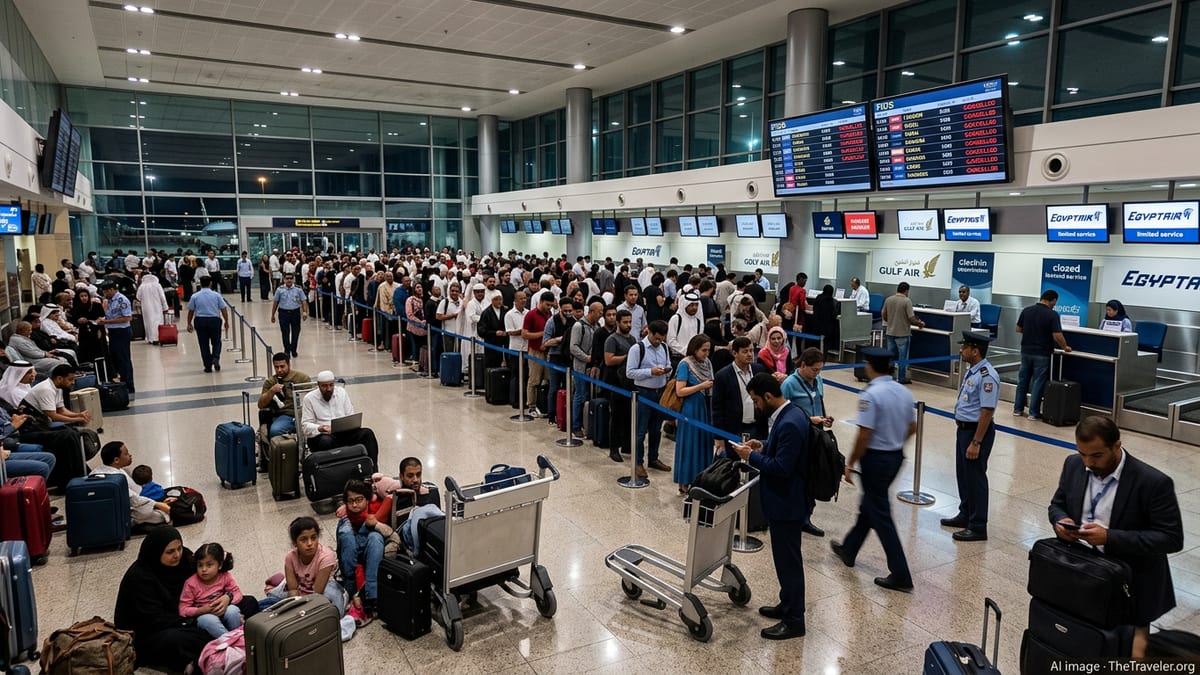
Beyond the security threat itself, practical disruption has become a defining feature of travel to Qatar and its neighbors in recent weeks. Port and aviation advisories for early March report that Qatari airspace was temporarily closed and all commercial air travel suspended for a period, while several Gulf countries imposed severe restrictions on overflights and arrivals. Industry circulars indicate that airlines in the region, including Qatar-based carriers, have operated on severely limited schedules or rerouted flights around higher-risk areas.
Maritime and aviation risk updates describe a sharp decline in traffic through the Strait of Hormuz, with many operators choosing to avoid the chokepoint despite the absence of a formal legal closure. For travelers, this has translated into cancellations, extended layovers in third countries and a reliance on complex routings via airports still functioning at normal capacity.
Travel discussion forums and airline notices suggest that, while some services are gradually resuming under constrained timetables, the situation remains fluid. The U.S. advisory language for Qatar and other Gulf states explicitly references the possibility of sudden airspace closures and interruptions to commercial flights, signaling that travelers should be prepared for rapid changes even where bookings appear to be confirmed.
Multiple Nations Now Flagged For Heightened Caution
The inclusion of Qatar in the latest round of U.S. travel advisories reflects a broader recalibration that encompasses much of the Middle East and North Africa. Publicly available summaries of State Department guidance and international travel warnings point to an expanded list of countries where Americans are advised either to reconsider travel or to proceed only with heightened vigilance. Alongside Qatar, these frequently include Oman, Saudi Arabia, Bahrain, Kuwait, Jordan, Israel and the United Arab Emirates, while Egypt is consistently highlighted at a slightly lower but still elevated level.
Other governments have issued parallel warnings. Regional media report that Singapore, for example, has released its own advisory urging citizens to avoid or defer travel to a cluster of Middle Eastern destinations that includes Qatar, Saudi Arabia, Bahrain, Egypt, Oman and several others, citing the evolving military and security environment. Commercial travel risk maps produced by private firms similarly shade much of the Gulf and Egypt as higher-risk zones compared with a year earlier.
The convergence of government, insurer and private-sector advisories has practical implications for travelers. Elevated warning levels can influence corporate travel approvals, insurance coverage and the willingness of tour operators to run itineraries, especially to multi-stop trips that would cross several countries now subject to tightened guidance.
What Travelers Should Watch In The Weeks Ahead
For would-be visitors to Qatar, Oman, Saudi Arabia, Bahrain, Egypt and the additional countries now appearing on advisory lists, the key message from publicly available guidance is to plan conservatively and expect conditions to evolve quickly. Travelers are urged in official notices to review the full text of destination-specific advisories, monitor embassy alerts and build flexibility into itineraries in case of sudden changes to security conditions or transport links.
Industry briefings emphasize the importance of checking airline policies on rebooking and refunds, particularly on routes touching Gulf hubs that have experienced temporary suspensions or schedule reductions. Travel planners also recommend verifying whether insurance policies treat updated U.S. or allied government advisories as a trigger for coverage limitations or evacuation benefits.
While there is no blanket prohibition on U.S. citizens traveling to Qatar or most other affected states, the clustering of these destinations under higher-risk categories illustrates the degree to which the Iran conflict has reshaped regional perceptions of safety. Until there is a sustained reduction in cross-border attacks and a normalization of airspace and maritime conditions, the expectation in current advisories is that heightened caution will remain the baseline for trips across this part of the world.