

More news on this day
Qatar’s abrupt airspace closure has forced Qatar Airways to suspend flights to and from Doha just as the Gulf state was courting a fresh wave of visitors, prompting emergency visa extensions and hotel support measures to keep stranded tourists legal and housed.
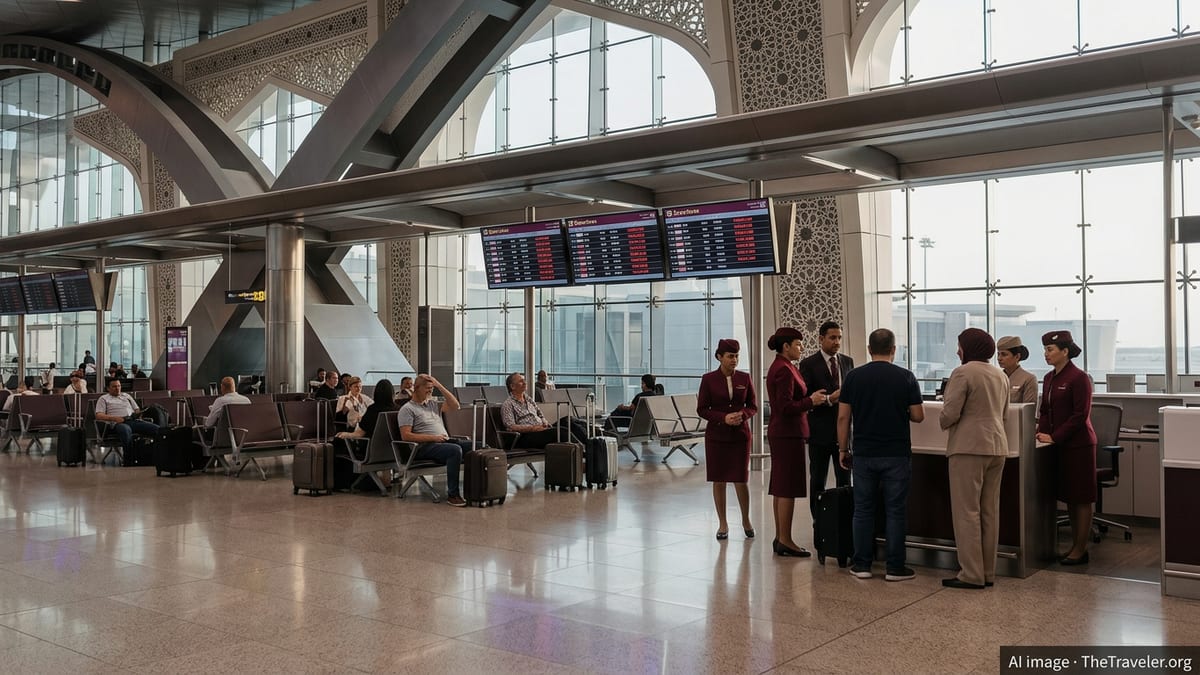
Qatar Airways Grounds Doha Operations Amid Regional Tensions
Qatar Airways has temporarily halted all flight operations through Doha after the Qatar Civil Aviation Authority ordered the closure of national airspace in response to fast-moving regional security concerns. The airline confirmed that services will remain suspended until authorities deem it safe to reopen the skies, with no fixed timeline yet for a full resumption of its global network.
The carrier, which operates one of the world’s largest long-haul networks, said the shutdown is a safety-first response and that its crisis management team is coordinating flight recovery plans. Passengers are being rebooked in phases as alternative routings become available, although options are constrained by wider airspace restrictions affecting parts of the Gulf and surrounding region.
The suspension is a blow to Qatar’s position as a key transit hub linking Europe, Africa and the Americas with Asia and Australasia. Hamad International Airport, which has consistently ranked among the world’s best, is operating at a fraction of normal capacity as departures and arrivals remain paused, leaving thousands of travelers in limbo.
Regional carriers serving Doha are also adjusting operations. Some partner airlines have cancelled or rerouted services that normally feed traffic into Qatar Airways’ hub, compounding disruption for passengers whose itineraries were built around smooth connections in the Qatari capital.
Ministry of Interior Automatically Extends Expiring Entry Visas
In an effort to prevent travelers from falling out of legal status while flights are suspended, Qatar’s Ministry of Interior has announced a blanket one-month extension for all types of entry visas that are expired or close to expiring. The measure, effective from February 28, 2026, applies automatically through official electronic systems and does not require visitors to submit applications or visit government offices in person.
Authorities stressed that the extension is free of charge, easing concern among tourists and business travelers who risked overstaying through no fault of their own. The decision is intended to give foreign visitors, residents’ family members and transit passengers enough time to reorganize their travel plans once air links begin to normalize.
The latest move builds on a broader push over the past two years to make entering Qatar easier, including the rollout of longer-validity visas for key markets and streamlined processing for residents of neighboring Gulf states. By acting quickly during the airspace shutdown, the government is signaling that its liberalized entry regime will not inadvertently penalize visitors caught by extraordinary circumstances.
Travel industry analysts say the automatic visa extension also simplifies the response for airlines and hotels, which no longer have to navigate case-by-case immigration issues for stranded customers. Instead, carriers can focus on rebooking, while accommodation providers manage extended stays under a clear legal framework.
Qatar Tourism Steps In To Cover Hotel Stays for Stranded Guests
Qatar Tourism has issued a directive to hotels across the country instructing them to extend the stays of guests unable to depart due to the airspace closure, confirming that the authority will cover associated accommodation costs. The guidance applies from February 28, 2026, until airport operations and airspace access are formally restored.
The intervention aims to prevent visitors from facing unexpected bills while they wait for new flights, and to reassure travelers that the country stands behind its “welcome” message even amid disruption. Hotels have been told that a dedicated Qatar Tourism team will coordinate with them directly on reimbursement and operational details.
The measure helps stabilize occupancy levels for properties that have invested heavily since the 2022 World Cup, while averting a potential public relations crisis if guests were asked to pay for unplanned extra nights. It also positions Qatar’s tourism authorities as proactive crisis managers at a time when global travelers are acutely sensitive to how destinations handle disruptions.
For visitors, the combination of extended visas and covered hotel stays significantly reduces the immediate financial and administrative shock of the grounding. However, tourists are still being urged to stay in close contact with their airlines or travel agents and to monitor official government channels for updates on when departures can resume.
Tourism Recovery Momentum Faces a New Stress Test
The airspace shutdown comes just as Qatar was seeking to consolidate the tourism gains made during and after the football World Cup. In recent seasons the country has rolled out multiple-entry visit options for Gulf Cooperation Council residents, lengthened permitted stays for several nationalities and positioned Doha as a stopover destination en route to Asia and Africa.
These efforts were beginning to pay dividends as hotel pipelines filled out and international arrivals trended upward. The latest disruption interrupts that trajectory, highlighting how exposed hub-focused tourism strategies remain to sudden geopolitical shocks and aviation bottlenecks.
Industry observers note that the real test for Qatar’s tourism recovery will not be the shutdown itself but how quickly and transparently the system restarts. Clear communication on flight resumptions, flexible change policies from airlines, and the smooth unwinding of temporary support measures will all shape traveler perceptions in the months ahead.
Tour operators and travel advisors are already revising itineraries, in some cases swapping Doha transits for routings via alternative hubs. Yet many are also emphasizing that Qatar’s policy response, particularly on visas and guest welfare, compares favorably with previous disruptions elsewhere in the region, which could help the destination regain trust once operations stabilize.
What Travelers With Upcoming or Ongoing Trips Should Do
For travelers already in Qatar, the priority is to confirm updated flight status directly with Qatar Airways or their ticketing carrier and to follow instructions regarding rebooking or hotel arrangements. Stranded passengers whose stays are being extended are advised to retain all documentation provided by airlines and hotels in case of later insurance or expense claims.
Visitors worried about expiring documents should check that their passport validity still meets entry requirements for onward destinations, even with Qatar’s visa extension in place. Those who have connecting trips, such as cruises or tour departures, may need to contact providers to adjust schedules or secure partial refunds if onward legs are missed.
Prospective visitors with travel dates in the coming weeks are being urged not to cancel reflexively, but to monitor official advisories from Qatar’s civil aviation and tourism authorities, as well as airline communications, for signs of a phased reopening. Flexible booking policies and travel insurance that covers disruption linked to airspace closures are likely to remain important tools for anyone planning itineraries through the region.
While Qatar’s decisive steps on visas and guest support cannot eliminate the disruption caused by grounded flights, they offer a clearer safety net for visitors caught mid-journey. How effectively these measures are implemented in practice will influence whether the country can quickly resume its role as a fast-growing stopover and short-break destination once aircraft are cleared to return to Doha’s skies.