

More news on this day
Qatar’s abrupt airspace shutdown after regional military strikes has plunged global travel into turmoil, grounding Qatar Airways’ vast network and stranding passengers worldwide, even as the carrier moves to contain the fallout with a rare seven-day window for fee-free refunds and rebooking.
Airspace Closure Freezes a Major Global Hub
Qatar’s Civil Aviation Authority ordered the closure of Qatari airspace on 28 February 2026, prompting Qatar Airways to suspend all flights to and from Doha, one of the world’s busiest long-haul hubs. The move instantly disrupted connections between Europe, Asia, Africa and the Americas, with Hamad International Airport brought to an abrupt standstill.
The shutdown followed US and Israeli strikes on Iran that triggered a wave of regional airspace restrictions, with multiple Gulf and neighboring states limiting or closing their skies. Airlines have been forced into last-minute diversions, extended routings and mass cancellations as they navigate a fast-changing security map across the Middle East.
Qatar Airways confirmed that operations will only resume once regulators declare the airspace safe to reopen, warning that even then, flight schedules will be heavily delayed as aircraft and crew are repositioned. For now, the carrier’s extensive global network is effectively on pause, with aircraft and passengers scattered across multiple continents.
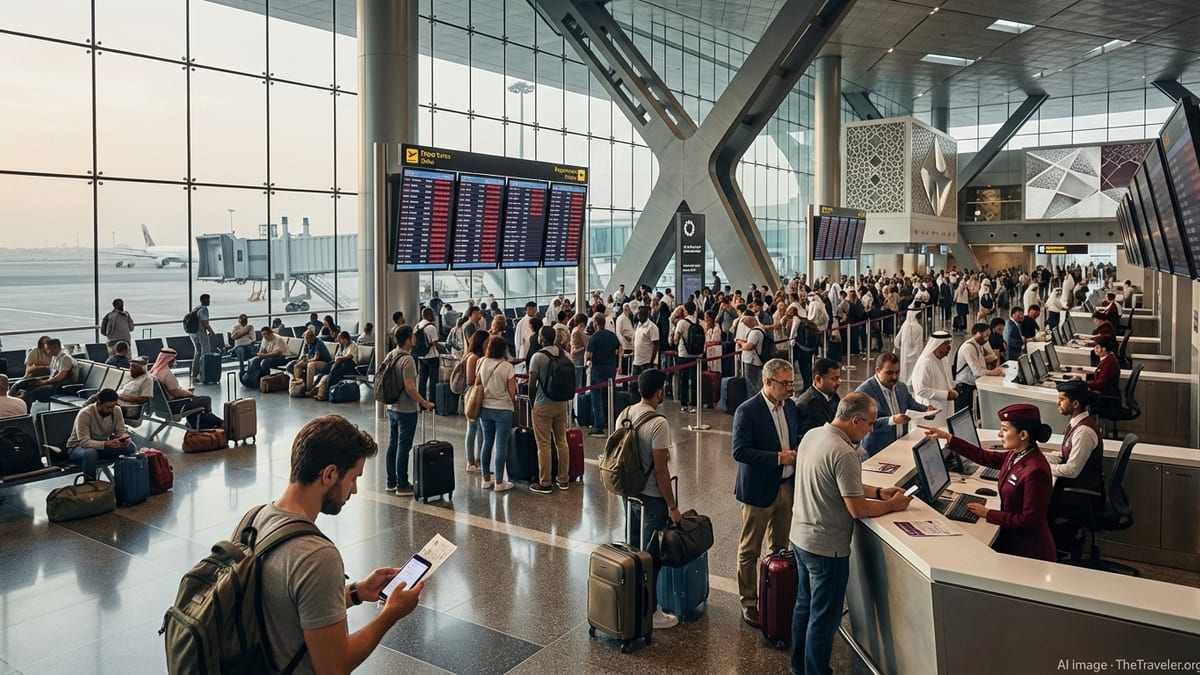
At Hamad International Airport, additional ground staff have been deployed to manage growing crowds of displaced travelers. Check-in areas and transfer desks have become information points for passengers trying to piece together alternative routes, temporary accommodation and onward connections.
Massive Disruption for Global Passengers
The sudden halt has cascaded across time zones, upending itineraries for holidaymakers, business travelers, students and migrant workers who rely on Doha as a key transit point. Flights that were already en route at the time of the closure were diverted to alternate airports such as Athens, Cairo and Muscat, where passengers faced overnight delays and uncertain onward travel options.
Travel data firms estimate that hundreds of flights have been affected in the wider region since the first strikes, with Qatar Airways alone handling tens of thousands of passengers a day through Doha in normal times. With the hub offline, travelers from cities as distant as London, Mumbai, Sydney and São Paulo have found themselves grounded or routed through unfamiliar airports.
Airport hotels in key diversion cities have quickly filled as travelers await new itineraries. In some cases, passengers report receiving meal vouchers, hotel stays and alternative routings on partner airlines, while others describe long queues, limited information and difficulty reaching call centers from abroad.
Tour operators and corporate travel managers are now racing to rework group itineraries and complex multi-city business trips, juggling shifting security advisories with tight corporate budgets and the practical limits of available seats on remaining routes.
Qatar Airways Unveils Unusually Flexible 7-Day Policy
In an attempt to stabilise the situation and reassure customers, Qatar Airways has introduced an exceptionally flexible commercial policy for tickets affected by the airspace closure. The airline is waiving refund penalties for its own tickets and associated ancillaries where travel is to, from or via Doha, effectively allowing passengers to claim their money back without the usual fees.
The carrier has confirmed that impacted travelers can either rebook or request refunds for journeys scheduled between 28 February and 6 March 2026, with new travel dates permitted up to 14 days either side of the original departure. Crucially for frustrated passengers, the airline is offering this flexibility for a limited period of seven days from the date of disruption, creating a brief window in which to decide whether to postpone, reroute or abandon trips entirely.
Within this framework, customers are being allowed up to two free ticket reissues, with rebooking into the lowest available booking class in the same cabin on Qatar Airways’ own flights and on selected partners for travel to or from Doha. No-show penalties are being waived where travelers were unable to board due to the rapidly evolving situation, removing another common source of unexpected cost.
Behind the scenes, revenue and operations teams are working to balance this unprecedented level of flexibility with the financial realities of a grounded long-haul fleet, all while maintaining future seat availability for when airspace eventually reopens.
Stranded Travelers Face Difficult Choices
For passengers already en route or stuck in transit hubs, the seven-day refund and rebooking window provides welcome leverage, but also forces quick decisions in a highly uncertain environment. Some are opting to cash out and abandon trips altogether, particularly leisure travelers and those with flexible plans, wary that regional airspace could reopen and close again at short notice.
Others, especially those travelling for work, education or family emergencies, are choosing to reroute via alternative carriers and airports, even if it means longer journeys and extra connections. Travel agents report a spike in demand for seats on carriers that can bypass the affected airspace altogether, driving up prices on select corridors and leaving fewer options for last-minute changes.
Consumer advocates urge passengers to document all communications with airlines and keep receipts for any out-of-pocket expenses such as hotels, meals and ground transport, noting that reimbursement policies vary by jurisdiction and ticket type. They also recommend that travelers familiarise themselves with local passenger rights rules, which may apply differently depending on the origin and operating carrier.
For now, many stranded travelers are focused less on future claims and more on simply finding a way home, as departure boards in multiple countries continue to show long lines of Qatar Airways cancellations with no firm restart time.
Uncertain Timeline for Reopening and Recovery
Officials and aviation analysts caution that the closure of Qatari airspace is likely to be lifted only after detailed risk assessments by military and civil aviation authorities, a process that could unfold in stages rather than a single, sweeping reopening. Even once limited corridors are declared safe, airlines must conduct their own internal safety and operational reviews before ramping up services.
Industry experts note that restarting a network of Qatar Airways’ scale is a complex puzzle, involving crew duty-time rules, aircraft positioning, maintenance windows and coordination with partner airlines. The carrier has already warned customers to expect sustained delays and schedule changes in the days following any reopening, as it rebuilds its hub-and-spoke system around Doha.
Airports that have absorbed diverted Qatar Airways traffic may also face continued congestion in the short term, with stand capacity, immigration queues and baggage systems all under strain. Ground handlers and air traffic controllers, already dealing with rerouted services from other affected carriers, are preparing for a challenging period as operations gradually normalise.
Until clearer guidance emerges from regulators and the airline, travelers with upcoming itineraries touching Doha are being advised to closely monitor airline communications and consider contingency plans, including possible rerouting or deferring non-essential trips while the unprecedented airspace shutdown and its aftershocks play out.