

More news on this day
Thousands of passengers were left stranded in Qatar on February 28, 2026, after the Gulf state abruptly closed its airspace as a precaution following joint United States and Israeli strikes on Iran, plunging one of the world’s busiest transit hubs into sudden paralysis.
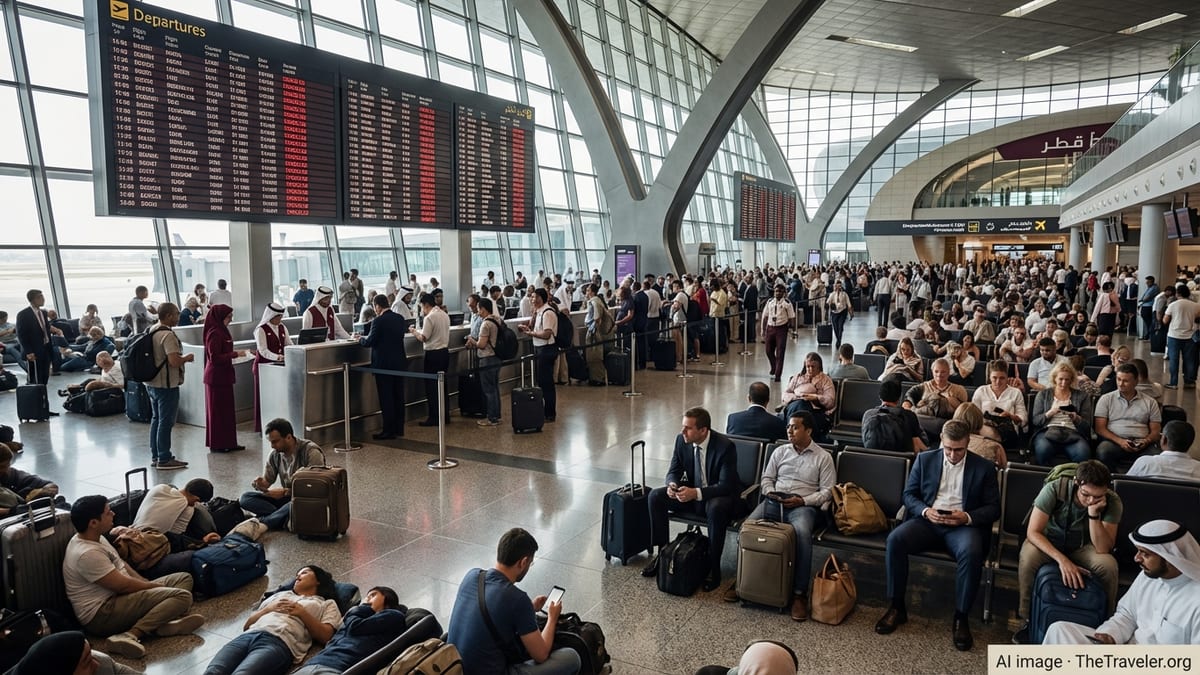
Hamad International Plunged Into Standstill
The closure of Qatari airspace forced inbound flights to divert mid route and halted all scheduled departures from Doha’s Hamad International Airport, a key global transfer point for Europe Asia and Africa traffic. Flight tracking platforms showed aircraft rerouting around the Gulf region as Qatar joined several neighbors in sharply restricting overflights amid fears of Iranian retaliation.
Arrivals halls and departure concourses at Hamad International quickly filled with confused and frustrated travelers, many of them long haul transit passengers who suddenly found themselves unable to continue their journeys. Airport screens showed a cascade of cancellations and indefinite delays as Qatar Airways and other carriers scrambled to rework schedules and secure alternative routings.
Airport staff directed stranded passengers into makeshift queues at transfer desks and boarding gates while loudspeaker announcements urged calm and promised further updates. Families with young children attempted to sleep on terminal floors and around gate areas as hotel capacity in Doha was rapidly exhausted.
By late afternoon, aviation analysts estimated that tens of thousands of people had been affected in Qatar alone, with knock on disruption rippling through major hubs in Europe, South Asia and Southeast Asia that depend on Gulf transit traffic.
Security Concerns After US and Israeli Strikes on Iran
The unprecedented disruption followed overnight strikes by the United States and Israel on targets inside Iran, which Washington said were aimed at blunting what it called imminent threats from the Iranian regime. Explosions were reported in multiple Iranian cities, prompting immediate fears that Tehran or allied groups could respond by targeting military facilities and strategic infrastructure across the region.
Qatar, which hosts the Al Udeid Air Base, the largest United States military facility in the Middle East, moved quickly to suspend air traffic in and out of its territory as reports of possible incoming threats circulated. Regional outlets said Qatar’s skies were effectively emptied of civilian aircraft within hours as controllers ordered diversions and refused new overflight clearances.
The closure mirrored earlier shutdowns seen in June 2025, when Iran fired missiles toward Al Udeid in retaliation for earlier United States strikes on Iranian nuclear facilities. On that occasion, Qatar, Bahrain and Kuwait all sealed their airspace and Qatar Airways later confirmed that around 20,000 passengers on diverted flights were rebooked within 24 hours. The scale of Saturday’s US and Israeli operation and the wider pattern of closures across the Middle East raised fears that the current disruption could be more prolonged.
Security experts noted that the concentration of Western military assets in the Gulf, including air bases in Qatar and the United Arab Emirates, has repeatedly placed civilian aviation on the frontline of regional crises, with commercial routes forced to adjust or shut whenever tensions flare.
Stranded Transit Passengers Face Long Delays
For passengers caught in Doha’s normally seamless transfer system, the rapid shift from smooth connections to open ended uncertainty was jarring. Many travelers had been in the air when the strikes on Iran began, only learning of the airspace closure and regional escalation after landing in Qatar or from inflight messages about route changes and diversions.
Social media posts from inside Hamad International described hours long queues at service counters as Qatar Airways agents attempted to rebook disrupted itineraries and arrange hotel vouchers where capacity allowed. Passengers reported shortages of available rooms in central Doha and nearby airport hotels as demand surged far beyond normal peak levels.
Some travelers, particularly those without visas allowing entry into Qatar, were confined to the terminal’s airside zones while awaiting further information. Others who were able to clear immigration sought accommodation in the city or with friends and relatives, mindful of advisories from several embassies urging residents and visitors to limit non essential movement.
Despite the frustration, many passengers acknowledged that the abrupt halt to air traffic reflected genuine safety concerns amid a rapidly changing security environment. Aviation authorities in the region have become more cautious about potential risks from missile and drone activity since earlier incidents in which conflict spilled close to civilian air routes.
Diplomatic Warnings and Travel Advisories Mount
The airspace shutdown was accompanied by a flurry of diplomatic warnings as Western governments reassessed the threat to their citizens in Qatar and across the wider Gulf. The United States Embassy in Doha issued a shelter in place recommendation for staff and American nationals, echoing similar alerts seen during previous spikes in regional tension. British officials and other European missions also urged travelers to stay indoors and monitor official channels for updates.
Qatari authorities framed the suspension of flights as a temporary and precautionary measure aimed at ensuring the safety of citizens, residents and visitors, signaling that normal operations would resume only once the perceived risk to aviation and critical infrastructure had eased. State media in neighboring Iraq reported that Baghdad had also closed its airspace, while regional outlets said Kuwait and the United Arab Emirates imposed significant restrictions after the strikes on Iran.
International aviation regulators advised airlines to exercise extreme caution when planning routes through the Middle East, with some carriers opting to avoid large swaths of airspace entirely. Industry observers warned that extended closures could force significant detours on popular Asia Europe corridors, increasing flight times and fuel costs and complicating crew scheduling.
Travel industry bodies stressed that passengers booked to transit through Doha and other Gulf hubs in the coming days should stay in close contact with airlines and tour operators and be prepared for last minute schedule changes. They also urged governments to coordinate closely on airspace management to minimize uncertainty while maintaining security.
Global Aviation Feels the Shockwaves
The disruption in Qatar underscored how quickly a regional security crisis can reverberate through global travel networks. With Qatar Airways operating one of the world’s largest long haul fleets and Hamad International serving as a critical east west bridge, the sudden halt in operations forced airlines and passengers thousands of miles away to reassess plans.
European and Asian carriers that rely on overflight corridors across Iran and its neighbors have already been rerouting aircraft to avoid conflict zones, in some cases adding hours to journey times. The fresh closures of airspace over Qatar, Iraq and parts of the Gulf complicated these workarounds, squeezing available routing options and funneling more flights into crowded alternative corridors over Turkey, the Caucasus and the Arabian Sea.
Analysts noted that the episode is likely to renew debate over the vulnerability of international aviation to geopolitical shocks, particularly in regions that sit astride key global transit lanes. Insurers and risk consultants are expected to revisit their assessments of overflight exposure and war risk premiums for airlines operating near the Gulf and over Iran.
For now, thousands of passengers remain in limbo in Qatar and other regional hubs, their onward journeys contingent on military and diplomatic decisions far beyond the walls of any terminal. As governments weigh their next moves in the escalating confrontation with Iran, the fate of stranded travelers has become an immediate, human measure of the wider cost to global mobility.